Loading...
Cao Kun vs Napoleon Bonaparte
Napoleon Bonaparte leads by 27.7 pts · 2 figures compared
…
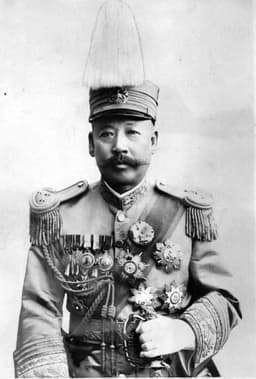
Cao Kun
General · Modern
43.2Total

Napoleon Bonaparte
General · Modern
70.9Total
Basic Information
Born
1862
1769
Died
1938
1821
Era
Modern
Modern
Nationality
China
France
Occupation
General
General
Civilization
Eastern
Western
Score Comparison
Military (10%)
38.3
94.0
Political (20%)
30.8
72.0
Influence (20%)
51.0
40.0
Legacy (20%)
40.8
80.0
Leadership (15%)
50.7
78.0
Strategy (15%)
41.7
90.0
TOTAL
43.2
70.9
Cao Kun — Complete Timeline
1920 AD
Zhili-Anhui WarWar◆ Major
Cao Kun led the Zhili clique to victory over the Anhui clique in the Zhili-Anhui War. This battle established the Zhili faction as the dominant force in northern China and expanded Cao Kun's political and military power.
Warlord EraWarZhili Clique
Impact: national
1922 AD
First Zhili-Fengtian WarWar◆ Major
Cao Kun's Zhili forces defeated the Fengtian clique under Zhang Zuolin in the First Zhili-Fengtian War. This victory solidified Zhili control over Beijing and the central government.
Warlord EraWarZhili Clique
Impact: national
1923 AD
Presidential Bribery ScandalPolitical Action
Cao Kun bribed members of the National Assembly to elect him President of the Republic of China, spending millions of yuan. This scandal discredited the Republican government and deepened public cynicism toward warlord politics.
Republic of ChinaCorruptionPresidency
Impact: nationaldestructive
1924 AD
Second Zhili-Fengtian WarWar◆ Major
Cao Kun's Zhili clique was defeated by the Fengtian clique in the Second Zhili-Fengtian War. The loss led to his overthrow and house arrest, ending his political career and the Zhili dominance.
Warlord EraWarDefeat
Impact: nationaltragic
Napoleon Bonaparte — Complete Timeline
1799 AD
Coup of 18 BrumaireOther◆ Major
Napoleon Bonaparte, with support from his brother Lucien and key political figures, overthrew the Directory in a bloodless coup. He established the Consulate with himself as First Consul, effectively becoming the ruler of France. This event ended the French Revolution's most unstable period.
French RevolutionCoupRise to Power
Impact: regional
1804 AD
Promulgation of the Napoleonic CodeOther◆ Major
Napoleon enacted the Civil Code of the French, known as the Napoleonic Code, a comprehensive set of laws that replaced the fragmented feudal legal systems. The code established legal equality, protected property rights, and secularized law. It became the basis for legal systems in many European and world countries.
Legal ReformNapoleonic CodeCivil Law
Impact: globalconstructive
1805 AD
Battle of AusterlitzWar◆ Major
Napoleon's Grande Arm
Napoleonic WarsBattleDecisive Victory
Impact: global
1812 AD
Invasion of RussiaWar◆ Major
Napoleon led the Grande Arm
Napoleonic WarsInvasionDisaster
Impact: globaldestructive
1815 AD
Battle of WaterlooWar◆ Major
Napoleon's French army was defeated by the combined forces of the Duke of Wellington's Anglo-Allied army and Gebhard Leberecht von Bl
Napoleonic WarsBattleFinal Defeat
Impact: globaldestructive
Expert Analysis
cao-kun-vs-napoleon-bonaparte
# The General and the Briber: Napoleon Bonaparte and Cao Kun
In the spring of 1815, Napoleon Bonaparte returned from exile on Elba to reclaim an empire. Soldiers sent to arrest him instead fell to their knees before their former emperor. By June, he had raised an army and marched toward Waterloo—a battle that would seal his legend forever. Just over a century later, in October 1923, a different general named Cao Kun sat in a Beijing mansion counting votes he had purchased. Millions of yuan had changed hands; members of the National Assembly had been bought like sacks of rice. Cao Kun became president of China not through conquest, but through bribery. One man bent Europe to his will; the other could not even hold his own country. Why did two military commanders, both products of turbulent times, meet such different fates?
Origins
Napoleon Bonaparte was born in 1769 on the island of Corsica, a year after France purchased the territory from Genoa. His family was minor nobility, but they were poor and Italian-speaking in a French world. Young Napoleon attended military school in mainland France, where classmates mocked his accent and his provincial manners. The sting of rejection forged something hard inside him—a hunger for recognition that would never be satisfied. The French Revolution erupted when he was twenty, shattering the old order and creating opportunities for ambitious men of talent. Napoleon seized them all.
Cao Kun was born in 1862 in Tianjin, a treaty port where Western powers had already carved out their concessions. China was collapsing—the Taiping Rebellion had devastated the south, the Opium Wars had humiliated the Qing dynasty, and foreign gunboats patrolled Chinese rivers. Cao’s family was modest, and he worked as a cloth merchant before joining the army. He rose through the ranks of the Beiyang Army, a modernized force built by Yuan Shikai, the man who would later betray the young Chinese Republic. Cao had no revolutionary ideals. He learned to survive in a world of warlords, shifting alliances, and casual violence.
Rise to Power
Napoleon’s ascent was meteoric. In 1793, at age twenty-four, he drove British forces from the port of Toulon and was promoted to brigadier general. In 1796, he took command of a starving, unpaid army in Italy and turned it into a conquering force, winning battle after battle against the Austrians. He returned to France a hero, then launched a coup in 1799 to make himself First Consul. By 1804, he crowned himself Emperor of the French. Each step was a gamble, and each gamble paid off—until the last one.
Cao Kun’s rise was slower, more cautious, and deeply entangled with the politics of warlord China. After the 1911 Revolution overthrew the Qing, the country fractured. Cao allied himself with the Zhili clique, one of several military factions that controlled northern China. In 1920, he led the Zhili forces to victory over the Anhui clique in the Zhili-Anhui War, a decisive victory that made him a major power broker. In 1922, he defeated the Fengtian clique under Zhang Zuolin in the First Zhili-Fengtian War, solidifying his control over Beijing. Unlike Napoleon, who conquered through genius and speed, Cao conquered through patience and pragmatism—but he never conquered hearts.
Leadership & Governance
Napoleon governed as he fought: with relentless energy and absolute authority. He reformed France’s legal system through the Napoleonic Code, which enshrined equality before the law, protected property rights, and secularized the state. He established the Bank of France, built roads and canals, and created a centralized education system. His military genius was undeniable—his campaigns are still studied in war colleges today. But his political wisdom had limits. He believed he could conquer Europe and force it to accept his reforms, and he never understood that nationalism would eventually turn against him.
Cao Kun governed as he rose: through money and manipulation. His military record was respectable—his scores in leadership (78.0) and strategy (59.9) are not terrible, but they are not Napoleon’s (80.0 and 93.0). His real talent lay in political maneuvering. In 1923, he bribed members of the National Assembly to elect him President of the Republic of China, spending millions of yuan in what became known as the Presidential Bribery Scandal. It worked—for a year. But China was not France. The republic was weak, the warlords were restless, and the people had no loyalty to a president who had bought his office.
Triumph & Tragedy
Napoleon’s greatest moment was probably Austerlitz in 1805, where he crushed the combined armies of Russia and Austria in a single day. “I have fought sixty battles,” he later said, “and I have learned nothing that I did not know at Austerlitz.” His greatest tragedy was the invasion of Russia in 1812. He marched with 600,000 men and returned with fewer than 100,000. The disaster broke his aura of invincibility, and within two years he was exiled to Elba. Even his return in 1815—the Hundred Days—ended at Waterloo, where he was defeated by the Duke of Wellington and the Prussian army.
Cao Kun’s triumph was the First Zhili-Fengtian War in 1922, where he defeated Zhang Zuolin and became the de facto ruler of northern China. His tragedy came two years later. In the Second Zhili-Fengtian War (1924), his own general, Feng Yuxiang, betrayed him in a coup. Cao was overthrown, arrested, and forced to resign the presidency he had bought with such care. He died in 1938, a forgotten figure in a country torn by war and revolution.
Character & Destiny
Napoleon was driven by ambition, pride, and a restless need for glory. “I am not a man,” he once said, “but a thing—an instrument of destiny.” He believed history had chosen him, and that belief gave him the courage to take impossible risks. But it also blinded him. He could not compromise, could not share power, and could not stop. His character made him great, and then it destroyed him.
Cao Kun was driven by survival and self-interest. He was not a visionary but a fixer, a man who navigated the chaos of warlord China by buying loyalty and forging temporary alliances. He lacked Napoleon’s genius, but he also lacked his hubris. Cao never dreamed of conquering the world; he only wanted to hold on to what he had. In the end, he could not even do that.
Legacy
Napoleon’s legacy is enormous. The Napoleonic Code influenced legal systems across Europe and the world. His military innovations shaped modern warfare. His conquests spread nationalism and liberalism, and his fall redrew the map of Europe. He is remembered as both a tyrant and a reformer, a genius and a madman. His scores—Military 94.0, Influence 82.0, Legacy 78.0—reflect a man who changed history forever.
Cao Kun’s legacy is almost invisible outside of Chinese history. His scores—Military 32.2, Legacy 57.2—tell the story of a man who was a footnote, not a chapter. He is remembered, if at all, as a symbol of the corruption that plagued the early Republic of China. His bribery scandal became a cautionary tale about the failure of democracy in a land without democratic traditions.
Conclusion
Napoleon and Cao Kun both rose to power in times of upheaval. Both were generals who became political leaders. But Napoleon changed the world; Cao Kun could not change his own country. The difference was not just talent—it was vision, opportunity, and the nature of the worlds they inhabited. Napoleon lived in an age when one man could reshape Europe; Cao Kun lived in an age when China was too fractured for any one man to hold. Napoleon’s tragedy was that he aimed too high; Cao Kun’s tragedy was that he aimed too low. History remembers the man who reached for the stars and fell, but it forgets the man who never looked up at all.
Rankings
🥇
Napoleon BonaparteLeader
Mil: 94.0Pol: 72.0Inf: 40.0
70.9
🥈
Cao Kun
Mil: 38.3Pol: 30.8Inf: 51.0
43.2
+27.7 behind
How This Comparison Works
Algorithm
Each figure is scored on 6 dimensions (0—100 scale) based on structured historical data: Military (10%), Political (20%), Influence (20%), Legacy (20%), Leadership (15%), Strategy (15%). The weighted total produces the final ranking.
Data Sources
Scores are computed from structured sub-indicators in the database. Scale factors adjust for era (Ancient ×0.85, Modern ×1.0) and civilization size (Eastern ×1.05, Other ×0.80) to account for differences in population and military scale.
Maximum 3 Figures
Comparisons are limited to 2—3 figures to ensure readability and statistical meaningfulness.
Error Margins
±5 points per dimension — Sub-scores are derived from historical records with inherent uncertainty. Two figures within 5 points on a dimension should be considered roughly equivalent in that area.
Total Score Accuracy
±3 points overall — The weighted combination of 6 dimensions produces a total score with approximately ±3 points of uncertainty. Differences of less than 3 points are not statistically significant— the figures are effectively tied.
Known Limitations
- Historical records are incomplete and uneven across civilizations
- Figures from oral-tradition societies may be underrepresented
- Occupation labels can misclassify multi-role figures
- Scores measure capability and impact, not moral character
- Quantitative scoring is a comparison tool, not absolute truth
Capability Radar
Military (10%) — Battles & Warfare
Battles
30
95
Win Rate
35
90
Expansion
25
95
Political (20%) — Governance & Reform
Reform
10
95
Diplomacy
20
80
Economy
15
85
Influence (20%) — Cultural & Global Reach
Cultural
15
85
Global
10
90
Legacy (20%) — Historical Impact
Historical
25
95
Longevity
10
90
Leadership (15%) — Power & Stability
Tenure
40
85
Stability
10
70
Strategy (15%) — Tactics & Innovation
Strategy
30
95
Tactics
25
98
Reform
20
92
Similar Comparisons
Comments & Discussion
老学究6/17/2026
拿笔一算,拿破仑用战役数量征服了欧洲,曹锟用钱袋数量买到了短命总统。1923年曹锟为贿选总统掏了相当于今天数亿元人民币的银元,连投票时还得派兵把守会场。拿破仑的滑铁卢是战败,曹锟的下场是被冯玉祥赶下台,逃往天津租界。两国政体差异决定了他们的命运:法兰西帝国靠军事天才,北洋军阀靠买办金库。你告诉我,谁更丢人?
江湖茶客6/17/2026
拿破仑带着几百人从厄尔巴岛逃回法国,一路兵不血刃拿下巴黎,那是因为士兵认他的军功章。曹锟呢?1923年当上大总统后不过半年,日本纵火焚烧日本纱厂,引发租界骚乱,他连出面都不敢。两人都生于乱世,一个靠奥斯特里茨战役封神,一个靠金佛郎案被骂臭。曹锟的“辉煌”就是一堆发霉的支票,拿破仑的辉煌至少能在博物馆里看到实弹打的伤疤。
Historian2846/17/2026
Two names, two eras, one truth: Napoleon's ambition wrote symphony; Cao Kun's ambition wrote a promissory note. Bonaparte studied Caesar at Brienne; Cao studied bribery records in the Military Government. The French Emperor's men marched through fire for him; Cao's allies were turncoats waiting for a better price. If Napoleon is the storming of the Bastille, Cao is the collapsed roof of the Great Hall of the People. One reshaped Europe, the other bungled a country sale. History's scales don't li
Historian2306/17/2026
Napoleon didn't buy loyalty—he forged it at Austerlitz. Cao Kun's 1923 presidential election saw him spending 13 million yuan bribing congressmen from the Old Transportation Clique—each vote cost 5,000 silver dollars. That's not leadership, that's an auction. Bonaparte's Hundred Days showed he could raise 200,000 men on reputation alone. Cao Kun couldn't hold Beijing when the Second Zhili-Fengtian War came. Two generals, one tempest: Europe fears charisma, China fears contracts.
Historian5806/17/2026
Waterloo wasn't Napoleon's masterpiece? Fine. But Cao Kun's masterpiece was a ledger book. The 1924 Beijing Coup happened because Feng Yuxiang smelled weakness—Cao couldn't even hold his own clique together. Napoleon lost one battle after 1,000 days of triumph; Cao's entire "empire" was three years of graft. Military history judges by decisions under fire. Cao decided to buy votes; Napoleon decided to cross the Alps. The difference is the difference between a campaign and a checkbook.