Loading...
Cao Kun vs Julius Caesar
Julius Caesar leads by 39.6 pts · 2 figures compared
…
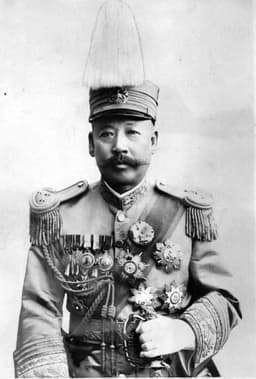
Cao Kun
General · Modern
43.2Total

Julius Caesar
General · Ancient
82.8Total
Basic Information
Born
1862
-100
Died
1938
-44
Era
Modern
Ancient
Nationality
China
Roman Republic
Occupation
General
General
Civilization
Eastern
Western
Score Comparison
Military (10%)
38.3
88.0
Political (20%)
30.8
78.0
Influence (20%)
51.0
85.0
Legacy (20%)
40.8
82.0
Leadership (15%)
50.7
80.0
Strategy (15%)
41.7
85.0
TOTAL
43.2
82.8
Cao Kun — Complete Timeline
1920 AD
Zhili-Anhui WarWar◆ Major
Cao Kun led the Zhili clique to victory over the Anhui clique in the Zhili-Anhui War. This battle established the Zhili faction as the dominant force in northern China and expanded Cao Kun's political and military power.
Warlord EraWarZhili Clique
Impact: national
1922 AD
First Zhili-Fengtian WarWar◆ Major
Cao Kun's Zhili forces defeated the Fengtian clique under Zhang Zuolin in the First Zhili-Fengtian War. This victory solidified Zhili control over Beijing and the central government.
Warlord EraWarZhili Clique
Impact: national
1923 AD
Presidential Bribery ScandalPolitical Action
Cao Kun bribed members of the National Assembly to elect him President of the Republic of China, spending millions of yuan. This scandal discredited the Republican government and deepened public cynicism toward warlord politics.
Republic of ChinaCorruptionPresidency
Impact: nationaldestructive
1924 AD
Second Zhili-Fengtian WarWar◆ Major
Cao Kun's Zhili clique was defeated by the Fengtian clique in the Second Zhili-Fengtian War. The loss led to his overthrow and house arrest, ending his political career and the Zhili dominance.
Warlord EraWarDefeat
Impact: nationaltragic
Julius Caesar — Complete Timeline
58 BC
Gallic WarsWar◆ Major
Caesar, as proconsul of Gaul, launched a series of campaigns that conquered all of Gaul (modern France, Belgium, and parts of Switzerland). He fought numerous battles, including against the Helvetii, the Belgae, and the Gallic chieftain Vercingetorix. The wars brought immense wealth and a loyal army to Caesar.
Gallic WarsConquestRoman Expansion
Impact: regional
49 BC
Crossing the RubiconPolitical Action◆ Major
Caesar led Legio XIII across the Rubicon River into Italy, defying the Roman Senate's order to disband his army. This act triggered a civil war against Pompey and the Optimates, ultimately leading to Caesar's dictatorship and the end of the Roman Republic.
Roman Civil WarEnd of RepublicPower Struggle
Impact: global
48 BC
Battle of PharsalusWar◆ Major
Caesar's outnumbered army defeated the larger forces of Pompey the Great at Pharsalus in Greece. Caesar's tactical use of a reserve line to counter Pompey's cavalry charge proved decisive. Pompey fled to Egypt, where he was assassinated, leaving Caesar as the undisputed master of the Roman world.
Roman Civil WarBattleDecisive Victory
Impact: regional
44 BC
Appointment as Dictator for LifePolitical Action◆ Major
The Roman Senate appointed Caesar dictator perpetuo (dictator for life), granting him unprecedented personal power. This move concentrated military, legislative, and judicial authority in one person, effectively ending the Roman Republic's traditional system of checks and balances and alarming many senators.
DictatorshipEnd of RepublicPower Consolidation
Impact: regionaldestructive
Assassination on the Ides of MarchPolitical Action◆ Major
A group of Roman senators, led by Marcus Junius Brutus and Gaius Cassius Longinus, stabbed Caesar to death at a meeting of the Senate in the Theatre of Pompey. The assassination was intended to restore the Republic, but instead triggered another civil war that led to the rise of the Roman Empire.
AssassinationRoman PoliticsEnd of Republic
Impact: globaldestructive
Expert Analysis
cao-kun-vs-julius-caesar
# The General Who Crossed His Rubicon, and the Warlord Who Bought His Throne
On a winter day in January 49 BCE, a Roman general stood at the edge of a small river in northern Italy. The Rubicon was not a great barrier—more a symbolic line between his province and the heart of the Republic. To cross it with an army was treason. Julius Caesar hesitated, then said, “The die is cast,” and led his legions into history. Two thousand years later, on an autumn afternoon in 1923, another general sat in a Beijing mansion counting banknotes. Cao Kun had no river to cross, no legions to command. He had only money—millions of yuan—which he would use to bribe his way into the presidency of a fractured China. These two men, separated by centuries and civilizations, both seized supreme power. But one reshaped the world; the other was swallowed by it. Why?
Origins
Julius Caesar was born into the patrician Julian clan, but his family was not wealthy. Rome in the first century BCE was a republic in name only—corrupt senators, landless veterans, and slave revolts had made it a powder keg. Caesar grew up in the shadow of his uncle Marius, a populist general, and learned early that in Rome, glory and gold came from the sword, not the senate floor. His education was Greek philosophy and military tactics; his playground was the Forum, where he watched men rise and fall by eloquence and ambition.
Cao Kun was born in 1862 in Tianjin, a port city then being carved up by foreign powers. The Qing Empire was crumbling, its armies humiliated by European guns. Cao’s family were poor laborers—his father sold bean curd. He learned to read and write only enough to join the local militia. When the Qing fell in 1912, China disintegrated into warlord fiefdoms. For a man like Cao, the path to power was not through birth or ideas, but through brute force and patronage. He was a product of chaos, not of a civilization’s peak but of its collapse.
Rise to Power
Caesar’s ascent was a masterpiece of calculated risk. He served as a military tribune in Spain, then as governor of Further Spain, where he conquered tribes and paid off his crushing debts with plunder. Back in Rome, he formed the First Triumvirate with Pompey and Crassus—a backroom deal that gave him command of Gaul. From 58 to 50 BCE, he did what no Roman had done: he conquered all of Gaul, crossed the Rhine into Germany, and landed in Britain. His *Commentaries* made him a legend, his veterans made him invincible.
Cao Kun’s rise was slower, less brilliant. He joined the Beiyang Army, the Qing’s modernized force, and rose through loyalty. By 1920, he was the leader of the Zhili clique, one of many warlord factions. His victory in the Zhili-Anhui War that year was not a stroke of genius—it was a slog of attrition, won by sheer numbers and better supplies. Two years later, in the First Zhili-Fengtian War, he defeated Zhang Zuolin, the “Old Marshal” of Manchuria. But Cao was no Caesar on the battlefield. He was a manager of men, not a maker of legends.
Leadership & Governance
As dictator, Caesar governed with furious energy. He reformed the calendar, gave land to veterans, extended citizenship to Gauls, and began massive public works. His rule was autocratic but visionary—he saw the Republic as broken and sought to replace it with a system that worked. He pardoned enemies, promoted talent regardless of birth, and centralized power in his own hands, but always with the rhetoric of reform. His military genius was inseparable from his political vision: the conquest of Gaul funded the rebuilding of Rome.
Cao Kun’s governance was a study in squandered opportunity. In 1923, he bribed 590 members of the National Assembly—each receiving 5,000 to 10,000 yuan—to elect him president. The “Piggy Parliament,” as it was called, became a national joke. Once in power, Cao did little. He had no reforms, no vision, no plan to unify China. He ruled like a landlord, collecting taxes and rewarding cronies. His only “achievement” was stability in Beijing, but it was the stability of stagnation.
Triumph & Tragedy
Caesar’s greatest moment was his triumph over Gaul—a victory that brought Rome a province larger than Italy itself. His tragedy was the Ides of March, 44 BCE, when sixty senators stabbed him to death. He had centralized power but failed to secure his own safety, dismissing warnings with a shrug. His last words, according to legend, were “*Et tu, Brute?*” to his adopted son. He died believing his work was unfinished.
Cao Kun’s triumph was his election—a hollow victory bought with cash. His tragedy came swiftly. In 1924, the Second Zhili-Fengtian War began. A subordinate general, Feng Yuxiang, betrayed him in a coup, seized Beijing, and imprisoned Cao. He was released two years later, a broken man, and died in 1938 as Japan invaded China. He had ruled for barely a year. His fall was not dramatic; it was pathetic.
Character & Destiny
Caesar was a gambler who understood odds. He crossed the Rubicon because he knew the alternative—prosecution, exile, obscurity—was worse. His personality was magnetic, his ambition boundless, but he also had a cold realism. He forgave enemies not out of kindness but because it was useful. His arrogance was his flaw: he thought he could control the Senate he had humiliated.
Cao Kun was a survivor, not a visionary. He rose by loyalty and fell by betrayal. His bribery revealed a man who saw power as a transaction, not a transformation. He lacked the imagination to see that a bought presidency could not command respect. His fate was sealed by the very chaos he helped create: in a world of shifting alliances, yesterday’s traitor becomes today’s betrayed.
Legacy
Caesar’s legacy is the Roman Empire. His name became a title—Kaiser, Tsar—and his reforms shaped Western law, language, and governance for two millennia. He is remembered as a genius, a tyrant, and a martyr, debated endlessly.
Cao Kun’s legacy is a footnote. In China, he is remembered as a symbol of warlord corruption, a cautionary tale of what happens when power is bought, not earned. His total score of 64.6—compared to Caesar’s 83.3—is not a judgment but a reflection of scale. One man conquered Gaul; the other bribed a parliament.
Conclusion
Caesar and Cao Kun both reached for absolute power, but they lived in different worlds. Caesar’s Rome was an empire waiting to be born; Cao’s China was an empire already dead. One crossed a river and changed history; the other crossed a palm with silver and was forgotten. The difference was not ambition—both had that. It was vision. Caesar saw a future and built it. Cao saw a chair and sat in it. In the end, the Rubicon was not a river. It was a choice.
Rankings
🥇
Julius CaesarLeader
Mil: 88.0Pol: 78.0Inf: 85.0
82.8
🥈
Cao Kun
Mil: 38.3Pol: 30.8Inf: 51.0
43.2
+39.6 behind
How This Comparison Works
Algorithm
Each figure is scored on 6 dimensions (0—100 scale) based on structured historical data: Military (10%), Political (20%), Influence (20%), Legacy (20%), Leadership (15%), Strategy (15%). The weighted total produces the final ranking.
Data Sources
Scores are computed from structured sub-indicators in the database. Scale factors adjust for era (Ancient ×0.85, Modern ×1.0) and civilization size (Eastern ×1.05, Other ×0.80) to account for differences in population and military scale.
Maximum 3 Figures
Comparisons are limited to 2—3 figures to ensure readability and statistical meaningfulness.
Error Margins
±5 points per dimension — Sub-scores are derived from historical records with inherent uncertainty. Two figures within 5 points on a dimension should be considered roughly equivalent in that area.
Total Score Accuracy
±3 points overall — The weighted combination of 6 dimensions produces a total score with approximately ±3 points of uncertainty. Differences of less than 3 points are not statistically significant— the figures are effectively tied.
Known Limitations
- Historical records are incomplete and uneven across civilizations
- Figures from oral-tradition societies may be underrepresented
- Occupation labels can misclassify multi-role figures
- Scores measure capability and impact, not moral character
- Quantitative scoring is a comparison tool, not absolute truth
Capability Radar
Military (10%) — Battles & Warfare
Battles
30
95
Win Rate
35
92
Expansion
25
97
Political (20%) — Governance & Reform
Reform
10
90
Diplomacy
20
85
Economy
15
82
Influence (20%) — Cultural & Global Reach
Cultural
15
88
Global
10
94
Legacy (20%) — Historical Impact
Historical
25
95
Longevity
10
96
Leadership (15%) — Power & Stability
Tenure
40
75
Stability
10
60
Strategy (15%) — Tactics & Innovation
Strategy
30
94
Tactics
25
96
Reform
20
88
Similar Comparisons
Comments & Discussion
No comments yet. Be the first to share your thoughts!