Loading...
Brian Mulroney vs Yeshey Zimba
Brian Mulroney leads by 8.2 pts · 2 figures compared
…
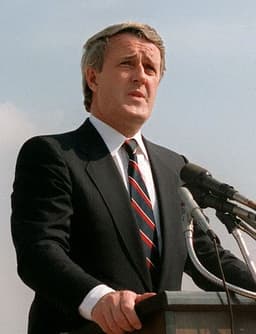
Brian Mulroney
Politician · Modern
60.8Total

Yeshey Zimba
Politician · Modern
52.6Total
Basic Information
Born
1939
1952
Died
—
—
Era
Modern
Modern
Nationality
Canada
Bhutan
Occupation
Politician
Politician
Civilization
Western
Indian
Score Comparison
Military (10%)
48.4
30.7
Political (20%)
78.0
68.0
Influence (20%)
61.0
49.4
Legacy (20%)
56.0
40.8
Leadership (15%)
72.0
72.0
Strategy (15%)
42.5
60.0
TOTAL
60.8
52.6
Brian Mulroney — Complete Timeline
1988 AD
Negotiation of the Canada-US Free Trade AgreementPolitical Action◆ Major
Mulroney's government negotiated the Canada-US Free Trade Agreement (CUSFTA), which eliminated tariffs and trade barriers between the two countries. The deal was controversial in Canada but passed after a federal election fought largely on the issue.
Free TradeUS-Canada RelationsEconomic Policy
Impact: regionalconstructive
1991 AD
Introduction of the Goods and Services TaxReform◆ Major
Mulroney's government implemented a 7% federal Goods and Services Tax (GST) to replace the hidden Manufacturers' Sales Tax. The GST was deeply unpopular and contributed to the Progressive Conservative Party's electoral collapse in 1993.
Tax ReformGSTFiscal Policy
Impact: nationaldestructive
1992 AD
Signing of the North American Free Trade AgreementPolitical Action◆ Major
Mulroney signed NAFTA alongside US President George H.W. Bush and Mexican President Carlos Salinas de Gortari. The agreement expanded CUSFTA to include Mexico, creating a trilateral trade bloc that reshaped North American commerce.
NAFTATrade BlocNorth America
Impact: regionalconstructive
Yeshey Zimba — Complete Timeline
1998 AD
Appointed as Minister of FinancePolitical Action
Yeshey Zimba was appointed Minister of Finance of Bhutan in 1998. He managed the national budget and oversaw economic reforms, including the introduction of a value-added tax and fiscal discipline.
FinanceEconomic Reform
Impact: nationalconstructive
2000 AD
First Term as Prime Minister of BhutanPolitical Action◆ Major
Yeshey Zimba served as Prime Minister of Bhutan from 2000 to 2001. His term focused on economic development and strengthening Bhutan's hydropower sector, including the Tala Hydroelectric Project.
Prime MinisterHydropower
Impact: nationalconstructive
2004 AD
Second Term as Prime Minister of BhutanPolitical Action◆ Major
Zimba served a second term as Prime Minister from 2004 to 2005. He continued economic reforms and oversaw the implementation of the 9th Five-Year Plan, focusing on poverty reduction and infrastructure.
Prime MinisterDevelopment
Impact: nationalconstructive
2005 AD
Negotiated Hydropower Agreements with IndiaPolitical Action◆ Major
As Finance Minister and PM, Zimba negotiated key hydropower agreements with India, including the Tala and Punatsangchhu projects. These deals provided Bhutan with significant revenue and energy exports.
HydropowerIndia-Bhutan Relations
Impact: regionalconstructive
Expert Analysis
Origins
Brian Mulroney was born on March 20, 1939, in Baie-Comeau, Quebec, a remote company town. His father was an electrician, and Mulroney grew up in a working-class Irish-Canadian family. He studied political science at St. Francis Xavier University and law at Université Laval, where he became fluent in French. His early career was in labor law, representing unions, which gave him negotiation skills and political connections.
Yeshey Zimba was born in 1952 in Bumthang, Bhutan, into a family with a tradition of government service. He studied at St. Joseph's College in Darjeeling, India, and later earned a degree in economics from the University of Delhi. He joined the Bhutanese civil service in the 1970s, working in the Ministry of Finance. His background in economics and finance shaped his policy approach.
Rise to Power
Mulroney entered politics in the 1970s, losing a leadership bid for the Progressive Conservative Party in 1976. He worked as a corporate executive and lawyer before winning the party leadership in 1983. In the 1984 federal election, he led the PCs to a landslide victory, winning 211 of 282 seats, the largest majority in Canadian history. His rise capitalized on dissatisfaction with the Liberal government and his charisma.
Zimba's rise was gradual within Bhutan's bureaucracy. He became Minister of Finance in 1998 under the absolute monarchy. In 2000, he was appointed Prime Minister (a position then appointed by the King) as part of the King's gradual democratization. He served two terms (2000-2001 and 2004-2005). His rise was based on expertise in finance and loyalty to the monarchy.
Leadership & Governance
Mulroney's leadership was defined by bold economic reforms. He pursued free trade with the US, signing the Canada-US Free Trade Agreement (CUSFTA) in 1988 and NAFTA in 1992. He introduced the Goods and Services Tax (GST) in 1991, replacing a hidden manufacturers' tax with a visible consumption tax. He also attempted constitutional reform (Meech Lake and Charlottetown Accords), which failed. His style was confrontational yet pragmatic, scoring 72.0 in leadership.
Zimba's governance focused on economic development through hydropower. He negotiated major agreements with India for the Tala and Punatsangchhu projects, scoring 72.0 in leadership. He oversaw Bhutan's 9th Five-Year Plan, emphasizing poverty reduction and infrastructure. His style was technocratic and collaborative, working within the monarchy's framework. He scored 60.0 in strategy, lower due to limited geopolitical maneuvering.
Triumph & Tragedy
Mulroney's triumph was NAFTA, which reshaped North American trade and boosted Canada's economy. His political score of 78.0 reflects this achievement. However, the GST was deeply unpopular, contributing to the PCs' collapse to 2 seats in 1993. His constitutional failures also tarnished his legacy. He scored 48.4 in military (no military role).
Zimba's triumph was securing hydropower deals that provided revenue and energy for Bhutan. His influence score of 49.4 reflects Bhutan's small global footprint. His tragedy was limited political power in a monarchy; his reforms were constrained. He scored 30.7 in military (none).
Character & Destiny
Mulroney was ambitious, charismatic, and willing to take risks. His negotiation skills enabled NAFTA but also led to compromises. His character drove him to pursue grand projects, but his inability to build consensus on constitutional issues led to failure. Historians view him as a transformative but polarizing figure.
Zimba was cautious, loyal, and methodical. His character suited Bhutan's gradual transition to democracy. He avoided confrontation, ensuring stability but limiting his impact. He is seen as a competent administrator rather than a visionary.
Legacy
Mulroney's legacy is mixed: NAFTA and free trade endure, but the GST remains controversial. His influence score of 61.0 reflects Canada's role in North America. He is remembered as a bold reformer whose policies shaped modern Canada.
Zimba's legacy is tied to Bhutan's hydropower and economic growth. His legacy score of 40.8 reflects Bhutan's small scale. He is remembered as a key figure in Bhutan's development.
Conclusion
Brian Mulroney had greater impact. His total score of 60.8 exceeds Zimba's 52.6. Mulroney's policies affected millions across three countries, while Zimba's impact was limited to Bhutan. NAFTA transformed global trade; Zimba's hydropower deals were regionally important but not world-changing. Mulroney's political score of 78.0 and influence of 61.0 demonstrate broader reach. Although Zimba was effective, Mulroney's decisions reshaped a continent.
Rankings
🥇
Brian MulroneyLeader
Mil: 48.4Pol: 78.0Inf: 61.0
60.8
🥈
Yeshey Zimba
Mil: 30.7Pol: 68.0Inf: 49.4
52.6
+8.2 behind
How This Comparison Works
Algorithm
Each figure is scored on 6 dimensions (0—100 scale) based on structured historical data: Military (10%), Political (20%), Influence (20%), Legacy (20%), Leadership (15%), Strategy (15%). The weighted total produces the final ranking.
Data Sources
Scores are computed from structured sub-indicators in the database. Scale factors adjust for era (Ancient ×0.85, Modern ×1.0) and civilization size (Eastern ×1.05, Other ×0.80) to account for differences in population and military scale.
Maximum 3 Figures
Comparisons are limited to 2—3 figures to ensure readability and statistical meaningfulness.
Error Margins
±5 points per dimension — Sub-scores are derived from historical records with inherent uncertainty. Two figures within 5 points on a dimension should be considered roughly equivalent in that area.
Total Score Accuracy
±3 points overall — The weighted combination of 6 dimensions produces a total score with approximately ±3 points of uncertainty. Differences of less than 3 points are not statistically significant— the figures are effectively tied.
Known Limitations
- Historical records are incomplete and uneven across civilizations
- Figures from oral-tradition societies may be underrepresented
- Occupation labels can misclassify multi-role figures
- Scores measure capability and impact, not moral character
- Quantitative scoring is a comparison tool, not absolute truth
Capability Radar
Military (10%) — Battles & Warfare
Battles
31
45
Win Rate
32
47
Expansion
36
51
Political (20%) — Governance & Reform
Reform
75
50
Diplomacy
80
45
Economy
75
60
Influence (20%) — Cultural & Global Reach
Cultural
40
20
Global
65
15
Legacy (20%) — Historical Impact
Historical
65
25
Longevity
55
20
Leadership (15%) — Power & Stability
Tenure
65
55
Stability
60
55
Strategy (15%) — Tactics & Innovation
Strategy
38
54
Tactics
39
53
Reform
46
58
Similar Comparisons
Comments & Discussion
No comments yet. Be the first to share your thoughts!