Loading...
Vo Van Kiet vs Yeshey Zimba
Yeshey Zimba leads by 2.6 pts · 2 figures compared
…
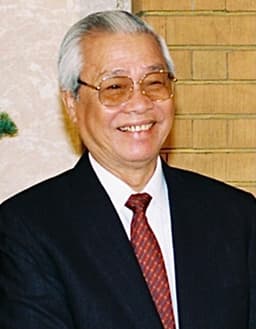
Vo Van Kiet
Politician · Modern
50.0Total

Yeshey Zimba
Politician · Modern
52.6Total
Basic Information
Born
1922
1952
Died
—
—
Era
Modern
Modern
Nationality
Vietnam
Bhutan
Occupation
Politician
Politician
Civilization
Eastern
Indian
Score Comparison
Military (10%)
13.3
30.7
Political (20%)
62.7
68.0
Influence (20%)
57.2
49.4
Legacy (20%)
48.3
40.8
Leadership (15%)
66.0
72.0
Strategy (15%)
29.9
60.0
TOTAL
50.0
52.6
Vo Van Kiet — Complete Timeline
1976 AD
Chairman of the State Planning CommissionPolitical Action
Vo Van Kiet was appointed Chairman of the State Planning Commission, overseeing Vietnam's central planning. He became a key economic reformer, advocating for market-oriented policies.
Planning CommissionEconomic reformCentral planning
Impact: nationalconstructive
1991 AD
Prime Minister of VietnamPolitical Action◆ Major
Vo Van Kiet became Prime Minister of Vietnam, succeeding Do Muoi. He accelerated Doi Moi reforms, promoting foreign investment and private enterprise, leading to rapid economic growth.
Prime MinisterDoi MoiEconomic growth
Impact: nationalprogressive
1995 AD
Normalization of relations with the USPolitical Action◆ Major
Vo Van Kiet oversaw the normalization of diplomatic relations between Vietnam and the United States. This ended decades of hostility and opened Vietnam to trade and investment.
US relationsNormalizationDiplomacy
Impact: globalconstructive
ASEAN membershipPolitical Action◆ Major
Vo Van Kiet led Vietnam's accession to the Association of Southeast Asian Nations (ASEAN). This integration helped Vietnam engage regionally and attract foreign investment.
ASEANRegional integrationForeign investment
Impact: regionalconstructive
Yeshey Zimba — Complete Timeline
1998 AD
Appointed as Minister of FinancePolitical Action
Yeshey Zimba was appointed Minister of Finance of Bhutan in 1998. He managed the national budget and oversaw economic reforms, including the introduction of a value-added tax and fiscal discipline.
FinanceEconomic Reform
Impact: nationalconstructive
2000 AD
First Term as Prime Minister of BhutanPolitical Action◆ Major
Yeshey Zimba served as Prime Minister of Bhutan from 2000 to 2001. His term focused on economic development and strengthening Bhutan's hydropower sector, including the Tala Hydroelectric Project.
Prime MinisterHydropower
Impact: nationalconstructive
2004 AD
Second Term as Prime Minister of BhutanPolitical Action◆ Major
Zimba served a second term as Prime Minister from 2004 to 2005. He continued economic reforms and oversaw the implementation of the 9th Five-Year Plan, focusing on poverty reduction and infrastructure.
Prime MinisterDevelopment
Impact: nationalconstructive
2005 AD
Negotiated Hydropower Agreements with IndiaPolitical Action◆ Major
As Finance Minister and PM, Zimba negotiated key hydropower agreements with India, including the Tala and Punatsangchhu projects. These deals provided Bhutan with significant revenue and energy exports.
HydropowerIndia-Bhutan Relations
Impact: regionalconstructive
Expert Analysis
Origins
Vo Van Kiet was born on November 23, 1922, in Trung Hiep village, Vinh Long province, in the Mekong Delta of southern Vietnam. He came from a peasant family and joined the Indochinese Communist Party in 1939 at age 17. His early life was shaped by French colonial rule and the struggle for independence. He received limited formal education but gained experience through revolutionary activities. Yeshey Zimba was born in 1952 in Bumthang, Bhutan. He studied at St. Joseph's College in Darjeeling, India, and later earned a degree in economics from the University of Delhi. His background is in finance and public administration, having worked as a civil servant before entering politics. Unlike Kiet's revolutionary path, Zimba's rise was through bureaucratic and technocratic channels.
Rise to Power
Vo Van Kiet rose through the ranks of the Communist Party of Vietnam. He served as a military commander during the Vietnam War, but his political ascent came after reunification. In 1976, he became Chairman of the State Planning Commission, where he advocated for economic reforms. His key turning point came in 1991 when he succeeded Do Muoi as Prime Minister, a position he held until 1997. He accelerated the Doi Moi (Renovation) reforms initiated in 1986, pushing for market liberalization and foreign investment. Yeshey Zimba's rise was more gradual. He served as Minister of Finance from 1998 to 2000, overseeing Bhutan's budget and economic reforms. In 2000, he became Prime Minister for the first time, serving until 2001. He returned for a second term from 2004 to 2005. His rise was based on his expertise in finance and his role in negotiating hydropower agreements with India.
Leadership & Governance
Vo Van Kiet's leadership style was pragmatic and reform-oriented. He focused on dismantling central planning and encouraging private enterprise. Under his tenure, Vietnam normalized relations with the United States in 1995 and joined ASEAN in 1995. These moves opened Vietnam to global trade and investment. His governance was characterized by cautious but steady liberalization. Yeshey Zimba's leadership was more focused on economic development through hydropower. He negotiated key agreements with India for the Tala and Punatsangchhu hydroelectric projects, which provided revenue and energy for Bhutan. His governance emphasized fiscal discipline and infrastructure development. Both leaders prioritized economic growth, but Kiet's reforms were more transformative, shifting Vietnam from a command economy to a market-oriented one. Zimba's impact was more sector-specific.
Triumph & Tragedy
Vo Van Kiet's greatest success was overseeing Vietnam's economic transformation. GDP growth averaged 8% during his tenure, and foreign investment surged. He also achieved diplomatic normalization with the US, a major foreign policy victory. However, his tenure saw rising inequality and corruption. The financial crisis of 1997 slowed growth, and he failed to address state-owned enterprise inefficiencies. Yeshey Zimba's greatest success was securing hydropower deals that boosted Bhutan's economy. The Tala project alone generates over 1,000 MW, providing 40% of government revenue. However, his terms were short, limiting his ability to implement broader reforms. Bhutan's economy remained heavily dependent on India, and social indicators like education and healthcare lagged.
Character & Destiny
Vo Van Kiet was known as a pragmatic reformer, willing to challenge orthodox communist ideology. His character was shaped by his peasant background and war experiences, making him focused on practical outcomes. He was cautious but persistent. Yeshey Zimba was a technocrat, methodical and detail-oriented. His finance background made him risk-averse. Both men's destinies were tied to their countries' economic paths: Kiet's Vietnam embraced market reforms; Zimba's Bhutan leveraged natural resources. Kiet's scores reflect his political skill (62.7) and leadership (66.0), while Zimba's leadership score is higher (72.0) due to his effective negotiation.
Legacy
Vo Van Kiet is remembered as a key architect of Doi Moi, alongside Nguyen Van Linh. His reforms laid the foundation for Vietnam's economic rise, lifting millions out of poverty. He scored 48.3 in legacy. Yeshey Zimba is remembered for securing Bhutan's hydropower future, which remains the backbone of the economy. His legacy score is 40.8. While both made lasting contributions, Kiet's impact was broader and more profound, transforming an entire nation's economic system.
Conclusion
Vo Van Kiet had a greater impact than Yeshey Zimba. Despite Zimba's higher total score (52.6 vs 50.0), Kiet's reforms fundamentally altered Vietnam's trajectory, integrating it into the global economy. Zimba's achievements were significant but narrower in scope. Kiet's political (62.7) and influence (57.2) scores reflect his larger role in history. The 2.6-point gap in total scores does not capture the magnitude of Kiet's transformative effect on a country of 90 million versus Zimba's impact on a small Himalayan kingdom.
Rankings
🥇
Yeshey ZimbaLeader
Mil: 30.7Pol: 68.0Inf: 49.4
52.6
🥈
Vo Van Kiet
Mil: 13.3Pol: 62.7Inf: 57.2
50.0
+2.6 behind
How This Comparison Works
Algorithm
Each figure is scored on 6 dimensions (0—100 scale) based on structured historical data: Military (10%), Political (20%), Influence (20%), Legacy (20%), Leadership (15%), Strategy (15%). The weighted total produces the final ranking.
Data Sources
Scores are computed from structured sub-indicators in the database. Scale factors adjust for era (Ancient ×0.85, Modern ×1.0) and civilization size (Eastern ×1.05, Other ×0.80) to account for differences in population and military scale.
Maximum 3 Figures
Comparisons are limited to 2—3 figures to ensure readability and statistical meaningfulness.
Error Margins
±5 points per dimension — Sub-scores are derived from historical records with inherent uncertainty. Two figures within 5 points on a dimension should be considered roughly equivalent in that area.
Total Score Accuracy
±3 points overall — The weighted combination of 6 dimensions produces a total score with approximately ±3 points of uncertainty. Differences of less than 3 points are not statistically significant— the figures are effectively tied.
Known Limitations
- Historical records are incomplete and uneven across civilizations
- Figures from oral-tradition societies may be underrepresented
- Occupation labels can misclassify multi-role figures
- Scores measure capability and impact, not moral character
- Quantitative scoring is a comparison tool, not absolute truth
Capability Radar
Military (10%) — Battles & Warfare
Battles
17
45
Win Rate
19
47
Expansion
21
51
Political (20%) — Governance & Reform
Reform
75
50
Diplomacy
65
45
Economy
80
60
Influence (20%) — Cultural & Global Reach
Cultural
30
20
Global
45
15
Legacy (20%) — Historical Impact
Historical
50
25
Longevity
40
20
Leadership (15%) — Power & Stability
Tenure
60
55
Stability
55
55
Strategy (15%) — Tactics & Innovation
Strategy
26
54
Tactics
29
53
Reform
31
58
Similar Comparisons
Comments & Discussion
No comments yet. Be the first to share your thoughts!