Loading...
Brian Mulroney vs Mikheil Saakashvili
Brian Mulroney leads by 6.9 pts · 2 figures compared
…
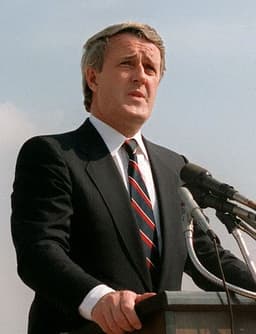
Brian Mulroney
Politician · Modern
60.8Total

Mikheil Saakashvili
Politician · Modern
53.9Total
Basic Information
Born
1939
1967
Died
—
—
Era
Modern
Modern
Nationality
Canada
Georgia
Occupation
Politician
Politician
Civilization
Western
Western
Score Comparison
Military (10%)
48.4
36.6
Political (20%)
78.0
53.8
Influence (20%)
61.0
57.2
Legacy (20%)
56.0
45.8
Leadership (15%)
72.0
74.0
Strategy (15%)
42.5
53.0
TOTAL
60.8
53.9
Brian Mulroney — Complete Timeline
1988 AD
Negotiation of the Canada-US Free Trade AgreementPolitical Action◆ Major
Mulroney's government negotiated the Canada-US Free Trade Agreement (CUSFTA), which eliminated tariffs and trade barriers between the two countries. The deal was controversial in Canada but passed after a federal election fought largely on the issue.
Free TradeUS-Canada RelationsEconomic Policy
Impact: regionalconstructive
1991 AD
Introduction of the Goods and Services TaxReform◆ Major
Mulroney's government implemented a 7% federal Goods and Services Tax (GST) to replace the hidden Manufacturers' Sales Tax. The GST was deeply unpopular and contributed to the Progressive Conservative Party's electoral collapse in 1993.
Tax ReformGSTFiscal Policy
Impact: nationaldestructive
1992 AD
Signing of the North American Free Trade AgreementPolitical Action◆ Major
Mulroney signed NAFTA alongside US President George H.W. Bush and Mexican President Carlos Salinas de Gortari. The agreement expanded CUSFTA to include Mexico, creating a trilateral trade bloc that reshaped North American commerce.
NAFTATrade BlocNorth America
Impact: regionalconstructive
Mikheil Saakashvili — Complete Timeline
2003 AD
Rose RevolutionPolitical Action
Saakashvili led mass protests against disputed parliamentary elections, culminating in the peaceful Rose Revolution. President Eduard Shevardnadze resigned, and Saakashvili was elected President of Georgia in a landslide victory, promising democratic reforms and anti-corruption measures.
RevolutionGeorgiaDemocracy
Impact: nationalconstructive
2004 AD
Launched Anti-Corruption CampaignReform◆ Major
Saakashvili's government launched a sweeping anti-corruption campaign, firing corrupt officials, reforming the police, and simplifying bureaucracy. The campaign dramatically reduced petty corruption and improved public services, but was criticized for using heavy-handed methods against political opponents.
Anti-CorruptionReformGeorgia
Impact: nationalconstructive
2008 AD
Russo-Georgian WarWar
Saakashvili ordered a military offensive to regain control of the breakaway region of South Ossetia. Russia responded with a full-scale invasion of Georgia, defeating the Georgian military and occupying parts of the country. The war ended with a ceasefire, but Georgia lost control of South Ossetia and Abkhazia.
WarRussiaGeorgiaSouth Ossetia
Impact: regionaldestructive
2013 AD
Lost Presidential ElectionPolitical Action◆ Major
Saakashvili's term as President ended, and he was constitutionally barred from running again. His party lost the presidential election to Giorgi Margvelashvili of the Georgian Dream coalition, marking a peaceful transfer of power and the end of Saakashvili's era.
ElectionGeorgiaPower Transfer
Impact: national
2017 AD
Arrested in UkrainePolitical Action◆ Major
Saakashvili, who had been granted Ukrainian citizenship and appointed governor of Odessa, was arrested in Kyiv during a protest against President Petro Poroshenko. He was accused of aiding a criminal organization and plotting a coup, charges he denied. The arrest highlighted his turbulent post-presidency.
UkraineArrestPolitical Conflict
Impact: regionaltragic
Expert Analysis
Origins
Brian Mulroney was born in 1939 in Baie-Comeau, Quebec, Canada, into a working-class family. His father was an electrician, and his mother a homemaker. He studied political science at St. Francis Xavier University and later law at Laval University, where he became involved in the Progressive Conservative Party. Mulroney worked as a labor lawyer and executive in the mining industry before entering politics.
Mikheil Saakashvili was born in 1967 in Tbilisi, Georgia, to a physician mother and a father who was a lawyer. He studied law at Kyiv University and later earned an LLM from Columbia University and a diploma from The George Washington University. He returned to Georgia in the 1990s and became a member of parliament, aligning with reformist movements.
Rise to Power
Mulroney became leader of the Progressive Conservative Party in 1983, following a brief stint as a candidate in 1976. He led the party to a landslide victory in the 1984 federal election, winning 211 out of 282 seats. His rise was fueled by his charisma, bilingualism, and appeal to Quebec nationalists, though his 1983 leadership win was narrow.
Saakashvili rose to prominence as a reformer and ally of President Eduard Shevardnadze, serving as Minister of Justice from 2000 to 2001. He resigned in protest over corruption and later formed the United National Movement. In 2003, he led the Rose Revolution after disputed parliamentary elections, forcing Shevardnadze to resign. Saakashvili won the presidency in 2004 with 96% of the vote.
Leadership & Governance
Mulroney's governance focused on economic integration and fiscal reform. He negotiated the Canada-US Free Trade Agreement (CUSFTA) in 1987 and signed NAFTA in 1992, expanding trade to Mexico. He also introduced the Goods and Services Tax (GST) in 1991, replacing the hidden Manufacturers' Sales Tax. While effective economically, the GST was deeply unpopular and contributed to his party's collapse. Mulroney's leadership style was consensus-building but also secretive, with scandals like the Airbus affair tarnishing his legacy. His political score of 78.0 reflects his electoral success, but his strategy score of 42.5 indicates poor long-term planning.
Saakashvili's governance centered on anti-corruption and modernization. He fired 30,000 corrupt officials, reformed the police, and simplified business regulations. His government reduced corruption dramatically, with Georgia rising in Transparency International's index. He also invested in infrastructure and education. However, his leadership was authoritarian: he centralized power, cracked down on opposition media, and initiated the 2008 Russo-Georgian War, which ended in disaster. His leadership score of 74.0 is high, but his military score of 36.6 reflects the costly war.
Triumph & Tragedy
Mulroney's greatest triumph was negotiating NAFTA, which reshaped North American trade and boosted Canada's economy. He also led the Meech Lake Accord and Charlottetown Accord attempts to reconcile Quebec, though both failed. His greatest tragedy was the GST, which destroyed his party's popularity. The Progressive Conservatives went from 211 seats in 1984 to 2 seats in 1993, the worst defeat in Canadian history. His legacy score of 56.0 reflects this mixed outcome.
Saakashvili's greatest triumph was the anti-corruption campaign, which transformed Georgia from a failed state into a regional reform model. Police reform was so successful that bribery virtually disappeared. His tragedy was the 2008 war, where his miscalculation led to a Russian invasion, loss of territory, and economic damage. He was later arrested in Ukraine in 2017 after a falling out with President Poroshenko. His influence score of 57.2 and legacy score of 45.8 reflect his mixed record.
Character & Destiny
Mulroney was a charismatic, pragmatic leader who prioritized economic deals over party unity. His ability to build coalitions with Quebec nationalists and US presidents was key, but his secretive style and focus on unpopular reforms (GST) sealed his party's fate. He scored 72.0 in leadership but 42.5 in strategy, indicating a disconnect between vision and execution.
Saakashvili was a visionary reformer with a confrontational style. His determination to root out corruption was genuine, but his impulsiveness and nationalism led to the disastrous war. He scored 74.0 in leadership but 36.6 in military, showing his strength in domestic reform but weakness in foreign policy. His destiny was shaped by his inability to balance ambition with caution.
Legacy
Mulroney's legacy is defined by NAFTA and the GST. NAFTA remains a cornerstone of Canadian trade policy, though it was renegotiated as USMCA in 2020. The GST is still in place, though unpopular. Mulroney's party collapsed, but his policies endured. His total score of 60.8 reflects a significant but polarizing impact.
Saakashvili's legacy is the anti-corruption model, which inspired reforms in other post-Soviet states. However, the war and his authoritarian tendencies damaged his reputation. Georgia's democratic backsliding after his rule also tarnished his legacy. His total score of 53.9 indicates a more mixed record.
Conclusion
Brian Mulroney had greater impact than Mikheil Saakashvili, with a total score of 60.8 compared to 53.9. Mulroney's economic policies reshaped North American trade and continue to affect millions. Saakashvili's reforms were impressive but limited to Georgia and overshadowed by the war. Mulroney's political score of 78.0 and influence of 61.0 outweigh Saakashvili's 53.8 and 57.2. While Saakashvili's anti-corruption work was transformative, Mulroney's structural changes to trade and taxation had a broader and more lasting effect.
Rankings
🥇
Brian MulroneyLeader
Mil: 48.4Pol: 78.0Inf: 61.0
60.8
🥈
Mikheil Saakashvili
Mil: 36.6Pol: 53.8Inf: 57.2
53.9
+6.9 behind
How This Comparison Works
Algorithm
Each figure is scored on 6 dimensions (0—100 scale) based on structured historical data: Military (10%), Political (20%), Influence (20%), Legacy (20%), Leadership (15%), Strategy (15%). The weighted total produces the final ranking.
Data Sources
Scores are computed from structured sub-indicators in the database. Scale factors adjust for era (Ancient ×0.85, Modern ×1.0) and civilization size (Eastern ×1.05, Other ×0.80) to account for differences in population and military scale.
Maximum 3 Figures
Comparisons are limited to 2—3 figures to ensure readability and statistical meaningfulness.
Error Margins
±5 points per dimension — Sub-scores are derived from historical records with inherent uncertainty. Two figures within 5 points on a dimension should be considered roughly equivalent in that area.
Total Score Accuracy
±3 points overall — The weighted combination of 6 dimensions produces a total score with approximately ±3 points of uncertainty. Differences of less than 3 points are not statistically significant— the figures are effectively tied.
Known Limitations
- Historical records are incomplete and uneven across civilizations
- Figures from oral-tradition societies may be underrepresented
- Occupation labels can misclassify multi-role figures
- Scores measure capability and impact, not moral character
- Quantitative scoring is a comparison tool, not absolute truth
Capability Radar
Military (10%) — Battles & Warfare
Battles
31
5
Win Rate
32
5
Expansion
36
5
Political (20%) — Governance & Reform
Reform
75
65
Diplomacy
80
60
Economy
75
50
Influence (20%) — Cultural & Global Reach
Cultural
40
40
Global
65
45
Legacy (20%) — Historical Impact
Historical
65
45
Longevity
55
30
Leadership (15%) — Power & Stability
Tenure
65
55
Stability
60
30
Strategy (15%) — Tactics & Innovation
Strategy
38
5
Tactics
39
5
Reform
46
10
Similar Comparisons
Comments & Discussion
No comments yet. Be the first to share your thoughts!