Loading...
This comparison has not been analyzed yet.
One-time AI generation (~1 minute). Scores and timeline are already available below.
Bipin Rawat vs Kenan Evren
Bipin Rawat leads by 2.4 pts · 2 figures compared
…
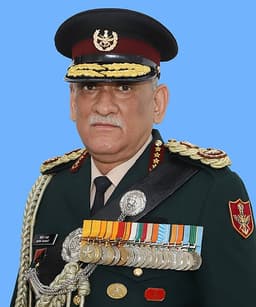
Bipin Rawat
General · Modern
55.0Total

Kenan Evren
General · Modern
52.6Total
Basic Information
Born
1958
1917
Died
—
2015
Era
Modern
Modern
Nationality
India
Turkey
Occupation
General
General
Civilization
Indian
Middle Eastern
Score Comparison
Military (10%)
40.0
25.9
Political (20%)
68.0
54.7
Influence (20%)
59.0
60.0
Legacy (20%)
45.0
48.3
Leadership (15%)
62.0
65.0
Strategy (15%)
55.0
50.0
TOTAL
55.0
52.6
Bipin Rawat — Complete Timeline
2016 AD
Led Counter-Insurgency Operations in KashmirWar
As Army Chief, Rawat oversaw intensified counter-insurgency operations in Kashmir following the 2016 unrest. He advocated for a tough approach against militants, leading to increased military presence.
KashmirCounter-insurgencyMilitary Operations
Impact: regional
Served as Chief of Army StaffPolitical Action◆ Major
Rawat was appointed Chief of Army Staff in 2016. He oversaw operations in Jammu and Kashmir, including the 2016 surgical strikes across the Line of Control, and focused on counter-insurgency.
Army ChiefSurgical StrikesCounter-insurgency
Impact: national
2019 AD
Appointed First Chief of Defence Staff of IndiaPolitical Action
General Bipin Rawat was appointed as India's first Chief of Defence Staff (CDS), a new position created to integrate the three armed services. He was tasked with improving jointness and military efficiency.
CDSMilitary ReformIntegration
Impact: nationalconstructive
2021 AD
Died in Helicopter CrashOther◆ Major
General Rawat, his wife, and 11 others died in a helicopter crash in Tamil Nadu. The crash occurred while he was traveling to a military event, and an inquiry attributed it to weather and pilot error.
DeathAccidentHelicopter Crash
Impact: nationaltragic
Kenan Evren — Complete Timeline
1980 AD
Led the 1980 Turkish Military CoupPolitical Action
General Kenan Evren led the Turkish Armed Forces in a coup d'
Coup d'étatMilitary RuleTurkish Politics
Impact: nationaldestructive
1982 AD
Became President of TurkeyPolitical Action◆ Major
Following the 1980 coup, a new constitution was approved by referendum in 1982, which also confirmed Evren as President. He served until 1989, overseeing a period of authoritarian rule and economic liberalization.
PresidencyConstitution
Impact: national
2014 AD
Sentenced to Life ImprisonmentPolitical Action◆ Major
In 2014, a Turkish court sentenced Kenan Evren to life imprisonment for his role in the 1980 coup, which was deemed a crime against the state. He was the first coup leader to be tried and convicted in Turkey.
TrialJusticeCoup
Impact: nationaltragic
This comparison has not been analyzed yet.
One-time AI generation (~1 minute). Scores and timeline are already available below.
Rankings
🥇
Bipin RawatLeader
Mil: 40.0Pol: 68.0Inf: 59.0
55.0
🥈
Kenan Evren
Mil: 25.9Pol: 54.7Inf: 60.0
52.6
+2.4 behind
How This Comparison Works
Algorithm
Each figure is scored on 6 dimensions (0—100 scale) based on structured historical data: Military (10%), Political (20%), Influence (20%), Legacy (20%), Leadership (15%), Strategy (15%). The weighted total produces the final ranking.
Data Sources
Scores are computed from structured sub-indicators in the database. Scale factors adjust for era (Ancient ×0.85, Modern ×1.0) and civilization size (Eastern ×1.05, Other ×0.80) to account for differences in population and military scale.
Maximum 3 Figures
Comparisons are limited to 2—3 figures to ensure readability and statistical meaningfulness.
Error Margins
±5 points per dimension — Sub-scores are derived from historical records with inherent uncertainty. Two figures within 5 points on a dimension should be considered roughly equivalent in that area.
Total Score Accuracy
±3 points overall — The weighted combination of 6 dimensions produces a total score with approximately ±3 points of uncertainty. Differences of less than 3 points are not statistically significant— the figures are effectively tied.
Known Limitations
- Historical records are incomplete and uneven across civilizations
- Figures from oral-tradition societies may be underrepresented
- Occupation labels can misclassify multi-role figures
- Scores measure capability and impact, not moral character
- Quantitative scoring is a comparison tool, not absolute truth
Capability Radar
Military (10%) — Battles & Warfare
Battles
45
10
Win Rate
50
10
Expansion
30
10
Political (20%) — Governance & Reform
Reform
55
40
Diplomacy
50
40
Economy
30
30
Influence (20%) — Cultural & Global Reach
Cultural
35
30
Global
30
40
Legacy (20%) — Historical Impact
Historical
40
50
Longevity
20
30
Leadership (15%) — Power & Stability
Tenure
40
60
Stability
45
20
Strategy (15%) — Tactics & Innovation
Strategy
65
20
Tactics
60
20
Reform
75
30
Similar Comparisons
Comments & Discussion
No comments yet. Be the first to share your thoughts!