Loading...
Afonso de Albuquerque vs Bipin Rawat
Afonso de Albuquerque leads by 24.6 pts · 2 figures compared
…
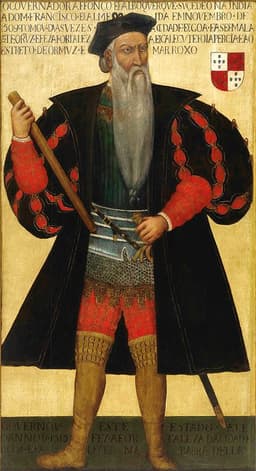
Afonso de Albuquerque
General · Medieval
79.6Total
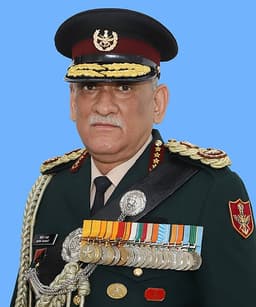
Bipin Rawat
General · Modern
55.0Total
Basic Information
Born
1453
1958
Died
1515
—
Era
Medieval
Modern
Nationality
Portugal
India
Occupation
General
General
Civilization
Western
Indian
Score Comparison
Military (10%)
77.5
40.0
Political (20%)
88.0
68.0
Influence (20%)
80.0
59.0
Legacy (20%)
75.0
45.0
Leadership (15%)
78.0
62.0
Strategy (15%)
82.0
55.0
TOTAL
79.6
55.0
Afonso de Albuquerque — Complete Timeline
1503 AD
First voyage to IndiaWar◆ Major
Afonso de Albuquerque led a fleet to India, establishing the first Portuguese fort at Cochin. This voyage laid the foundation for Portuguese control of the Indian Ocean trade.
ExplorationColonialismIndia
Impact: global
1510 AD
Conquest of GoaWar◆ Major
Albuquerque captured Goa from the Sultan of Bijapur. He made Goa the capital of Portuguese India, a position it held for over 400 years.
ConquestColonialismIndia
Impact: regional
1511 AD
Conquest of MalaccaWar◆ Major
Albuquerque led a Portuguese fleet to capture the strategic port of Malacca. This gave Portugal control of the spice trade route between the Indian Ocean and the Pacific.
ConquestSpice TradeSoutheast Asia
Impact: global
1513 AD
Siege of AdenWar
Albuquerque attempted to capture Aden in Yemen but failed. This failure prevented Portugal from controlling the entrance to the Red Sea and limited their influence in the region.
SiegeFailureRed Sea
Impact: regional
1515 AD
Death at seaOther◆ Major
Afonso de Albuquerque died at sea off the coast of Goa, possibly from illness or poison. His death left the Portuguese Empire in the Indian Ocean without its most capable leader.
DeathLeadershipEmpire
Impact: regionaltragic
Bipin Rawat — Complete Timeline
2016 AD
Led Counter-Insurgency Operations in KashmirWar
As Army Chief, Rawat oversaw intensified counter-insurgency operations in Kashmir following the 2016 unrest. He advocated for a tough approach against militants, leading to increased military presence.
KashmirCounter-insurgencyMilitary Operations
Impact: regional
Served as Chief of Army StaffPolitical Action◆ Major
Rawat was appointed Chief of Army Staff in 2016. He oversaw operations in Jammu and Kashmir, including the 2016 surgical strikes across the Line of Control, and focused on counter-insurgency.
Army ChiefSurgical StrikesCounter-insurgency
Impact: national
2019 AD
Appointed First Chief of Defence Staff of IndiaPolitical Action
General Bipin Rawat was appointed as India's first Chief of Defence Staff (CDS), a new position created to integrate the three armed services. He was tasked with improving jointness and military efficiency.
CDSMilitary ReformIntegration
Impact: nationalconstructive
2021 AD
Died in Helicopter CrashOther◆ Major
General Rawat, his wife, and 11 others died in a helicopter crash in Tamil Nadu. The crash occurred while he was traveling to a military event, and an inquiry attributed it to weather and pilot error.
DeathAccidentHelicopter Crash
Impact: nationaltragic
Expert Analysis
Afonso de Albuquerque vs Bipin Rawat
# The Admiral and the General: Two Architects of Empire, Five Centuries Apart
On a December morning in 2021, a military helicopter slammed into the hills of Tamil Nadu, killing India’s first Chief of Defence Staff, General Bipin Rawat, along with his wife and eleven others. Five hundred and six years earlier, another military commander—Afonso de Albuquerque—died at sea off the coast of Goa, possibly poisoned, possibly from illness, leaving behind a Portuguese empire in the Indian Ocean that he had single-handedly forged. One death was a national tragedy broadcast in real time; the other was a quiet passing that nevertheless sent shockwaves through the trading networks of three continents. Both men were builders of empires, but their empires were of vastly different kinds—and the worlds they inhabited could not have been more different.
Origins
Afonso de Albuquerque was born in 1453, the year Constantinople fell to the Ottomans—a date that marks the end of the medieval world for many historians. He came from the Portuguese nobility, the second son of a minor lord, trained in mathematics and military arts at the court of King Afonso V. His Portugal was a small, poor kingdom on the edge of Europe, driven by a desperate hunger for spices and a crusading zeal against Islam. Albuquerque was shaped by this world of wooden ships, monsoon winds, and the belief that a handful of determined men could redirect the flow of history.
Bipin Rawat was born in 1958 in Pauri, a hill town in the Indian state of Uttarakhand. His father was a senior military officer, and young Bipin grew up in an independent India still finding its footing—a nation of a billion people, nuclear-armed, democratic, and deeply suspicious of its neighbors. Rawat attended the National Defence Academy and was commissioned into the Indian Army in 1978. His world was one of jeeps and helicopters, satellite communications and international diplomacy, a world where the old imperial powers had receded and new nation-states fought proxy wars across contested borders.
The difference in their origins is not merely one of geography or chronology. Albuquerque came from a civilization that was expanding outward, hungry for territory and trade. Rawat came from a civilization that had been colonized and was now asserting its own sovereignty. One was an agent of empire; the other was a defender of a nation.
Rise to Power
Albuquerque’s path to power was forged on the high seas. In 1503, at age fifty, he led his first fleet to India, establishing a Portuguese fort at Cochin. This was not a gentle introduction—it was a violent assertion of presence in a world of competing sultanates and trading cities. Over the next decade, he would capture Goa in 1510, turning it into the capital of Portuguese India, and then Malacca in 1511, seizing control of the spice trade that had made Southeast Asia the richest region on earth. His rise was brutal, swift, and dependent entirely on naval firepower and ruthless political calculation.
Rawat’s rise was slower, more institutional. He spent decades climbing the ranks of the Indian Army, serving in counter-insurgency operations in Kashmir and the northeast. His turning point came in 2016 when he was appointed Chief of Army Staff. In that role, he oversaw the surgical strikes across the Line of Control that followed the Uri attack, operations that were as much about domestic political signaling as military effectiveness. In 2019, he was appointed India’s first Chief of Defence Staff, a newly created position meant to integrate the army, navy, and air force. Unlike Albuquerque, who carved his own path with cannon and sword, Rawat was the product of a modern bureaucracy, his authority derived from a civilian government.
Leadership and Governance
Albuquerque governed like a Renaissance prince who had read Machiavelli before Machiavelli wrote. He understood that in the Indian Ocean, power was not about occupying vast territories but about controlling strategic chokepoints: Goa, Malacca, Hormuz. He was ruthless—he ordered the massacre of Muslim prisoners in Goa and the torture of captured nobles—but he was also pragmatic. He encouraged his soldiers to marry local women, established a mint, and built a hospital. His military genius lay in his understanding that the Portuguese Empire would live or die by its ability to project naval power from a few key fortresses. His failure at the Siege of Aden in 1513, where he could not capture the entrance to the Red Sea, was a strategic mistake that would haunt Portugal for decades.
Rawat’s leadership was that of a modern military bureaucrat operating in a democratic framework. He was known for his bluntness—he once said that the Indian Army was not a “saluting army” but a “fighting army”—and for his advocacy of integrated theater commands. He pushed for the modernization of India’s armed forces and a more aggressive posture toward China and Pakistan. His counter-insurgency strategy in Kashmir was controversial: he supported the revocation of Article 370, which stripped the state of its special status, and argued for a hardline approach to militants. Where Albuquerque commanded by personal decree, Rawat commanded by committee, by policy paper, by press conference.
Triumph and Tragedy
Albuquerque’s greatest triumph was the conquest of Malacca in 1511. With a fleet of eighteen ships and perhaps a thousand men, he defeated a sultanate that controlled the narrow strait through which all spice trade flowed. He built a fortress, established a Portuguese administration, and sent ships to explore the Spice Islands. It was a moment of pure imperial audacity. His greatest tragedy was his death: returning from a failed campaign at Hormuz, sick and disgraced in the eyes of his king, he died at sea. Some say he was poisoned. His last letter to the king pleaded for his son’s future. The empire he built would survive, but it would never again have a leader of his vision.
Rawat’s triumph was his role in creating the position of Chief of Defence Staff itself—a reform that military thinkers had advocated for decades. His tragedy, of course, was his death in that helicopter crash. The crash was investigated, theories of sabotage circulated, but the official conclusion was pilot error. What is undeniable is that his death was a profound shock to India’s military establishment. Unlike Albuquerque, who died alone and forgotten by his king, Rawat died in the full glare of national attention, with a state funeral and a nation in mourning.
Character and Destiny
Albuquerque was a man of the 16th century: proud, cruel, visionary, and deeply religious. He believed he was doing God’s work, spreading Christianity and breaking Muslim control of the spice trade. His personality was forged by the age of exploration—a time when a single ship could change the course of history. He was impatient, arrogant, and prone to violent rages, but he was also capable of strategic patience and political cunning. His destiny was to build an empire that would last four centuries, even if he did not live to see it.
Rawat was a man of the 21st century: professional, political, media-savvy, and intensely nationalistic. He grew up in a post-colonial world, where the old empires were gone and the new struggles were over borders, resources, and ideology. His personality was shaped by the Indian Army’s institutional culture—disciplined, hierarchical, and wary of civilian interference. He was not a visionary in the Albuquerque mold; he was a reformer working within a system. His destiny was to die before his reforms could fully take root, leaving behind a legacy that is still debated.
Legacy
Albuquerque’s legacy is written in the geography of the Indian Ocean. Goa remained a Portuguese colony until 1961. Malacca is still a strategic port. The Portuguese language survives in parts of India and Southeast Asia. He is remembered as the founder of the Portuguese Empire in the East, a title that carries both glory and shame. Statues of him stand in Lisbon and Goa, but his methods—the massacres, the forced conversions, the destruction of rival trading networks—are also a reminder of the violence that accompanied European expansion.
Rawat’s legacy is more contested. He is remembered as India’s first CDS, a man who pushed for military integration at a time when the country faced threats on multiple fronts. But his tenure was short, his reforms incomplete, and his approach to Kashmir remains controversial. He is a hero to some, a hawk to others. The helicopter crash that killed him has become a symbol of the unpredictability of military life—and a reminder that even in the modern age, death can come suddenly, without warning, in the green hills of Tamil Nadu.
Conclusion
What connects these two men, five centuries apart? Both were soldiers who believed they were serving a larger cause—Albuquerque, his king and his God; Rawat, his nation and its democracy. Both understood that military power, to be effective, must be combined with political strategy. And both died before their work was finished, leaving others to carry on.
But the differences are more instructive. Albuquerque built an empire in a world where empires were the only game in town. Rawat defended a nation in a world where empires had been discredited. Albuquerque’s violence was open, celebrated, and necessary for his project. Rawat’s violence was constrained, controversial, and always subject to political oversight. One was a conqueror; the other was a commander. One died in obscurity; the other died in headlines.
Perhaps the deepest difference lies in what they reveal about their times. Albuquerque’s story is about the birth of globalization—the violent, unequal, transformative process that connected the world. Rawat’s story is about the management of that world once it was connected—the endless negotiations, the simmering conflicts, the institutional reforms that try to keep chaos at bay. Both men were products of their centuries. Neither could have succeeded in the other’s time. And that, perhaps, is the most honest measure of historical greatness: not whether a leader transcends his era, but whether he masters it.
Rankings
🥇
Afonso de AlbuquerqueLeader
Mil: 77.5Pol: 88.0Inf: 80.0
79.6
🥈
Bipin Rawat
Mil: 40.0Pol: 68.0Inf: 59.0
55.0
+24.6 behind
How This Comparison Works
Algorithm
Each figure is scored on 6 dimensions (0—100 scale) based on structured historical data: Military (10%), Political (20%), Influence (20%), Legacy (20%), Leadership (15%), Strategy (15%). The weighted total produces the final ranking.
Data Sources
Scores are computed from structured sub-indicators in the database. Scale factors adjust for era (Ancient ×0.85, Modern ×1.0) and civilization size (Eastern ×1.05, Other ×0.80) to account for differences in population and military scale.
Maximum 3 Figures
Comparisons are limited to 2—3 figures to ensure readability and statistical meaningfulness.
Error Margins
±5 points per dimension — Sub-scores are derived from historical records with inherent uncertainty. Two figures within 5 points on a dimension should be considered roughly equivalent in that area.
Total Score Accuracy
±3 points overall — The weighted combination of 6 dimensions produces a total score with approximately ±3 points of uncertainty. Differences of less than 3 points are not statistically significant— the figures are effectively tied.
Known Limitations
- Historical records are incomplete and uneven across civilizations
- Figures from oral-tradition societies may be underrepresented
- Occupation labels can misclassify multi-role figures
- Scores measure capability and impact, not moral character
- Quantitative scoring is a comparison tool, not absolute truth
Capability Radar
Military (10%) — Battles & Warfare
Battles
85
45
Win Rate
80
50
Expansion
95
30
Political (20%) — Governance & Reform
Reform
80
55
Diplomacy
85
50
Economy
80
30
Influence (20%) — Cultural & Global Reach
Cultural
70
35
Global
85
30
Legacy (20%) — Historical Impact
Historical
85
40
Longevity
80
20
Leadership (15%) — Power & Stability
Tenure
70
40
Stability
65
45
Strategy (15%) — Tactics & Innovation
Strategy
95
65
Tactics
90
60
Reform
75
75
Similar Comparisons
Comments & Discussion
NavalCrusader6/16/2026
Albuquerque was the original naval strategist who understood that controlling chokepoints like Malacca and Hormuz was the key to dominating trade—Rawat, for all his modern reforms, never had to think beyond land borders. The Portuguese admiral built an empire with 20 ships and 1,500 men; Rawat commanded one of the world’s largest armies but couldn’t secure a single helicopter flight. There’s no comparison: one created a blueprint, the other just filled a chair.
数据侦探6/16/2026
把16世纪的海盗和21世纪的将军放一起比?这就像拿帆船比战斗机。Rawat手下有150万士兵、核武器和卫星,Albuquerque连火药都不够用。非要比较的话,前者在官僚体系里爬了40年才当上CDS,后者15年就从船长变成印度总督。时间尺度不一样,成功定义也不一样——但至少Rawat没被自己人毒死。
Deckhands&Diplomacy6/16/2026
Let’s be honest: Albuquerque understood soft power better than Rawat ever did. The Portuguese governor married his men to local women, minted coins in conquered territories, and even learned Persian to negotiate—meanwhile, Rawat’s legacy is mostly barking about “winning hearts and minds” while the Indian Army still struggles with Urdu in Kashmir. One built a multicultural empire that lasted centuries; the other managed a bureaucratic title that died with him.
古典学书生6/16/2026
俩人都够狠,但Albuquerque更有古典英雄气:他死前写的信说“我对得起国王,对得起十字架”,然后独自在海上等死。Rawat死在直升机里,身后是Instagram悼念和议会默哀。前者像修昔底德笔下的伯利克里——个人意志改变历史;后者像罗马帝国的近卫军长官——重要,但换个人也行。差距不在能力,在时代慷慨与否。
RevisionistAxe6/16/2026
Everyone romanticizes Albuquerque as the “architect of empire,” but let’s not forget he burned alive 8,000 Muslim prisoners in Goa after promising safe passage. Rawat was no saint—he controversially used sedition laws to suppress dissent in Kashmir, and his push for “integrated theater commands” raised authoritarian fears. But comparing these two is like comparing smallpox to COVID: same family of problems, vastly different contexts. Neither deserves blind hero worship.