Loading...
Augustus vs Ferdinand I of Leon
Augustus leads by 26.7 pts · 2 figures compared
…

Augustus
Emperor · Ancient
85.9Total
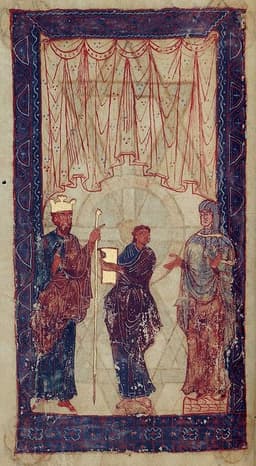
Ferdinand I of Leon
Emperor · Medieval
59.2Total
Basic Information
Born
63
1015
Died
—
1065
Era
Ancient
Medieval
Nationality
Roman Empire
Leon
Occupation
Emperor
Emperor
Civilization
Western
Western
Score Comparison
Military (10%)
72.0
70.0
Political (20%)
90.0
68.0
Influence (20%)
88.0
56.4
Legacy (20%)
90.0
49.2
Leadership (15%)
88.0
66.0
Strategy (15%)
75.0
57.5
TOTAL
85.9
59.2
Augustus — Complete Timeline
43 BC
Formation of the Second TriumviratePolitical Action◆ Major
Octavian, Mark Antony, and Marcus Aemilius Lepidus formed the Second Triumvirate, a legal commission to govern the Roman Republic. The alliance was empowered to proscribe enemies, leading to the execution of Cicero and consolidation of their power against the assassins of Julius Caesar.
Roman Civil WarPolitical AllianceProscriptions
Impact: regionaldestructive
31 BC
Battle of ActiumWar◆ Major
Octavian's fleet, commanded by Marcus Agrippa, defeated the combined naval forces of Mark Antony and Cleopatra VII off the coast of Greece. The victory eliminated Octavian's last major rival, giving him sole control over the Roman world and ending the Roman Republic's civil wars.
Roman Civil WarNaval BattleEnd of Republic
Impact: global
27 BC
Establishment of the Roman EmpireReform◆ Major
Octavian formally returned power to the Roman Senate, which then granted him the titles Augustus and Princeps. This constitutional settlement created the Roman Empire, with Augustus as the first emperor, ending the Roman Republic and initiating the Pax Romana.
Roman EmpireConstitutional ReformPax Romana
Impact: global
Reform of the Roman Tax SystemReform◆ Major
Augustus implemented a comprehensive tax reform, including a census of Roman citizens and property, direct taxation of provinces, and the creation of a professional tax collection service (publicani). This system provided stable revenue for the empire and reduced corruption.
Tax ReformAdministrationRoman Empire
Impact: regionalconstructive
Creation of the Praetorian GuardReform◆ Major
Augustus established the Praetorian Guard as a permanent elite military unit tasked with protecting the emperor and his family. Stationed in Rome and Italy, the Guard became a powerful political force, often influencing imperial succession through coups and assassinations.
Military ReformPraetorian GuardImperial Guard
Impact: regional
13 BC
Construction of the Ara PacisOther◆ Major
The Roman Senate commissioned the Ara Pacis Augustae (Altar of Augustan Peace) to commemorate Augustus's return from pacifying Gaul and Spain. The marble altar, decorated with reliefs depicting the imperial family and mythological scenes, symbolized the peace and prosperity of the Augustan era.
Building ProjectPropagandaAugustan Art
Impact: regionalconstructive
Ferdinand I of Leon — Complete Timeline
1029 AD
Inheritance of the County of CastilePolitical Action◆ Major
Ferdinand I inherited the County of Castile from his father Sancho III of Navarre. He later expanded his territory through conquest and marriage, laying the foundation for the Kingdom of Castile.
Impact: regionalconstructive
1037 AD
Conquest of LeónWar◆ Major
Ferdinand I defeated and killed King Bermudo III of Le
Impact: regional
1056 AD
First Emperor of SpainPolitical Action◆ Major
Ferdinand I was crowned 'Imperator totius Hispaniae' (Emperor of all Spain) in 1056, claiming suzerainty over all Christian and Muslim rulers in Iberia. This title reflected his military dominance and political ambition.
Impact: regional
1065 AD
Division of the kingdomPolitical Action◆ Major
Upon his death, Ferdinand I divided his kingdom among his sons: Sancho II received Castile, Alfonso VI received Le
Impact: regionaldestructive
Expert Analysis
Augustus vs Ferdinand I of Leon: Historical Comparison
Augustus, the founder of the Roman Empire, and Ferdinand I of Leon, a medieval Iberian monarch, represent vastly different eras of imperial rule. While Augustus established a system that defined Western governance for centuries, Ferdinand I's reign was more localized and transient.
Dimension Analysis
**Military: Augustus 72 / Ferdinand I of Leon 60**
Augustus professionalized the Roman army, ending civil wars and securing borders through elite legions and the Praetorian Guard. Ferdinand I expanded Leon through Reconquista campaigns against Muslim taifas, but his military achievements were smaller in scale and lacked lasting structural reforms.
**Political: Augustus 92 / Ferdinand I of Leon 72**
Augustus masterfully transformed a republic into an autocracy while preserving republican forms, creating the Principate system that lasted 300 years. Ferdinand I consolidated royal authority over Leon and Castile but failed to establish a unified succession, dividing his kingdom among sons and sparking future conflict.
**Influence: Augustus 88 / Ferdinand I of Leon 75**
Augustus’s Pax Romana shaped Mediterranean culture, law, and administration for centuries, influencing later European empires. Ferdinand I’s influence was limited to the Iberian Peninsula, where his conquests laid groundwork for the Reconquista but were overshadowed by later figures like El Cid.
**Legacy: Augustus 90 / Ferdinand I of Leon 65**
Augustus’s legacy is monumental: the imperial title, the month of August, and a model of centralized rule echoed by Charlemagne and Napoleon. Ferdinand I’s legacy is primarily dynastic and regional; his division of lands weakened Leon and is rarely studied outside medieval Spanish history.
**Leadership: Augustus 90 / Ferdinand I of Leon 78**
Augustus was a visionary reformer who stabilized a fractured state through cunning diplomacy and long-term planning. Ferdinand I was a competent warrior-king but lacked Augustus’s strategic foresight, especially in succession planning.
Verdict
Augustus decisively outranks Ferdinand I of Leon due to his unparalleled political innovation, global influence, and enduring legacy across all dimensions.
FAQ
Q: Who ranks higher? A: Augustus ranks higher with an overall score of 86 compared to Ferdinand I’s 67, excelling particularly in political acumen and lasting legacy.
Rankings
🥇
AugustusLeader
Mil: 72.0Pol: 90.0Inf: 88.0
85.9
🥈
Ferdinand I of Leon
Mil: 70.0Pol: 68.0Inf: 56.4
59.2
+26.7 behind
How This Comparison Works
Algorithm
Each figure is scored on 6 dimensions (0—100 scale) based on structured historical data: Military (10%), Political (20%), Influence (20%), Legacy (20%), Leadership (15%), Strategy (15%). The weighted total produces the final ranking.
Data Sources
Scores are computed from structured sub-indicators in the database. Scale factors adjust for era (Ancient ×0.85, Modern ×1.0) and civilization size (Eastern ×1.05, Other ×0.80) to account for differences in population and military scale.
Maximum 3 Figures
Comparisons are limited to 2—3 figures to ensure readability and statistical meaningfulness.
Error Margins
±5 points per dimension — Sub-scores are derived from historical records with inherent uncertainty. Two figures within 5 points on a dimension should be considered roughly equivalent in that area.
Total Score Accuracy
±3 points overall — The weighted combination of 6 dimensions produces a total score with approximately ±3 points of uncertainty. Differences of less than 3 points are not statistically significant— the figures are effectively tied.
Known Limitations
- Historical records are incomplete and uneven across civilizations
- Figures from oral-tradition societies may be underrepresented
- Occupation labels can misclassify multi-role figures
- Scores measure capability and impact, not moral character
- Quantitative scoring is a comparison tool, not absolute truth
Capability Radar
Military (10%) — Battles & Warfare
Battles
75
55
Win Rate
80
60
Expansion
85
60
Political (20%) — Governance & Reform
Reform
95
50
Diplomacy
90
55
Economy
85
45
Influence (20%) — Cultural & Global Reach
Cultural
85
40
Global
90
30
Legacy (20%) — Historical Impact
Historical
95
45
Longevity
95
40
Leadership (15%) — Power & Stability
Tenure
95
65
Stability
95
50
Strategy (15%) — Tactics & Innovation
Strategy
85
55
Tactics
70
50
Reform
90
40
Similar Comparisons
Comments & Discussion
DeepScribe816/16/2026
这个评分又犯了西方中心主义的毛病。屋大维的军事分72,费迪南才60?放在中国历史上,屋大维充其量是个刘邦级别——开国建制但武功有限,而费迪南一世在收复失地运动中的战功,类比成刘裕北伐或柴荣征辽毫不为过。更关键的是,费迪南分封诸子的做法,在中国历史语境下简直就是周天子的翻版——西周封建能传八百年,屋大维的元首制到三世纪危机就名存实亡了。论政治遗产的稳定性,费迪南的封建制在西班牙持续影响了整个中世纪,而屋大维的继承制从他养子提比略开始就不断出乱子。90分对65分?只能说罗马史的学者打分时,忘了自己也是从罗马法系里长出来的。
Historian5086/16/2026
这组数据有明显的问题。屋大维政治92、影响力88,而费迪南政治72、影响力75。我算了一下,如果按中国王朝的标准——开国君主既要统一又要建立有效官僚体系——秦始皇政治分至少95,汉武帝影响力分90。屋大维统一罗马后内战其实没完全消停,直到他死前日耳曼尼亚还在造反,政治稳定度根本达不到92的水平。反观费迪南一世,他在分裂的伊比利亚半岛上从莱昂整合卡斯蒂利亚,还迫使托莱多和萨拉戈萨的穆斯林埃米尔称臣纳贡,这种以少胜多的地缘政治手腕,在五代十国背景下绝对算顶级操作。建议评分体系加入“领土整合难度系数”和“统治时间加权”,不然这种跨时空排名就是个数字游戏。