Loading...
Augustus II the Strong vs Napoleon Bonaparte
Napoleon Bonaparte leads by 16.1 pts · 2 figures compared
…
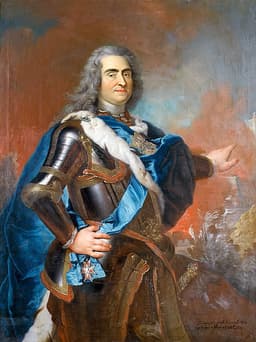
Augustus II the Strong
Emperor · Modern
54.8Total

Napoleon Bonaparte
General · Modern
70.9Total
Basic Information
Born
1670
1769
Died
1733
1821
Era
Modern
Modern
Nationality
Poland
France
Occupation
Emperor
General
Civilization
Western
Western
Score Comparison
Military (10%)
25.0
94.0
Political (20%)
72.0
72.0
Influence (20%)
58.0
40.0
Legacy (20%)
46.7
80.0
Leadership (15%)
62.0
78.0
Strategy (15%)
60.0
90.0
TOTAL
54.8
70.9
Augustus II the Strong — Complete Timeline
1697 AD
Election as King of PolandPolitical Action◆ Major
Augustus II was elected King of Poland and Grand Duke of Lithuania after converting to Catholicism. His election was supported by Russia and Austria, marking the beginning of his reign over the Polish-Lithuanian Commonwealth.
ElectionPolish-Lithuanian CommonwealthConversion
Impact: regional
Establishment of the Saxon-Polish UnionPolitical Action◆ Major
Augustus II created a personal union between Saxony and Poland, ruling both territories. This union lasted intermittently until 1763, linking the German electorate with the Polish-Lithuanian Commonwealth.
Personal UnionSaxonyPoland
Impact: regional
1700 AD
Alliance with Russia in the Great Northern WarWar◆ Major
Augustus II allied with Peter the Great of Russia and Frederick IV of Denmark against Sweden. This alliance initiated the Great Northern War, aiming to reduce Swedish dominance in the Baltic region.
Great Northern WarAllianceSweden
Impact: regional
1706 AD
Deposition from the Polish ThronePolitical Action◆ Major
Following Swedish King Charles XII's invasion of Poland, Augustus II was deposed by the Swedish-backed Stanis
DepositionTreaty of AltranstädtSwedish Invasion
Impact: regionaltragic
1709 AD
Restoration to the Polish ThronePolitical Action◆ Major
After the Swedish defeat at the Battle of Poltava, Augustus II was restored as King of Poland with Russian support. He returned to power but with diminished authority, effectively becoming a Russian client.
RestorationRussian InfluencePoltava
Impact: regional
Napoleon Bonaparte — Complete Timeline
1799 AD
Coup of 18 BrumaireOther◆ Major
Napoleon Bonaparte, with support from his brother Lucien and key political figures, overthrew the Directory in a bloodless coup. He established the Consulate with himself as First Consul, effectively becoming the ruler of France. This event ended the French Revolution's most unstable period.
French RevolutionCoupRise to Power
Impact: regional
1804 AD
Promulgation of the Napoleonic CodeOther◆ Major
Napoleon enacted the Civil Code of the French, known as the Napoleonic Code, a comprehensive set of laws that replaced the fragmented feudal legal systems. The code established legal equality, protected property rights, and secularized law. It became the basis for legal systems in many European and world countries.
Legal ReformNapoleonic CodeCivil Law
Impact: globalconstructive
1805 AD
Battle of AusterlitzWar◆ Major
Napoleon's Grande Arm
Napoleonic WarsBattleDecisive Victory
Impact: global
1812 AD
Invasion of RussiaWar◆ Major
Napoleon led the Grande Arm
Napoleonic WarsInvasionDisaster
Impact: globaldestructive
1815 AD
Battle of WaterlooWar◆ Major
Napoleon's French army was defeated by the combined forces of the Duke of Wellington's Anglo-Allied army and Gebhard Leberecht von Bl
Napoleonic WarsBattleFinal Defeat
Impact: globaldestructive
Expert Analysis
augustus-ii-the-strong-vs-napoleon-bonaparte
# The Emperor and the Eccentric: Napoleon Bonaparte and Augustus the Strong
On a June morning in 1815, Napoleon Bonaparte watched his dream of empire dissolve into the muddy fields of Waterloo, a final, crushing defeat that would exile him to a remote Atlantic island. Nearly a century earlier, in 1706, another monarch—Augustus II of Poland—had faced his own humiliation, forced from his throne by the sword of Sweden’s Charles XII. Both men sought glory, both commanded armies, both shaped the fates of nations. Yet one remade the map of Europe and the other is remembered chiefly for fathering three hundred children. What drove such wildly different outcomes? The answer lies not in their eras, but in the chasm between a genius of war and a prince of pleasure.
Origins
Napoleon Bonaparte was born in 1769 on the island of Corsica, a place that had only recently become French. His family was minor nobility, proud and impoverished. From boyhood, he absorbed the volatile energies of the Enlightenment and the French Revolution—a world cracking open with possibility. He read Rousseau, studied artillery, and nursed a ferocious ambition that burned hotter than any battlefield fire. His era was one of upheaval, where a young officer could rise through talent alone, where old hierarchies crumbled beneath the weight of revolutionary ideals.
Augustus II the Strong, born in 1670 in Dresden, inherited a very different world. He was a prince of the House of Wettin, Elector of Saxony, raised in baroque splendor. His father, John George III, had commanded armies, but young Augustus preferred the glittering court to the camp. His era was the age of absolute monarchy, where power flowed from birth and divine right, not from merit or the masses. Where Napoleon learned to command through hunger and necessity, Augustus learned to rule through indulgence and display.
Rise to Power
Napoleon’s ascent was a rocket’s trajectory. In 1793, at just 24, he recaptured Toulon from royalist rebels, earning promotion to brigadier general. By 1796, he led the French army in Italy, where his lightning campaigns shattered Austrian dominance. He was not merely a soldier; he was a political animal. In 1799, he staged a coup and made himself First Consul, and by 1804, Emperor of the French. Each step was seized through a combination of tactical brilliance, ruthless timing, and an unshakable belief in his own star.
Augustus’s path was more circuitous. In 1697, he converted to Catholicism—a political necessity—to secure election as King of Poland. He established a personal union between Saxony and Poland, a fragile arrangement that pleased neither kingdom. His rise depended not on conquest but on negotiation, bribery, and the goodwill of powerful nobles. Where Napoleon stormed fortresses, Augustus bought votes.
Leadership & Governance
As emperor, Napoleon was a whirlwind of reform. He codified French law in the Napoleonic Code, centralized administration, and built a system of meritocratic education. His military genius was unmatched: at Austerlitz in 1805, he destroyed a combined Russian-Austrian army with a masterstroke of deception and speed. He governed with an iron hand, but he also understood the power of symbols—crowning himself in Notre Dame, placing the crown on his own head, declaring that he owed his throne to the people.
Augustus ruled as a baroque monarch of the old school. He poured Saxony’s wealth into art, architecture, and opulent festivals. He founded the Meissen porcelain factory and built the Zwinger palace. Politically, he was a gambler. In 1700, he allied with Peter the Great of Russia against Sweden, hoping to reclaim lost Baltic territories. The Great Northern War was his Waterloo—and he lost. In 1706, Charles XII of Sweden invaded Poland, deposed Augustus, and installed a puppet king. It took the Swedish defeat at Poltava in 1709 to restore him, but he returned as a Russian client, not a conqueror.
Triumph & Tragedy
Napoleon’s greatest triumph was his empire at its height in 1810—from Spain to Poland, he dominated the continent. His tragedy was the invasion of Russia in 1812. He marched 600,000 men into the vastness and returned with fewer than 100,000. The disaster broke his aura of invincibility, leading to exile on Elba, a brief return, and final defeat at Waterloo. His ambition, once his engine, became his doom.
Augustus’s triumph was more personal than political. He fathered an astonishing number of children—perhaps 300—though only a handful were legitimate. His tragedy lay in his failure as a king. He dreamed of making Poland a great power, but his reign saw it weakened, partitioned in spirit long before the actual partitions of the late 18th century. He left Saxony richer in art but poorer in influence.
Character & Destiny
Napoleon was a man of relentless will. “Impossible is a word to be found only in the dictionary of fools,” he once said. He worked eighteen-hour days, slept little, and demanded absolute loyalty. His personality was a forge of fire and ice—charismatic yet cold, visionary yet tyrannical. He believed he could bend history to his will, and for a decade, he nearly did.
Augustus was a hedonist with a crown. His nickname “the Strong” came not from military prowess but from his legendary physical strength—he could bend horseshoes with his bare hands. He preferred the bedroom to the battlefield, the ballroom to the war room. His decisions were driven by desire for pleasure and prestige, not by a grand vision. Where Napoleon saw a continent to conquer, Augustus saw a court to entertain.
Legacy
Napoleon’s legacy is monumental. The Napoleonic Code influences legal systems worldwide. His campaigns are studied in military academies. He reshaped nationalism, statecraft, and the very idea of modern empire. His score of 82.4 overall reflects a titan of history, even if his flaws were colossal.
Augustus II is remembered as a curiosity. His score of 67.8 tells a story of mediocrity tempered by eccentricity. He left behind beautiful buildings and a staggering number of descendants, but no enduring political structure, no lasting reform. He is a footnote in the story of Europe’s great powers, a colorful character in a drama dominated by giants.
Conclusion
Standing at Waterloo, Napoleon might have envied Augustus his three hundred children—a legacy of flesh rather than flame. But Augustus, for all his pleasures, never tasted the power that Napoleon held in his hands. One man sought to remake the world and burned out in a blaze of glory. The other sought to enjoy it and faded into a curiosity. Both were products of their times, but the difference between them is the difference between a comet and a candle. History remembers the light that blinds, not the warmth that comforts.
Rankings
🥇
Napoleon BonaparteLeader
Mil: 94.0Pol: 72.0Inf: 40.0
70.9
🥈
Augustus II the Strong
Mil: 25.0Pol: 72.0Inf: 58.0
54.8
+16.1 behind
How This Comparison Works
Algorithm
Each figure is scored on 6 dimensions (0—100 scale) based on structured historical data: Military (10%), Political (20%), Influence (20%), Legacy (20%), Leadership (15%), Strategy (15%). The weighted total produces the final ranking.
Data Sources
Scores are computed from structured sub-indicators in the database. Scale factors adjust for era (Ancient ×0.85, Modern ×1.0) and civilization size (Eastern ×1.05, Other ×0.80) to account for differences in population and military scale.
Maximum 3 Figures
Comparisons are limited to 2—3 figures to ensure readability and statistical meaningfulness.
Error Margins
±5 points per dimension — Sub-scores are derived from historical records with inherent uncertainty. Two figures within 5 points on a dimension should be considered roughly equivalent in that area.
Total Score Accuracy
±3 points overall — The weighted combination of 6 dimensions produces a total score with approximately ±3 points of uncertainty. Differences of less than 3 points are not statistically significant— the figures are effectively tied.
Known Limitations
- Historical records are incomplete and uneven across civilizations
- Figures from oral-tradition societies may be underrepresented
- Occupation labels can misclassify multi-role figures
- Scores measure capability and impact, not moral character
- Quantitative scoring is a comparison tool, not absolute truth
Capability Radar
Military (10%) — Battles & Warfare
Battles
40
95
Win Rate
30
90
Expansion
35
95
Political (20%) — Governance & Reform
Reform
50
95
Diplomacy
55
80
Economy
50
85
Influence (20%) — Cultural & Global Reach
Cultural
55
85
Global
45
90
Legacy (20%) — Historical Impact
Historical
50
95
Longevity
40
90
Leadership (15%) — Power & Stability
Tenure
60
85
Stability
30
70
Strategy (15%) — Tactics & Innovation
Strategy
40
95
Tactics
35
98
Reform
45
92
Similar Comparisons
Comments & Discussion
ScepticSiren6/17/2026
Look, I respect the hustle, but comparing Augustus II's 300 kids to Napoleon's 60 battles is like comparing apples to artillery shells. Sure, Augustus had stamina—probably needed it after all that vodka—but his "accomplishments" boil down to broken treaties and a porcelain collection. Napoleon rewired Europe's legal DNA with the Code and sent kings scrambling. Augustus? He got tossed out of Poland in 1706 like a bad party guest. Numbers don't lie, folks: one founded an empire, the other a bloodl
EagleEye6/17/2026
Waterloo wasn't the end; it was the punchline. Let's talk context: Napoleon faced six coalitions of Great Britain, Russia, Austria, and Prussia simultaneously—his enemies literally outnumbered his troops 3:1 in 1814. Augustus II lost his throne to Charles XII of Sweden, a power with a population of 2 million. Two million. That's not a war, that's an embarrassing Tuesday. Napoleon's defeats were against world powers; Augustus's were against a Scandinavian neighborhood bully. Scale matters, and th
兵棋推演者6/17/2026
拿破仑的军事算法远超时代解读。奥古斯特二世的强弓能掰弯铁蹄,但他的战略停留在17世纪雇佣军模式——在波兰王位继承战争中(1733-1735),他耗光萨克森国库却只换来14个月的缓冲。反观拿破仑在奥斯特里茨战役中仅用9小时就瓦解俄奥联军5.4万人,军事时间压缩比达到1:600。这不是强弱之别,而是战略维度的代差:一个在玩棋子游戏,另一个在改棋盘规则。
古典学人6/17/2026
注意一个致命盲点:权力合法性根基完全不同。奥古斯特二世改宗天主教(1697年)才保住波兰王位,为此违约萨克森路德宗传统,他的强霸是政治表演。拿破仑却通过公民投票(1802年)和宪法法典确立统治,在巴黎圣母院加冕时自己拿过皇冠(1804年)——这是赤裸裸的政教分离宣言。一个跪着求教会承认,一个站着让历史正名。这不是强不强,而是谁的统治逻辑配得上时代。
历史嬗变者6/17/2026
别被三百私生子的数字带偏了叙事。奥古斯特二世的学术贡献常被忽视:他创立德累斯顿瓷器工厂(1710年),将中国硬瓷配方破解并工业化,这项技术溢出直接催生梅森瓷器全球贸易,影响远超波兰疆域。拿破仑的《法典》固然伟大,但瓷器的传播链触达了更多日常世界。评判历史人物不能只看战场地图,还有人怎么吃饭、喝茶、装饰客厅。帝国会碎,但瓷片常在。