Loading...
Askia Muhammad vs Frederick II
Askia Muhammad leads by 9.5 pts · 2 figures compared
…
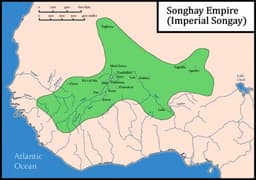
Askia Muhammad
Emperor · Medieval
71.2Total
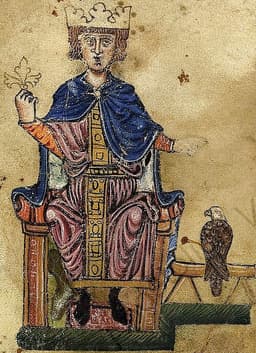
Frederick II
Emperor · Medieval
61.7Total
Basic Information
Born
1443
1194
Died
1538
1250
Era
Medieval
Medieval
Nationality
Songhai Empire
Holy Roman Empire
Occupation
Emperor
Emperor
Civilization
Other
Western
Score Comparison
Military (10%)
78.0
72.5
Political (20%)
70.3
70.3
Influence (20%)
82.0
40.0
Legacy (20%)
55.0
65.0
Leadership (15%)
78.0
72.0
Strategy (15%)
69.1
68.1
TOTAL
71.2
61.7
Askia Muhammad — Complete Timeline
1493 AD
Coup against Sonni BaruPolitical Action
Askia Muhammad overthrew Sonni Baru, the son of Sonni Ali, in a coup. Muhammad, a general under Sonni Ali, seized power after Baru refused to embrace Islam more fully, establishing the Askia dynasty.
CoupAskia DynastyIslam
Impact: regional
1496 AD
Pilgrimage to MeccaCultural◆ Major
Askia Muhammad made a pilgrimage to Mecca, traveling with a large retinue and distributing gold. He was appointed Caliph of the Sudan by the Abbasid caliph, enhancing his religious and political legitimacy.
PilgrimageMeccaCaliph
Impact: regionalconstructive
1498 AD
Administrative ReformsReform◆ Major
Askia Muhammad reorganized the Songhai Empire into provinces governed by appointed officials. He standardized weights, measures, and currency, and established a professional bureaucracy, improving tax collection and governance.
AdministrationBureaucracyTaxation
Impact: regionalconstructive
1500 AD
Promotion of Islamic ScholarshipCultural◆ Major
Askia Muhammad patronized Islamic scholars and built mosques and schools in Timbuktu, Gao, and Djenn
ScholarshipTimbuktuIslam
Impact: regionalconstructive
1512 AD
Conquest of the Hausa StatesWar◆ Major
Askia Muhammad led a military campaign against the Hausa city-states, including Kano and Katsina. He conquered them and imposed tribute, extending Songhai control over the Hausa region and securing trade routes.
ConquestHausa StatesTrade Routes
Impact: regional
Frederick II — Complete Timeline
1224 AD
Foundation of the University of NaplesCultural◆ Major
Frederick II founded the University of Naples, the first state-run university in Europe. It was established to train administrators and lawyers for the kingdom, independent of papal control. The university became a center for legal and scientific studies.
EducationUniversitySicily
Impact: regionalconstructive
1228 AD
Sixth CrusadeWar◆ Major
Frederick II led the Sixth Crusade while excommunicated. Through diplomacy with Sultan al-Kamil, he secured the return of Jerusalem, Bethlehem, and Nazareth to Christian control without major battle. He crowned himself King of Jerusalem in the Church of the Holy Sepulchre.
CrusadeDiplomacyJerusalem
Impact: globalconstructive
1231 AD
Promulgation of the Constitutions of MelfiReform◆ Major
Frederick II issued the Constitutions of Melfi, a comprehensive legal code for the Kingdom of Sicily. The code centralized royal authority, reformed administration, and established a uniform legal system. It was one of the most advanced legal codes of the medieval period.
Legal ReformSicilyAdministration
Impact: regionalconstructive
1237 AD
Battle of CortenuovaWar◆ Major
Frederick II defeated the Lombard League at Cortenuova in northern Italy. He captured the League's carroccio and sent it to Rome as a trophy. The victory strengthened imperial control over northern Italy but did not end the League's resistance.
Lombard LeagueBattleItaly
Impact: regional
Expert Analysis
Origins
Askia Muhammad, born Muhammad Touré around 1442 in the Futa Toro region of present-day Senegal, rose from a military family. He served as a general under Sonni Ali, the founder of the Songhai Empire. His early life was shaped by the expansionist policies of Sonni Ali and the cultural milieu of the Niger River valley. In contrast, Frederick II was born in 1194 in Jesi, Italy, to Holy Roman Emperor Henry VI and Constance of Sicily. Orphaned by age four, he grew up under the guardianship of Pope Innocent III, who sought to control the young king. Frederick's upbringing in the multicultural Kingdom of Sicily exposed him to Greek, Arab, and Latin learning, which profoundly influenced his worldview.
Rise to Power
Askia Muhammad seized power in 1493 through a coup against Sonni Baru, Sonni Ali's son, who had refused to embrace Islam. Muhammad's military acumen and support from Islamic scholars enabled his takeover. He consolidated control by appointing loyal governors and expanding the empire. Frederick II's rise was more complex: he was crowned King of Sicily in 1198, but his minority led to a regency. He assumed personal rule in 1208 and later claimed the German throne, facing opposition from Otto IV. In 1211, he was elected King of the Romans and crowned Holy Roman Emperor in 1220 by Pope Honorius III, after promising to go on crusade.
Leadership & Governance
Askia Muhammad reorganized Songhai into provinces with appointed governors, standardized weights and measures, and established a professional army. He promoted Islamic scholarship, building mosques and schools in Timbuktu, Gao, and Djenné, and invited scholars from North Africa. His administrative reforms scored 70.3 in political capability. Frederick II, with the same political score of 70.3, promulgated the Constitutions of Melfi in 1231, a centralized legal code for Sicily that reformed taxation and justice. He founded the University of Naples in 1224, the first state-run university, to train administrators. Both rulers centralized power, but Frederick's legal code was more systematic, while Askia's integration of Islamic institutions was culturally transformative.
Triumph & Tragedy
Askia Muhammad's triumphs include the conquest of the Hausa states (Kano, Katsina) and the expansion of Songhai to its greatest extent. His pilgrimage to Mecca (1496-1498) elevated his prestige and secured his appointment as Caliph of the Sudan. However, his later years were marred by a coup from his son Musa in 1528, leading to his exile and death in 1538. Frederick II's greatest success was the Sixth Crusade (1228-1229), where through diplomacy he regained Jerusalem, Bethlehem, and Nazareth without battle. His defeat of the Lombard League at Cortenuova in 1237 was a military high point. Yet his conflicts with the papacy led to excommunication and a propaganda war that damaged his legacy. Frederick died in 1250, his empire crumbling under papal pressure.
Character & Destiny
Askia Muhammad was a pious Muslim and capable administrator, but his coup against Sonni Baru and later usurpation by his son illustrate the volatile succession patterns of Songhai. Frederick II was known as "Stupor Mundi" for his intellectual curiosity and tolerance, but his authoritarian tendencies and conflicts with the Church isolated him. His decision to lead a crusade while excommunicated showed his pragmatic approach to power. Askia's character was more aligned with traditional Islamic governance, while Frederick's was uniquely secular and progressive for his time.
Legacy
Askia Muhammad's legacy is the golden age of Songhai, with Timbuktu becoming a center of Islamic learning. His administrative reforms influenced later West African empires. However, Songhai declined after his death. Frederick II's legal code influenced later European law, and his support for learning fostered the early Renaissance. The University of Naples persists today. In military terms, Askia scored 78.0, Frederick 72.5; overall, Askia's TOTAL score of 71.2 exceeds Frederick's 61.7.
Conclusion
Askia Muhammad had a greater impact on his region, creating a centralized empire that promoted Islamic scholarship and trade. Frederick II's influence was more diffuse, affecting European law and education but failing to sustain his imperial ambitions. Askia's higher total score (71.2 vs 61.7) and his role in integrating sub-Saharan Africa into the Islamic world give him the edge. While Frederick was a remarkable thinker, Askia's tangible empire-building and cultural patronage had more enduring effects on a vast region.
Rankings
🥇
Askia MuhammadLeader
Mil: 78.0Pol: 70.3Inf: 82.0
71.2
🥈
Frederick II
Mil: 72.5Pol: 70.3Inf: 40.0
61.7
+9.5 behind
How This Comparison Works
Algorithm
Each figure is scored on 6 dimensions (0—100 scale) based on structured historical data: Military (10%), Political (20%), Influence (20%), Legacy (20%), Leadership (15%), Strategy (15%). The weighted total produces the final ranking.
Data Sources
Scores are computed from structured sub-indicators in the database. Scale factors adjust for era (Ancient ×0.85, Modern ×1.0) and civilization size (Eastern ×1.05, Other ×0.80) to account for differences in population and military scale.
Maximum 3 Figures
Comparisons are limited to 2—3 figures to ensure readability and statistical meaningfulness.
Error Margins
±5 points per dimension — Sub-scores are derived from historical records with inherent uncertainty. Two figures within 5 points on a dimension should be considered roughly equivalent in that area.
Total Score Accuracy
±3 points overall — The weighted combination of 6 dimensions produces a total score with approximately ±3 points of uncertainty. Differences of less than 3 points are not statistically significant— the figures are effectively tied.
Known Limitations
- Historical records are incomplete and uneven across civilizations
- Figures from oral-tradition societies may be underrepresented
- Occupation labels can misclassify multi-role figures
- Scores measure capability and impact, not moral character
- Quantitative scoring is a comparison tool, not absolute truth
Capability Radar
Military (10%) — Battles & Warfare
Battles
75
65
Win Rate
80
60
Expansion
80
55
Political (20%) — Governance & Reform
Reform
90
90
Diplomacy
80
85
Economy
85
80
Influence (20%) — Cultural & Global Reach
Cultural
70
85
Global
60
70
Legacy (20%) — Historical Impact
Historical
75
80
Longevity
65
75
Leadership (15%) — Power & Stability
Tenure
85
85
Stability
80
60
Strategy (15%) — Tactics & Innovation
Strategy
75
70
Tactics
70
75
Reform
85
80
Similar Comparisons
Comments & Discussion
No comments yet. Be the first to share your thoughts!