Loading...
Frederick II vs Napoleon Bonaparte
Napoleon Bonaparte leads by 9.2 pts · 2 figures compared
…
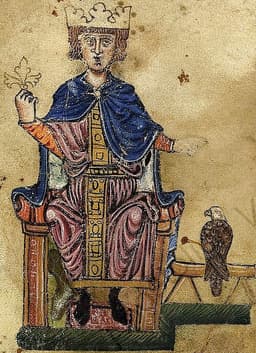
Frederick II
Emperor · Medieval
61.7Total

Napoleon Bonaparte
General · Modern
70.9Total
Basic Information
Born
1194
1769
Died
1250
1821
Era
Medieval
Modern
Nationality
Holy Roman Empire
France
Occupation
Emperor
General
Civilization
Western
Western
Score Comparison
Military (10%)
72.5
94.0
Political (20%)
70.3
72.0
Influence (20%)
40.0
40.0
Legacy (20%)
65.0
80.0
Leadership (15%)
72.0
78.0
Strategy (15%)
68.1
90.0
TOTAL
61.7
70.9
Frederick II — Complete Timeline
1224 AD
Foundation of the University of NaplesCultural◆ Major
Frederick II founded the University of Naples, the first state-run university in Europe. It was established to train administrators and lawyers for the kingdom, independent of papal control. The university became a center for legal and scientific studies.
EducationUniversitySicily
Impact: regionalconstructive
1228 AD
Sixth CrusadeWar◆ Major
Frederick II led the Sixth Crusade while excommunicated. Through diplomacy with Sultan al-Kamil, he secured the return of Jerusalem, Bethlehem, and Nazareth to Christian control without major battle. He crowned himself King of Jerusalem in the Church of the Holy Sepulchre.
CrusadeDiplomacyJerusalem
Impact: globalconstructive
1231 AD
Promulgation of the Constitutions of MelfiReform◆ Major
Frederick II issued the Constitutions of Melfi, a comprehensive legal code for the Kingdom of Sicily. The code centralized royal authority, reformed administration, and established a uniform legal system. It was one of the most advanced legal codes of the medieval period.
Legal ReformSicilyAdministration
Impact: regionalconstructive
1237 AD
Battle of CortenuovaWar◆ Major
Frederick II defeated the Lombard League at Cortenuova in northern Italy. He captured the League's carroccio and sent it to Rome as a trophy. The victory strengthened imperial control over northern Italy but did not end the League's resistance.
Lombard LeagueBattleItaly
Impact: regional
Napoleon Bonaparte — Complete Timeline
1799 AD
Coup of 18 BrumaireOther◆ Major
Napoleon Bonaparte, with support from his brother Lucien and key political figures, overthrew the Directory in a bloodless coup. He established the Consulate with himself as First Consul, effectively becoming the ruler of France. This event ended the French Revolution's most unstable period.
French RevolutionCoupRise to Power
Impact: regional
1804 AD
Promulgation of the Napoleonic CodeOther◆ Major
Napoleon enacted the Civil Code of the French, known as the Napoleonic Code, a comprehensive set of laws that replaced the fragmented feudal legal systems. The code established legal equality, protected property rights, and secularized law. It became the basis for legal systems in many European and world countries.
Legal ReformNapoleonic CodeCivil Law
Impact: globalconstructive
1805 AD
Battle of AusterlitzWar◆ Major
Napoleon's Grande Arm
Napoleonic WarsBattleDecisive Victory
Impact: global
1812 AD
Invasion of RussiaWar◆ Major
Napoleon led the Grande Arm
Napoleonic WarsInvasionDisaster
Impact: globaldestructive
1815 AD
Battle of WaterlooWar◆ Major
Napoleon's French army was defeated by the combined forces of the Duke of Wellington's Anglo-Allied army and Gebhard Leberecht von Bl
Napoleonic WarsBattleFinal Defeat
Impact: globaldestructive
Expert Analysis
frederick-ii-vs-napoleon-bonaparte
# The Emperor and the Conqueror: Two Visions of Power
On a June morning in 1815, Napoleon Bonaparte watched his Imperial Guard advance through the mud of Waterloo, only to see them shattered by British volleys. Six hundred years earlier, in the autumn of 1228, another emperor—excommunicated, despised by the Pope, and leading a crusade that no one wanted—sailed for the Holy Land with an army that would never fire a shot. One man sought glory through the cannon's mouth; the other through the diplomat's quill. Both remade Europe in their image, yet their paths diverged like the Rhine and the Tiber. Why did Napoleon fall into exile while Frederick II died in his bed, still ruling an empire? The answer lies not in their ambition, but in how they understood the nature of power itself.
Origins
Napoleon Bonaparte was born in 1769 on Corsica, an island that France had purchased from Genoa only a year earlier. His family were minor nobles in a land of bandits and vendettas. The young Napoleon spoke Italian before French, and his early letters seethed with resentment against the French occupiers. But the French Revolution shattered the old order, and a boy who had dreamed of Corsican independence found himself leading French armies. He was a creature of the Revolution—restless, meritocratic, hungry.
Frederick II, born in 1194, inherited a different kind of chaos. His father, Emperor Henry VI, died when Frederick was three. His mother, Constance of Sicily, died shortly after. The boy was raised in the streets of Palermo, surrounded by Muslim scholars, Jewish physicians, and Byzantine merchants. Sicily was a crossroads of three civilizations—Latin, Greek, and Arab—and young Frederick absorbed them all. He spoke six languages, debated philosophy with Islamic thinkers, and kept a harem. Where Napoleon was forged in the fire of revolution, Frederick was molded in the crucible of tolerance.
Rise to Power
Napoleon's ascent was meteoric. At twenty-four, he drove the British from Toulon. At twenty-six, he crushed a royalist uprising in Paris with a "whiff of grapeshot." At twenty-seven, he conquered Italy. Each victory fed the next. By 1804, at thirty-five, he crowned himself Emperor of the French, taking the crown from Pope Pius VII's hands and placing it on his own head. The message was clear: power came from him, not from God.
Frederick II's rise was slower, more precarious. He was crowned King of Sicily at fourteen, but the German princes elected another emperor. For years, he was a king without a kingdom, a pawn in papal politics. He promised Pope Innocent III that he would go on crusade—a vow he had no intention of keeping. When he finally marched on Germany in 1212, he did so not with an army, but with a handful of knights and a mountain of promises. He was crowned Holy Roman Emperor in 1220, but only after swearing to protect the Church's lands. Napoleon took power by force; Frederick took it by patience and negotiation.
Leadership & Governance
Napoleon's genius was military. His campaigns are still studied in war colleges: the lightning marches, the concentration of force, the destruction of enemy armies. At Austerlitz in 1805, he lured the Russians and Austrians into a trap and annihilated them. His political reforms were equally sweeping. The Napoleonic Code standardized French law, abolished feudal privileges, and established merit-based bureaucracy. But Napoleon governed like a general: he centralized everything, tolerated no opposition, and treated conquered territories as spoils of war.
Frederick II governed like a philosopher-king. In 1231, he promulgated the Constitutions of Melfi, a legal code for the Kingdom of Sicily that was centuries ahead of its time. It established state-run courts, protected peasants from feudal lords, and created the first state-run university in Europe at Naples in 1224. His court in Palermo was a laboratory of ideas: he translated Arabic works on astronomy, wrote a book on falconry, and debated the immortality of the soul with Jewish rabbis. Where Napoleon imposed order through fear, Frederick created order through law and learning.
Triumph & Tragedy
Napoleon's greatest moment was Austerlitz, where he destroyed a coalition of two empires. His worst was the invasion of Russia in 1812. He marched six hundred thousand men into the snow and came back with twenty thousand. The tragedy was not just military—it was psychological. Napoleon could not stop. He had to conquer, had to fight, had to prove himself again and again. Waterloo was the final proof: he gambled everything on a single battle and lost.
Frederick II's greatest triumph was the Sixth Crusade of 1228. Excommunicated, cursed by the Pope, he negotiated the return of Jerusalem, Bethlehem, and Nazareth without a single battle. He crowned himself King of Jerusalem in the Church of the Holy Sepulchre, while the Patriarch of Jerusalem placed the city under interdict. It was a masterpiece of diplomacy. But his greatest failure was his war with the Lombard League. At Cortenuova in 1237, he defeated them decisively, captured their war chariot, and sent it to Rome as a trophy. Then he overreached. He demanded total submission, and the League fought on, bleeding his empire for years. Like Napoleon, he could not turn victory into peace.
Character & Destiny
Napoleon was driven by an insatiable hunger. "I love power," he said, "as a musician loves his violin." But power was never enough. He needed glory, recognition, the adoration of crowds. His personality was a whirlwind—brilliant, ruthless, insecure. He divorced Josephine for a Habsburg princess, alienated his allies, and trusted no one. In the end, he was alone on St. Helena, dictating his memoirs to a handful of loyalists.
Frederick II was colder, more detached. He was called *Stupor Mundi*—the Wonder of the World—but also the Antichrist. He treated religion as a tool of state, allied with Muslims against Christians, and wrote a book mocking the three great faiths. His motto was *"The world is a great book, and he who does not travel reads only one page."* He was curious, tolerant, and utterly pragmatic. He died in 1250, wrapped in a Cistercian habit, having reconciled with the Church at the last moment. His empire collapsed within decades, but he died in his own bed.
Legacy
Napoleon left a continent reshaped by war. He destroyed the Holy Roman Empire, spread nationalism across Europe, and inspired revolutions in Spain, Germany, and Italy. His legal code still governs France and much of the world. But his legacy is ambiguous: a liberator who became a tyrant, a reformer who made himself emperor.
Frederick II left a different legacy. His legal reforms influenced the development of modern bureaucracy. His university at Naples became a model for state education. His court in Palermo was a beacon of multiculturalism in an age of crusades. But his empire vanished. The Hohenstaufen dynasty was exterminated, and Germany fell into chaos.
Conclusion
Two emperors, two visions. Napoleon believed power came from the barrel of a gun. Frederick believed it came from the mind. One conquered the world and lost everything; the other negotiated with his enemies and kept his throne. Perhaps the difference is that Napoleon wanted to be remembered, while Frederick wanted to understand. Napoleon built monuments; Frederick built institutions. Napoleon's empire died at Waterloo; Frederick's ideas survived in the universities and law courts of Europe. In the end, perhaps the quietest legacy is the longest.
Rankings
🥇
Napoleon BonaparteLeader
Mil: 94.0Pol: 72.0Inf: 40.0
70.9
🥈
Frederick II
Mil: 72.5Pol: 70.3Inf: 40.0
61.7
+9.2 behind
How This Comparison Works
Algorithm
Each figure is scored on 6 dimensions (0—100 scale) based on structured historical data: Military (10%), Political (20%), Influence (20%), Legacy (20%), Leadership (15%), Strategy (15%). The weighted total produces the final ranking.
Data Sources
Scores are computed from structured sub-indicators in the database. Scale factors adjust for era (Ancient ×0.85, Modern ×1.0) and civilization size (Eastern ×1.05, Other ×0.80) to account for differences in population and military scale.
Maximum 3 Figures
Comparisons are limited to 2—3 figures to ensure readability and statistical meaningfulness.
Error Margins
±5 points per dimension — Sub-scores are derived from historical records with inherent uncertainty. Two figures within 5 points on a dimension should be considered roughly equivalent in that area.
Total Score Accuracy
±3 points overall — The weighted combination of 6 dimensions produces a total score with approximately ±3 points of uncertainty. Differences of less than 3 points are not statistically significant— the figures are effectively tied.
Known Limitations
- Historical records are incomplete and uneven across civilizations
- Figures from oral-tradition societies may be underrepresented
- Occupation labels can misclassify multi-role figures
- Scores measure capability and impact, not moral character
- Quantitative scoring is a comparison tool, not absolute truth
Capability Radar
Military (10%) — Battles & Warfare
Battles
65
95
Win Rate
60
90
Expansion
55
95
Political (20%) — Governance & Reform
Reform
90
95
Diplomacy
85
80
Economy
80
85
Influence (20%) — Cultural & Global Reach
Cultural
85
85
Global
70
90
Legacy (20%) — Historical Impact
Historical
80
95
Longevity
75
90
Leadership (15%) — Power & Stability
Tenure
85
85
Stability
60
70
Strategy (15%) — Tactics & Innovation
Strategy
70
95
Tactics
75
98
Reform
80
92
Similar Comparisons
Comments & Discussion
No comments yet. Be the first to share your thoughts!