Loading...
Askia Muhammad vs Napoleon Bonaparte
Askia Muhammad leads by 0.3 pts · 2 figures compared
…
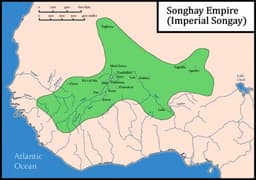
Askia Muhammad
Emperor · Medieval
71.2Total

Napoleon Bonaparte
General · Modern
70.9Total
Basic Information
Born
1443
1769
Died
1538
1821
Era
Medieval
Modern
Nationality
Songhai Empire
France
Occupation
Emperor
General
Civilization
Other
Western
Score Comparison
Military (10%)
78.0
94.0
Political (20%)
70.3
72.0
Influence (20%)
82.0
40.0
Legacy (20%)
55.0
80.0
Leadership (15%)
78.0
78.0
Strategy (15%)
69.1
90.0
TOTAL
71.2
70.9
Askia Muhammad — Complete Timeline
1493 AD
Coup against Sonni BaruPolitical Action
Askia Muhammad overthrew Sonni Baru, the son of Sonni Ali, in a coup. Muhammad, a general under Sonni Ali, seized power after Baru refused to embrace Islam more fully, establishing the Askia dynasty.
CoupAskia DynastyIslam
Impact: regional
1496 AD
Pilgrimage to MeccaCultural◆ Major
Askia Muhammad made a pilgrimage to Mecca, traveling with a large retinue and distributing gold. He was appointed Caliph of the Sudan by the Abbasid caliph, enhancing his religious and political legitimacy.
PilgrimageMeccaCaliph
Impact: regionalconstructive
1498 AD
Administrative ReformsReform◆ Major
Askia Muhammad reorganized the Songhai Empire into provinces governed by appointed officials. He standardized weights, measures, and currency, and established a professional bureaucracy, improving tax collection and governance.
AdministrationBureaucracyTaxation
Impact: regionalconstructive
1500 AD
Promotion of Islamic ScholarshipCultural◆ Major
Askia Muhammad patronized Islamic scholars and built mosques and schools in Timbuktu, Gao, and Djenn
ScholarshipTimbuktuIslam
Impact: regionalconstructive
1512 AD
Conquest of the Hausa StatesWar◆ Major
Askia Muhammad led a military campaign against the Hausa city-states, including Kano and Katsina. He conquered them and imposed tribute, extending Songhai control over the Hausa region and securing trade routes.
ConquestHausa StatesTrade Routes
Impact: regional
Napoleon Bonaparte — Complete Timeline
1799 AD
Coup of 18 BrumaireOther◆ Major
Napoleon Bonaparte, with support from his brother Lucien and key political figures, overthrew the Directory in a bloodless coup. He established the Consulate with himself as First Consul, effectively becoming the ruler of France. This event ended the French Revolution's most unstable period.
French RevolutionCoupRise to Power
Impact: regional
1804 AD
Promulgation of the Napoleonic CodeOther◆ Major
Napoleon enacted the Civil Code of the French, known as the Napoleonic Code, a comprehensive set of laws that replaced the fragmented feudal legal systems. The code established legal equality, protected property rights, and secularized law. It became the basis for legal systems in many European and world countries.
Legal ReformNapoleonic CodeCivil Law
Impact: globalconstructive
1805 AD
Battle of AusterlitzWar◆ Major
Napoleon's Grande Arm
Napoleonic WarsBattleDecisive Victory
Impact: global
1812 AD
Invasion of RussiaWar◆ Major
Napoleon led the Grande Arm
Napoleonic WarsInvasionDisaster
Impact: globaldestructive
1815 AD
Battle of WaterlooWar◆ Major
Napoleon's French army was defeated by the combined forces of the Duke of Wellington's Anglo-Allied army and Gebhard Leberecht von Bl
Napoleonic WarsBattleFinal Defeat
Impact: globaldestructive
Expert Analysis
askia-muhammad-vs-napoleon-bonaparte
# The Conqueror and the Caliph
On a June morning in 1815, a short, pale man in a grey greatcoat watched his cavalry charge across a muddy Belgian field. Four miles away, the thunder of hooves would soon be silenced by cannon fire, and Napoleon Bonaparte’s dream of empire would end in the mud of Waterloo. Three centuries earlier and four thousand miles south, another conqueror knelt in the dust of Mecca, a crowned emperor transformed into a humble pilgrim. Askia Muhammad had traveled across the Sahara with sixty thousand followers and so much gold that its value crashed Cairo’s currency for a decade. Both men built empires. Both men were undone by forces they could not control. But the worlds they ruled, and the paths they walked, could not have been more different.
Origins
Napoleon Bonaparte was born in 1769 on the island of Corsica, a year after France had purchased the island from Genoa. His family was minor nobility, but poor—his father a lawyer who bent with the political winds. The young Napoleon was short, intense, and fiercely ambitious. He attended French military schools, where his Corsican accent marked him as an outsider, and he devoured histories of Alexander and Caesar. The French Revolution, which began when he was twenty, tore down the old order and opened a door for men of talent, regardless of birth. Napoleon walked through it.
Askia Muhammad was born in 1443, probably in the Soninke region of what is now Senegal. His father was a general, and Muhammad grew up in the service of Sonni Ali, the warrior-king who had forged the Songhai Empire from the ashes of the Mali Empire. Unlike Napoleon, Muhammad was not a child of revolution but of consolidation. The world he knew was one of trans-Saharan trade routes, Islamic scholarship, and riverine warfare on the Niger. He learned to lead men in battle, but he also learned the art of administration from a master who ruled through terror and charisma.
Rise to Power
Napoleon’s rise was meteoric and bloody. In 1793, at age twenty-four, he drove British forces from the port of Toulon. By 1796, he was commanding the French army in Italy, where he won a string of victories against the Austrians that stunned Europe. He was not merely a general; he was a political phenomenon. In 1799, he staged a coup d’état and made himself First Consul of France. By 1804, he crowned himself Emperor in Notre Dame Cathedral, taking the crown from the Pope’s hands and placing it on his own head. His path was one of relentless upward motion, powered by gunpowder, ambition, and the chaos of revolution.
Askia Muhammad’s rise was quieter but no less decisive. In 1493, after the death of Sonni Ali, his son Sonni Baru took power. Baru was a traditionalist, resistant to Islam. Muhammad, a general under Ali and a devout Muslim, saw his chance. He gathered his forces and overthrew Baru in a coup that was as much ideological as political. Where Napoleon seized power in the name of the French nation, Askia Muhammad seized it in the name of God. He immediately consolidated his rule by making a pilgrimage to Mecca in 1496, a journey that took two years and established him as the spiritual leader of West African Islam. The Sultan of Egypt appointed him Caliph for the Sudan, a title that gave his rule religious legitimacy.
Leadership & Governance
Napoleon ruled through force and law. His Napoleonic Code, enacted in 1804, standardized French law across his empire, abolishing feudal privileges and establishing equality before the law. It was a revolutionary document that influenced legal systems from Europe to Latin America. But Napoleon also ruled through propaganda and censorship. He controlled the press, suppressed dissent, and created a new aristocracy of generals and officials loyal to him alone. His military genius was unmatched: he won sixty battles, from Austerlitz in 1805 to Wagram in 1809, by using speed, deception, and overwhelming force at the decisive point.
Askia Muhammad ruled through administration and faith. He reorganized the Songhai Empire into provinces governed by appointed officials, standardizing weights and measures to facilitate trade. He built mosques and schools in Timbuktu, Gao, and Djenné, turning Timbuktu into a center of Islamic learning that drew scholars from across the Muslim world. His military campaigns, such as the conquest of the Hausa states in 1512, were less about territorial expansion and more about securing trade routes and tribute. Where Napoleon was a gambler who staked everything on battle, Askia Muhammad was a builder who invested in institutions.
Triumph & Tragedy
Napoleon’s greatest triumph was the Empire at its height in 1810-1812, when he controlled most of continental Europe. His greatest tragedy was the invasion of Russia in 1812. He marched with 600,000 men; fewer than 100,000 returned. The Russian winter, the vast distances, and the scorched-earth tactics of the enemy broke his army and his legend. Exiled to Elba in 1814, he escaped a year later, only to meet final defeat at Waterloo in 1815. He died in 1821 on the remote island of Saint Helena, a prisoner of the British.
Askia Muhammad’s triumph was the golden age of Songhai, a period of peace, prosperity, and learning that lasted for decades. His tragedy came in old age. In 1528, at eighty-five, he was deposed by his own son, Musa, and forced into exile. He died ten years later, in 1538, blind and broken. The empire he built survived for another half-century, but in 1591, Moroccan forces armed with firearms defeated the Songhai army at the Battle of Tondibi. The empire collapsed, and Timbuktu’s libraries were scattered.
Character & Destiny
Napoleon’s character was a paradox: a man of genius who could not stop. His ambition was boundless, his energy inexhaustible, but he lacked the wisdom to know when to stop fighting. “I love power as a musician loves his violin,” he once said. But power consumed him. He trusted no one, centralized everything, and could not delegate. His downfall was not the result of a single mistake but of a pattern: he could not make peace.
Askia Muhammad’s character was shaped by faith and pragmatism. He was ruthless when necessary—he overthrew his own king—but his rule was marked by a desire to build, not just to conquer. He understood that an empire based on force alone would not last. His downfall came not from external enemies but from the internal dynamics of succession. In old age, he was betrayed by his own blood.
Legacy
Napoleon’s legacy is global. He reshaped Europe’s borders, spread the ideals of the French Revolution, and created a model of modern warfare that lasted for a century. His name is synonymous with ambition, genius, and hubris. He is studied in every military academy, remembered in every history book.
Askia Muhammad’s legacy is more localized but no less profound. In West Africa, he is remembered as the greatest ruler of the Songhai Empire, a man who brought Islam, law, and learning to the Sahel. The mosques he built still stand. The schools he founded still echo with the recitation of the Quran. But his story is less known outside Africa, a reminder that history’s lens is often focused on the West.
Conclusion
Napoleon and Askia Muhammad lived in different centuries, on different continents, under different skies. One was a child of revolution, the other of tradition. One built an empire that lasted a decade, the other an empire that lasted a century. One died in exile, the other in obscurity. Yet both faced the same fundamental truth: that power is fleeting, that empires rise and fall, and that the greatest legacy is not the territory one conquers but the institutions one leaves behind. Napoleon changed the law. Askia Muhammad changed the faith. In the end, both built something that outlasted them.
Rankings
🥇
Askia MuhammadLeader
Mil: 78.0Pol: 70.3Inf: 82.0
71.2
🥈
Napoleon Bonaparte
Mil: 94.0Pol: 72.0Inf: 40.0
70.9
+0.3 behind
How This Comparison Works
Algorithm
Each figure is scored on 6 dimensions (0—100 scale) based on structured historical data: Military (10%), Political (20%), Influence (20%), Legacy (20%), Leadership (15%), Strategy (15%). The weighted total produces the final ranking.
Data Sources
Scores are computed from structured sub-indicators in the database. Scale factors adjust for era (Ancient ×0.85, Modern ×1.0) and civilization size (Eastern ×1.05, Other ×0.80) to account for differences in population and military scale.
Maximum 3 Figures
Comparisons are limited to 2—3 figures to ensure readability and statistical meaningfulness.
Error Margins
±5 points per dimension — Sub-scores are derived from historical records with inherent uncertainty. Two figures within 5 points on a dimension should be considered roughly equivalent in that area.
Total Score Accuracy
±3 points overall — The weighted combination of 6 dimensions produces a total score with approximately ±3 points of uncertainty. Differences of less than 3 points are not statistically significant— the figures are effectively tied.
Known Limitations
- Historical records are incomplete and uneven across civilizations
- Figures from oral-tradition societies may be underrepresented
- Occupation labels can misclassify multi-role figures
- Scores measure capability and impact, not moral character
- Quantitative scoring is a comparison tool, not absolute truth
Capability Radar
Military (10%) — Battles & Warfare
Battles
75
95
Win Rate
80
90
Expansion
80
95
Political (20%) — Governance & Reform
Reform
90
95
Diplomacy
80
80
Economy
85
85
Influence (20%) — Cultural & Global Reach
Cultural
70
85
Global
60
90
Legacy (20%) — Historical Impact
Historical
75
95
Longevity
65
90
Leadership (15%) — Power & Stability
Tenure
85
85
Stability
80
70
Strategy (15%) — Tactics & Innovation
Strategy
75
95
Tactics
70
98
Reform
85
92
Similar Comparisons
Comments & Discussion
No comments yet. Be the first to share your thoughts!