Loading...
Frederick II vs Julius Caesar
Julius Caesar leads by 21.1 pts · 2 figures compared
…
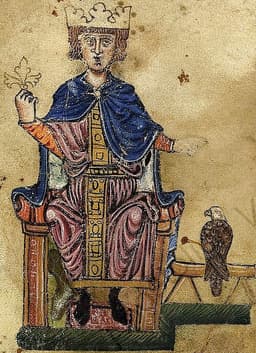
Frederick II
Emperor · Medieval
61.7Total

Julius Caesar
General · Ancient
82.8Total
Basic Information
Born
1194
-100
Died
1250
-44
Era
Medieval
Ancient
Nationality
Holy Roman Empire
Roman Republic
Occupation
Emperor
General
Civilization
Western
Western
Score Comparison
Military (10%)
72.5
88.0
Political (20%)
70.3
78.0
Influence (20%)
40.0
85.0
Legacy (20%)
65.0
82.0
Leadership (15%)
72.0
80.0
Strategy (15%)
68.1
85.0
TOTAL
61.7
82.8
Frederick II — Complete Timeline
1224 AD
Foundation of the University of NaplesCultural◆ Major
Frederick II founded the University of Naples, the first state-run university in Europe. It was established to train administrators and lawyers for the kingdom, independent of papal control. The university became a center for legal and scientific studies.
EducationUniversitySicily
Impact: regionalconstructive
1228 AD
Sixth CrusadeWar◆ Major
Frederick II led the Sixth Crusade while excommunicated. Through diplomacy with Sultan al-Kamil, he secured the return of Jerusalem, Bethlehem, and Nazareth to Christian control without major battle. He crowned himself King of Jerusalem in the Church of the Holy Sepulchre.
CrusadeDiplomacyJerusalem
Impact: globalconstructive
1231 AD
Promulgation of the Constitutions of MelfiReform◆ Major
Frederick II issued the Constitutions of Melfi, a comprehensive legal code for the Kingdom of Sicily. The code centralized royal authority, reformed administration, and established a uniform legal system. It was one of the most advanced legal codes of the medieval period.
Legal ReformSicilyAdministration
Impact: regionalconstructive
1237 AD
Battle of CortenuovaWar◆ Major
Frederick II defeated the Lombard League at Cortenuova in northern Italy. He captured the League's carroccio and sent it to Rome as a trophy. The victory strengthened imperial control over northern Italy but did not end the League's resistance.
Lombard LeagueBattleItaly
Impact: regional
Julius Caesar — Complete Timeline
58 BC
Gallic WarsWar◆ Major
Caesar, as proconsul of Gaul, launched a series of campaigns that conquered all of Gaul (modern France, Belgium, and parts of Switzerland). He fought numerous battles, including against the Helvetii, the Belgae, and the Gallic chieftain Vercingetorix. The wars brought immense wealth and a loyal army to Caesar.
Gallic WarsConquestRoman Expansion
Impact: regional
49 BC
Crossing the RubiconPolitical Action◆ Major
Caesar led Legio XIII across the Rubicon River into Italy, defying the Roman Senate's order to disband his army. This act triggered a civil war against Pompey and the Optimates, ultimately leading to Caesar's dictatorship and the end of the Roman Republic.
Roman Civil WarEnd of RepublicPower Struggle
Impact: global
48 BC
Battle of PharsalusWar◆ Major
Caesar's outnumbered army defeated the larger forces of Pompey the Great at Pharsalus in Greece. Caesar's tactical use of a reserve line to counter Pompey's cavalry charge proved decisive. Pompey fled to Egypt, where he was assassinated, leaving Caesar as the undisputed master of the Roman world.
Roman Civil WarBattleDecisive Victory
Impact: regional
44 BC
Appointment as Dictator for LifePolitical Action◆ Major
The Roman Senate appointed Caesar dictator perpetuo (dictator for life), granting him unprecedented personal power. This move concentrated military, legislative, and judicial authority in one person, effectively ending the Roman Republic's traditional system of checks and balances and alarming many senators.
DictatorshipEnd of RepublicPower Consolidation
Impact: regionaldestructive
Assassination on the Ides of MarchPolitical Action◆ Major
A group of Roman senators, led by Marcus Junius Brutus and Gaius Cassius Longinus, stabbed Caesar to death at a meeting of the Senate in the Theatre of Pompey. The assassination was intended to restore the Republic, but instead triggered another civil war that led to the rise of the Roman Empire.
AssassinationRoman PoliticsEnd of Republic
Impact: globaldestructive
Expert Analysis
frederick-ii-vs-julius-caesar
# The Ambitious Emperor and the Pragmatic King: Caesar and Frederick II Compared
On a January morning in 49 BCE, Julius Caesar stood at the banks of the Rubicon River, a small stream that marked the boundary between his province of Gaul and Italy proper. To cross with his army would be treason, a declaration of civil war against the Roman Senate. He hesitated, then uttered the famous words, "The die is cast," and led his legions across. Twelve centuries later, in 1228, another ruler—Frederick II, Holy Roman Emperor—set sail for the Holy Land on a crusade, but under a cloud of excommunication. He had been banned by the Pope himself. Yet where Caesar gambled everything on military conquest, Frederick gambled on diplomacy. Both men defied the established order of their worlds, but their paths diverged sharply—one toward violent glory, the other toward cautious reform. What drove these two titans to such different outcomes?
Origins
Caesar was born into a patrician family in Rome, but his lineage, though ancient, was not wealthy. The Roman Republic of the first century BCE was a brutal arena of aristocratic competition, where success meant military command, political office, and the adulation of the masses. From his youth, Caesar absorbed the lessons of ambition: he was kidnapped by pirates as a young man, raised his own ransom, then returned to crucify them. His world demanded ruthlessness.
Frederick II, born in 1194 in the Kingdom of Sicily, inherited a far different legacy. His father was the Holy Roman Emperor Henry VI, his mother Constance, the heiress of the Norman kingdom of Sicily. Orphaned as a child, Frederick grew up in Palermo—a city where Muslim, Byzantine, Jewish, and Latin cultures mingled. He learned Arabic, Greek, and Latin, and studied falconry, mathematics, and philosophy. His era was defined not by senatorial intrigue but by the clash between papal authority and imperial ambition. The Church cast a long shadow over every ruler's throne.
Rise to Power
Caesar's ascent was a masterclass in calculated risk. He aligned himself with the populist faction, borrowed enormous sums to fund lavish games, and secured the governorship of Gaul in 58 BCE. Over the next eight years, he conquered a vast territory (modern France and Belgium), fought over 800 battles, and built a loyal army that worshipped him. His military score of 88.0 reflects this unparalleled campaign—he was a general who led from the front, who understood logistics, and who turned defeats into victories.
Frederick's rise was more legalistic. Crowned King of Germany in 1212 and Holy Roman Emperor in 1220, he spent his early years consolidating control over Sicily, his true power base. He avoided open war with the papacy, instead using marriage alliances and treaties. His key turning point came in 1224, when he founded the University of Naples—the first state-run university in Europe. This was not a battlefield triumph but an institutional one, designed to train administrators loyal to the crown rather than the Church. His military score of 57.7 is modest, but his political and leadership scores of 74.5 and 88.0 reveal a ruler who understood that power could be built with laws and learning as much as with swords.
Leadership & Governance
Caesar governed through personal magnetism and military force. As dictator, he reformed the calendar (the Julian calendar), granted citizenship to provincials, and initiated public works. But his style was autocratic. He centralized power in his own hands, packed the Senate with his supporters, and accepted the title "dictator for life." His political score of 78.0 reflects the fragility of this system—it depended entirely on his survival.
Frederick II, by contrast, governed through codified law. In 1231, he issued the Constitutions of Melfi, a comprehensive legal code for the Kingdom of Sicily. This document centralized royal authority, curbed feudal privileges, and established a professional bureaucracy. It was the most advanced legal system in medieval Europe. Frederick's leadership score of 88.0 matches Caesar's, but it was exercised differently: he ruled from a desk, not a battlefield. He also wrote a book on falconry, *De Arte Venandi cum Avibus*, a scientific treatise that showed his intellectual curiosity—a trait alien to Caesar's pragmatic militarism.
Triumph & Tragedy
Caesar's greatest triumph was his conquest of Gaul, which he immortalized in his *Commentaries*. His most devastating failure was his assassination on the Ides of March in 44 BCE, stabbed by senators he had pardoned. He died at 56, his life's work—the transformation of the Republic into a monarchy—left incomplete. His tragedy was that his ambition destroyed the very system that had produced him.
Frederick's greatest triumph was the Sixth Crusade of 1228. Excommunicated and leading a small army, he negotiated with Sultan al-Kamil of Egypt, securing Jerusalem, Bethlehem, and Nazareth for Christian control without a single major battle. It was a stunning diplomatic victory. But his tragedy came in 1237 at the Battle of Cortenuova, where he defeated the Lombard League—only to squander the victory by refusing to press his advantage. His empire never fully controlled northern Italy, and his final years were consumed by endless war with the papacy. He died in 1250 at age 56, his grand vision of a unified Italy unrealized.
Character & Destiny
Caesar was driven by an insatiable need for glory. He once said, "I came, I saw, I conquered"—the boast of a man who measured life in victories. His personality was magnetic, but also ruthless and impulsive. He pardoned his enemies because he believed he could control them, a fatal miscalculation.
Frederick was more calculating, more skeptical. He was called *Stupor Mundi*—"Wonder of the World"—for his intellectual breadth, but also "the baptized Sultan" for his tolerance of Muslims. He was a rationalist in an age of faith, which isolated him. His personality bred suspicion, not loyalty; his court was brilliant, but his alliances were fragile. Where Caesar died by the sword, Frederick died in his bed, but his dynasty crumbled within decades.
Legacy
Caesar's legacy is monumental. His name became synonymous with imperial rule: the German *Kaiser* and Russian *Tsar* derive from it. His reforms paved the way for the Roman Empire, and his writings shaped Western military thought. His legacy score of 82.0 reflects this—he is remembered as the man who ended the Republic and began an era.
Frederick's legacy is more subtle. His University of Naples became a model for state-sponsored education. His Constitutions of Melfi influenced later European legal codes. His crusade by treaty remains a rare example of peaceful coexistence. Yet he is less known today, a figure studied by specialists rather than celebrated in popular culture. His influence score of 76.8 and legacy score of 80.0 are high, but they belong to a different kind of greatness—not the conqueror's path, but the reformer's.
Conclusion
Caesar and Frederick II both sought to reshape their worlds, but they did so with opposite tools. Caesar trusted the sword, the speech, the gamble—and died a martyr to his own ambition. Frederick trusted the law, the university, the negotiation—and died a lonely emperor whose empire dissolved. Their stories remind us that there is no single formula for historical greatness. The Rubicon and the University of Naples are both monuments to human will, but they point in different directions. One leads to glory, the other to order. Which is more lasting? Perhaps neither, for in the end, both men were mortal, and their empires turned to dust. What remains is the question they posed: how far will ambition carry a man, and what price will he pay?
Rankings
🥇
Julius CaesarLeader
Mil: 88.0Pol: 78.0Inf: 85.0
82.8
🥈
Frederick II
Mil: 72.5Pol: 70.3Inf: 40.0
61.7
+21.1 behind
How This Comparison Works
Algorithm
Each figure is scored on 6 dimensions (0—100 scale) based on structured historical data: Military (10%), Political (20%), Influence (20%), Legacy (20%), Leadership (15%), Strategy (15%). The weighted total produces the final ranking.
Data Sources
Scores are computed from structured sub-indicators in the database. Scale factors adjust for era (Ancient ×0.85, Modern ×1.0) and civilization size (Eastern ×1.05, Other ×0.80) to account for differences in population and military scale.
Maximum 3 Figures
Comparisons are limited to 2—3 figures to ensure readability and statistical meaningfulness.
Error Margins
±5 points per dimension — Sub-scores are derived from historical records with inherent uncertainty. Two figures within 5 points on a dimension should be considered roughly equivalent in that area.
Total Score Accuracy
±3 points overall — The weighted combination of 6 dimensions produces a total score with approximately ±3 points of uncertainty. Differences of less than 3 points are not statistically significant— the figures are effectively tied.
Known Limitations
- Historical records are incomplete and uneven across civilizations
- Figures from oral-tradition societies may be underrepresented
- Occupation labels can misclassify multi-role figures
- Scores measure capability and impact, not moral character
- Quantitative scoring is a comparison tool, not absolute truth
Capability Radar
Military (10%) — Battles & Warfare
Battles
65
95
Win Rate
60
92
Expansion
55
97
Political (20%) — Governance & Reform
Reform
90
90
Diplomacy
85
85
Economy
80
82
Influence (20%) — Cultural & Global Reach
Cultural
85
88
Global
70
94
Legacy (20%) — Historical Impact
Historical
80
95
Longevity
75
96
Leadership (15%) — Power & Stability
Tenure
85
75
Stability
60
60
Strategy (15%) — Tactics & Innovation
Strategy
70
94
Tactics
75
96
Reform
80
88
Similar Comparisons
Comments & Discussion
No comments yet. Be the first to share your thoughts!