Loading...
Askia Muhammad vs Julius Caesar
Julius Caesar leads by 11.6 pts · 2 figures compared
…
Askia Muhammad
Emperor · Medieval
71.2Total

Julius Caesar
General · Ancient
82.8Total
Basic Information
Born
1443
-100
Died
1538
-44
Era
Medieval
Ancient
Nationality
Songhai Empire
Roman Republic
Occupation
Emperor
General
Civilization
Other
Western
Score Comparison
Military (10%)
78.0
88.0
Political (20%)
70.3
78.0
Influence (20%)
82.0
85.0
Legacy (20%)
55.0
82.0
Leadership (15%)
78.0
80.0
Strategy (15%)
69.1
85.0
TOTAL
71.2
82.8
Askia Muhammad — Complete Timeline
1493 AD
Coup against Sonni BaruPolitical Action
Askia Muhammad overthrew Sonni Baru, the son of Sonni Ali, in a coup. Muhammad, a general under Sonni Ali, seized power after Baru refused to embrace Islam more fully, establishing the Askia dynasty.
CoupAskia DynastyIslam
Impact: regional
1496 AD
Pilgrimage to MeccaCultural◆ Major
Askia Muhammad made a pilgrimage to Mecca, traveling with a large retinue and distributing gold. He was appointed Caliph of the Sudan by the Abbasid caliph, enhancing his religious and political legitimacy.
PilgrimageMeccaCaliph
Impact: regionalconstructive
1498 AD
Administrative ReformsReform◆ Major
Askia Muhammad reorganized the Songhai Empire into provinces governed by appointed officials. He standardized weights, measures, and currency, and established a professional bureaucracy, improving tax collection and governance.
AdministrationBureaucracyTaxation
Impact: regionalconstructive
1500 AD
Promotion of Islamic ScholarshipCultural◆ Major
Askia Muhammad patronized Islamic scholars and built mosques and schools in Timbuktu, Gao, and Djenn
ScholarshipTimbuktuIslam
Impact: regionalconstructive
1512 AD
Conquest of the Hausa StatesWar◆ Major
Askia Muhammad led a military campaign against the Hausa city-states, including Kano and Katsina. He conquered them and imposed tribute, extending Songhai control over the Hausa region and securing trade routes.
ConquestHausa StatesTrade Routes
Impact: regional
Julius Caesar — Complete Timeline
58 BC
Gallic WarsWar◆ Major
Caesar, as proconsul of Gaul, launched a series of campaigns that conquered all of Gaul (modern France, Belgium, and parts of Switzerland). He fought numerous battles, including against the Helvetii, the Belgae, and the Gallic chieftain Vercingetorix. The wars brought immense wealth and a loyal army to Caesar.
Gallic WarsConquestRoman Expansion
Impact: regional
49 BC
Crossing the RubiconPolitical Action◆ Major
Caesar led Legio XIII across the Rubicon River into Italy, defying the Roman Senate's order to disband his army. This act triggered a civil war against Pompey and the Optimates, ultimately leading to Caesar's dictatorship and the end of the Roman Republic.
Roman Civil WarEnd of RepublicPower Struggle
Impact: global
48 BC
Battle of PharsalusWar◆ Major
Caesar's outnumbered army defeated the larger forces of Pompey the Great at Pharsalus in Greece. Caesar's tactical use of a reserve line to counter Pompey's cavalry charge proved decisive. Pompey fled to Egypt, where he was assassinated, leaving Caesar as the undisputed master of the Roman world.
Roman Civil WarBattleDecisive Victory
Impact: regional
44 BC
Appointment as Dictator for LifePolitical Action◆ Major
The Roman Senate appointed Caesar dictator perpetuo (dictator for life), granting him unprecedented personal power. This move concentrated military, legislative, and judicial authority in one person, effectively ending the Roman Republic's traditional system of checks and balances and alarming many senators.
DictatorshipEnd of RepublicPower Consolidation
Impact: regionaldestructive
Assassination on the Ides of MarchPolitical Action◆ Major
A group of Roman senators, led by Marcus Junius Brutus and Gaius Cassius Longinus, stabbed Caesar to death at a meeting of the Senate in the Theatre of Pompey. The assassination was intended to restore the Republic, but instead triggered another civil war that led to the rise of the Roman Empire.
AssassinationRoman PoliticsEnd of Republic
Impact: globaldestructive
Expert Analysis
askia-muhammad-vs-julius-caesar
# The Crossing and the Pilgrimage
On a January day in 49 BCE, a Roman general stood at the banks of a small river in northern Italy. The Rubicon was little more than a stream, but it marked the boundary between the provinces and Rome itself. To cross it with an army was treason. Julius Caesar hesitated, then uttered a phrase that would echo through millennia: *“Alea iacta est”*—the die is cast.
Nearly fifteen hundred years later and three thousand miles to the south, another general made his own fateful crossing. Askia Muhammad, a former commander under the great Sonni Ali, marched on the Songhai capital of Gao in 1493. He did not cross a river but a line of loyalty, overthrowing Sonni Ali’s son in a coup that would remake West Africa. Both men seized power by breaking sacred bonds. But why did Caesar’s crossing lead to assassination and civil war, while Askia Muhammad’s led to three decades of stable rule?
Origins
Caesar was born into the chaos of the late Roman Republic, a world of senatorial intrigue, slave revolts, and civil wars. His family, the Julii, claimed descent from the goddess Venus, but their political fortunes had faded. Young Caesar learned early that in Rome, survival meant mastering the art of debt, bribery, and alliances. He was captured by pirates at twenty-five, laughed at their ransom demand, and later crucified them—a preview of the ruthless calculation that would define him.
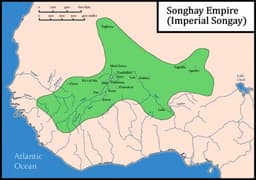
Askia Muhammad emerged from a different world entirely—the Sahel, where the Niger River carved a green corridor through the Sahara. The Songhai Empire had risen from the ashes of the Mali Empire, and its people were traders, scholars, and warriors. Muhammad was born a Soninke, not of royal blood, but he rose through military merit under Sonni Ali, the empire’s founder. Where Caesar inherited a name, Muhammad inherited a sword.
Rise to Power
Caesar’s path was a masterpiece of patience and audacity. He climbed the Roman political ladder—quaestor, aedile, praetor—each step lubricated by borrowed money and strategic marriages. His true breakthrough came in 58 BCE, when he secured command of Gaul. For eight years, he fought, negotiated, and massacred his way across modern France and Belgium, writing his own propaganda in elegant Latin. The Gallic Wars made him rich, famous, and the master of a loyal army.
Askia Muhammad’s rise was swifter and bloodier. After Sonni Ali’s death in 1492, his son Baru inherited a fractious empire. Baru was a nominal Muslim who clung to traditional animist practices, alienating the urban scholars and merchants who were the empire’s backbone. Muhammad, a devout Muslim and seasoned general, saw his moment. In 1493, he marched on Gao, defeated Baru’s forces, and declared himself Askia—a title meaning “usurper” that he transformed into “emperor.” He did not need to conquer Gaul; he needed to conquer a palace.
Leadership & Governance
Caesar governed like a storm. As dictator, he reformed the calendar, granted citizenship to provincials, and launched massive public works. But his rule was always personal, not institutional. He centralized power in his own hands, stacked the Senate with his supporters, and accepted the title “dictator for life.” The Roman Republic was a system of checks and balances; Caesar was the check that broke.
Askia Muhammad built an empire of laws. After his 1496 pilgrimage to Mecca—a journey of thousands of miles with a retinue of hundreds, distributing gold so lavishly that it crashed local economies—he returned with the title of Caliph. He then reorganized Songhai into provinces governed by appointed officials, standardized weights and measures, and created a professional bureaucracy. In Timbuktu, he built mosques and schools that attracted scholars from Cairo to Fez. Where Caesar was a conqueror who happened to govern, Muhammad was an administrator who happened to conquer.
Their military styles reflected this contrast. Caesar led from the front at Alesia and Pharsalus, winning through tactical brilliance and personal courage. Askia Muhammad’s campaigns against the Hausa states in 1512 were methodical conquests, consolidating trade routes rather than seeking glory. His strategy score of 55.4, compared to Caesar’s 88.0, suggests not incompetence but a different priority: stability over spectacle.
Triumph & Tragedy
Caesar’s greatest triumph was Gaul—the conquest of a million people and the destruction of a million more. His greatest tragedy was the Ides of March, 44 BCE, when sixty senators stabbed him to death in the Pompeian theater. He fell at the feet of a statue of his former rival, Pompey, blood pooling on the marble. The assassins thought they were saving the Republic; they only hastened the Empire.
Askia Muhammad’s triumph was his reign itself—thirty-five years of peace, prosperity, and intellectual flowering. His tragedy came in old age. In 1528, blind and frail, he was deposed by his own son, Musa. He lived another decade as a prisoner in his own palace, dying in 1538 at ninety-five. The empire he built would be destroyed by Moroccan muskets at the Battle of Tondibi in 1591, but that was the tragedy of his successors, not his own.
Character & Destiny
Caesar was driven by an insatiable hunger for glory. He once said, “It is better to be the first in a village than the second in Rome.” His arrogance blinded him to the hatred he inspired. He dismissed the soothsayer’s warning about the Ides of March, disbanded his bodyguard, and walked into the Senate unarmed. His personality demanded that he rule alone; his destiny demanded that he die alone.
Askia Muhammad was driven by piety and pragmatism. He did not seek glory but order. His pilgrimage to Mecca was not just a religious duty but a political statement—a claim to legitimacy that transcended tribal loyalties. He ruled from a throne, not a battlefield, and died in obscurity, not infamy. His personality sought stability; his destiny gave it to him, at the cost of drama.
Legacy
Caesar’s legacy is the Roman Empire. His adopted heir, Octavian, became Augustus, and the Republic died forever. His name became a title: Kaiser, Tsar, Caesar. He is remembered as the man who crossed the Rubicon, who loved Cleopatra, who was betrayed by Brutus. His story is a tragedy in the classical sense—a great man undone by his own greatness.
Askia Muhammad’s legacy is the Songhai Empire at its height. He made Timbuktu a center of learning where the University of Sankore rivaled any in the Islamic world. He is remembered as a builder of institutions, not empires. In West African oral tradition, he is “Askia the Great,” a ruler who brought the word of God and the rule of law. His story is a success in the Islamic sense—a righteous man who ruled justly and died in faith.
Conclusion
Two men, two rivers, two destinies. Caesar crossed the Rubicon and changed the world forever in a single act of defiance. Askia Muhammad crossed a threshold of loyalty and changed his world slowly, through years of patient reform. One sought to conquer the known world; the other sought to order his own. Both succeeded. Both failed. And both remind us that history is not a ladder of progress but a gallery of choices—each one a die cast, each one a prayer answered.
Rankings
🥇
Julius CaesarLeader
Mil: 88.0Pol: 78.0Inf: 85.0
82.8
🥈
Askia Muhammad
Mil: 78.0Pol: 70.3Inf: 82.0
71.2
+11.6 behind
How This Comparison Works
Algorithm
Each figure is scored on 6 dimensions (0—100 scale) based on structured historical data: Military (10%), Political (20%), Influence (20%), Legacy (20%), Leadership (15%), Strategy (15%). The weighted total produces the final ranking.
Data Sources
Scores are computed from structured sub-indicators in the database. Scale factors adjust for era (Ancient ×0.85, Modern ×1.0) and civilization size (Eastern ×1.05, Other ×0.80) to account for differences in population and military scale.
Maximum 3 Figures
Comparisons are limited to 2—3 figures to ensure readability and statistical meaningfulness.
Error Margins
±5 points per dimension — Sub-scores are derived from historical records with inherent uncertainty. Two figures within 5 points on a dimension should be considered roughly equivalent in that area.
Total Score Accuracy
±3 points overall — The weighted combination of 6 dimensions produces a total score with approximately ±3 points of uncertainty. Differences of less than 3 points are not statistically significant— the figures are effectively tied.
Known Limitations
- Historical records are incomplete and uneven across civilizations
- Figures from oral-tradition societies may be underrepresented
- Occupation labels can misclassify multi-role figures
- Scores measure capability and impact, not moral character
- Quantitative scoring is a comparison tool, not absolute truth
Capability Radar
Military (10%) — Battles & Warfare
Battles
75
95
Win Rate
80
92
Expansion
80
97
Political (20%) — Governance & Reform
Reform
90
90
Diplomacy
80
85
Economy
85
82
Influence (20%) — Cultural & Global Reach
Cultural
70
88
Global
60
94
Legacy (20%) — Historical Impact
Historical
75
95
Longevity
65
96
Leadership (15%) — Power & Stability
Tenure
85
75
Stability
80
60
Strategy (15%) — Tactics & Innovation
Strategy
75
94
Tactics
70
96
Reform
85
88
Similar Comparisons
Comments & Discussion
No comments yet. Be the first to share your thoughts!