Loading...
Antonio Lopez de Santa Anna vs Lon Nol
Antonio Lopez de Santa Anna leads by 17.4 pts · 2 figures compared
…
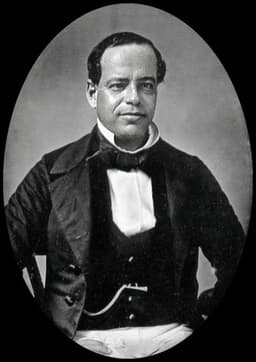
Antonio Lopez de Santa Anna
General · Modern
58.9Total
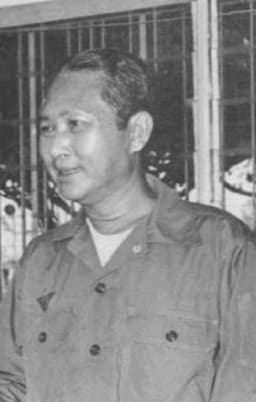
Lon Nol
General · Modern
41.5Total
Basic Information
Born
1794
1913
Died
1876
1985
Era
Modern
Modern
Nationality
Mexico
Cambodia
Occupation
General
General
Civilization
Western
Eastern
Score Comparison
Military (10%)
70.0
25.9
Political (20%)
46.6
30.8
Influence (20%)
56.7
47.9
Legacy (20%)
58.0
38.3
Leadership (15%)
68.0
61.1
Strategy (15%)
60.0
35.7
TOTAL
58.9
41.5
Antonio Lopez de Santa Anna — Complete Timeline
1823 AD
Led the Plan of Casa Mata rebellionPolitical Action
Santa Anna, then a general, issued the Plan of Casa Mata on February 1, 1823, calling for the overthrow of Emperor Agust
RebellionOverthrowRepublic
Impact: nationalconstructive
1829 AD
Defended Mexico at the Battle of TampicoWar◆ Major
Santa Anna commanded Mexican forces that defeated a Spanish invasion force at Tampico on September 11, 1829. The victory ended Spain's last attempt to reconquer Mexico and made Santa Anna a national hero. He was hailed as the 'Hero of Tampico' and used this fame to advance politically.
VictorySpanish InvasionNational Hero
Impact: nationalconstructive
1833 AD
Became President of Mexico for the first timePolitical Action◆ Major
Santa Anna was elected President of Mexico in 1833. He quickly delegated power to Vice President Valent
PresidencyPolitical InstabilityPower
Impact: national
1836 AD
Commanded at the Siege of the AlamoWar◆ Major
Santa Anna personally led the Mexican army in the siege of the Alamo mission in San Antonio, Texas. After a 13-day siege, Mexican forces stormed the fort on March 6, 1836, killing all 180-250 Texan defenders. The battle became a symbol of Texan resistance and a rallying cry for independence.
BattleTexas RevolutionAlamo
Impact: regionaldestructive
Defeated and captured at the Battle of San JacintoWar
Santa Anna's army was surprised and routed by Texan forces under Sam Houston at the Battle of San Jacinto on April 21, 1836. Santa Anna was captured the next day. He was forced to sign the Treaties of Velasco, recognizing Texan independence, though Mexico later repudiated them.
DefeatCaptureTexas Independence
Impact: regionaltragic
1847 AD
Lost the Mexican-American WarWar
Santa Anna returned from exile to command Mexican forces during the Mexican-American War. Despite initial efforts, his army was defeated at the Battle of Cerro Gordo and later at the Battle of Chapultepec. US forces captured Mexico City on September 14, 1847, leading to the Treaty of Guadalupe Hidalgo and massive territorial losses.
Mexican-American WarDefeatTerritorial Loss
Impact: globaltragic
1853 AD
Sold La Mesilla to the United StatesPolitical Action◆ Major
During his final presidency, Santa Anna agreed to the Gadsden Purchase, selling 29,670 square miles of territory (La Mesilla) to the United States for $10 million. The sale was widely condemned in Mexico as a betrayal. This act further damaged his reputation and led to his overthrow.
Territorial CessionGadsden PurchaseBetrayal
Impact: nationaldestructive
1855 AD
Overthrown and exiled for the final timePolitical Action◆ Major
The Plan of Ayutla, led by Juan
OverthrowExileEnd of Career
Impact: nationaltragic
Lon Nol — Complete Timeline
1970 AD
Coup against Norodom SihanoukPolitical Action
Lon Nol led a military coup that overthrew King Sihanouk while he was abroad. He established the Khmer Republic, ending the monarchy and aligning Cambodia with the United States during the Vietnam War.
CoupKhmer RepublicUS alliance
Impact: nationaldestructive
Declaration of the Khmer RepublicPolitical Action◆ Major
Lon Nol officially proclaimed the Khmer Republic, abolishing the monarchy. He became president and implemented a pro-American, anti-communist regime, which led to civil war with the Khmer Rouge and North Vietnamese forces.
RepublicRegime changeCivil War
Impact: national
1975 AD
Fall of Phnom PenhWar
Lon Nol's government collapsed as Khmer Rouge forces captured Phnom Penh. He fled into exile in the United States, ending the Khmer Republic and leading to the establishment of Democratic Kampuchea under Pol Pot.
Khmer Rouge victoryExileRegime collapse
Impact: nationaltragic
Expert Analysis
Antonio Lopez de Santa Anna vs Lon Nol
# The Caudillo and the General: Two Paths to Ruin
On an April afternoon in 1836, Antonio López de Santa Anna, the self-styled “Napoleon of the West,” surrendered to a wounded Sam Houston beside a muddy Texas creek. One hundred thirty-nine years later, in April 1975, Lon Nol, the last president of the Khmer Republic, boarded a helicopter from the roof of a crumbling Phnom Penh, leaving behind a city about to fall to the Khmer Rouge. Both men were generals who seized power, both saw their nations torn apart by war, and both fled into exile. Yet their stories are not the same. One was a chameleon who bent Mexico to his will for decades; the other was a soldier who stepped into chaos and was swallowed by it. Why did Santa Anna keep returning, while Lon Nol vanished into history’s footnotes?
Origins
Santa Anna was born in 1794 in Jalapa, Veracruz, into a Spanish colonial family of modest means. Young Antonio joined the army at sixteen, and the wars of Mexican independence gave him his first taste of battlefield glory. He was a creature of the early republic, a time when Mexico was a raw, fractured nation searching for identity. He learned to read the winds of power, switching sides from the Spanish to the insurgents, from Emperor Agustín de Iturbide to the republicans. By his twenties, he understood that in Mexico, loyalty was a commodity, not a virtue.
Lon Nol came into the world in 1913, in Prey Veng province, French Indochina. His father was a minor official in the colonial administration. If Santa Anna was forged in the crucible of revolution, Lon Nol was molded by the quiet bureaucracy of empire. He studied law, joined the civil service, and only later entered the army. He was a man of order, not ambition. Where Santa Anna craved glory, Lon Nol craved stability—a difference that would define their fates.
Rise to Power
Santa Anna’s rise was a series of calculated gambles. In 1823, he issued the Plan of Casa Mata, a rebellion that toppled Emperor Iturbide. He positioned himself as a defender of federalism, but his true allegiance was always to opportunity. By 1829, he became a national hero when he defeated a Spanish invasion force at Tampico. The victory was genuine, but Santa Anna milked it for all it was worth, styling himself the “Hero of Tampico.” In 1833, he became president for the first time—but he quickly handed the daily grind to his vice president and retreated to his hacienda. He wanted power, not responsibility.
Lon Nol’s ascent was quieter. He served loyally under King Norodom Sihanouk, rising through the ranks of the army. By the 1960s, he was prime minister, a technocrat in a kingdom drifting toward disaster. Unlike Santa Anna, Lon Nol did not seek power; he accepted it. In 1970, while Sihanouk was abroad in Moscow, Lon Nol led a coup that overthrew the king. It was a defensive move, driven by fear of Vietnamese communist infiltration. He proclaimed the Khmer Republic, abolished the monarchy, and aligned Cambodia with the United States. He was not a caudillo; he was a crisis manager who had stumbled into the throne.
Leadership & Governance
Santa Anna ruled Mexico seven times, but he never governed. He saw the presidency as a prize to be won, not a burden to be borne. His military genius was real but fleeting: the victory at Tampico, the siege of the Alamo in 1836, where his army overwhelmed 189 Texan defenders after thirteen days. Yet his strategy was brittle. At San Jacinto, he was caught napping—literally, in his tent—and his army was routed in eighteen minutes. He signed away Texas under duress. Later, during the Mexican-American War, he returned from exile to command, but his arrogance and poor logistics led to defeat after defeat. His political wisdom was nonexistent: he sold La Mesilla to the United States in 1853 for $10 million, a transaction so reviled it sparked his final overthrow.
Lon Nol’s leadership was a tragedy of good intentions. He was no strategist—his military score of 44.6 reflects a man who promoted his brother to high command and ignored the growing strength of the Khmer Rouge. He imposed martial law, bombed the countryside, and alienated the peasantry. The United States propped him up with aid, but he could not build a nation. By 1975, his government controlled little more than Phnom Penh. His political score of 74.3 is deceptive; he had the machinery of power but not the legitimacy.
Triumph & Tragedy
Santa Anna’s greatest moment was the Alamo. It was a brutal, total victory that made him a legend in Mexico. But it was also his undoing: the massacre hardened Texan resolve, and the disaster at San Jacinto followed weeks later. His tragedy was that he never learned. He returned again and again, selling territory, betraying allies, and clinging to power until 1855, when the Plan of Ayutla finally drove him out for good. He died in 1876, poor and forgotten.
Lon Nol’s triumph was the coup itself. For a brief moment, Cambodia seemed free of Sihanouk’s erratic rule. But his tragedy was the fall of Phnom Penh in 1975. He fled to Hawaii, then to California, where he lived in obscurity. He died in 1985, a footnote to the genocide that followed.
Character & Destiny
Santa Anna was a chameleon: liberal one day, conservative the next. He had no ideology, only ambition. This made him resilient—he could adapt, survive, and return. But it also made him hollow. He left Mexico weaker, smaller, and more divided.
Lon Nol was a man of conviction but not vision. He believed in order, but he could not create it. His personality was rigid, his decisions defensive. He was a general who never wanted to be a general, a president who never wanted to be a president. Destiny swept him up and crushed him.
Legacy
Santa Anna is remembered as the man who lost half of Mexico. His legacy is a cautionary tale of personal ambition over national interest. In Mexican memory, he is a villain, a traitor, a clown. Yet his influence score of 68.5 reflects his long shadow: he shaped Mexico’s chaos.
Lon Nol is barely remembered. His legacy score of 53.6 is the lowest of any major Cambodian leader. He is a ghost, a prelude to the killing fields. History judges him as a failure, but also as a victim of forces he could not control.
Conclusion
Santa Anna and Lon Nol both rose as generals, ruled as presidents, and fled as exiles. But Santa Anna was a predator who fed on his nation; Lon Nol was a prey who was devoured by it. One was the architect of his own ruin; the other was its instrument. Their stories remind us that leadership is not just about seizing power—it is about knowing what to do with it. And when men who do not know, the cost is measured in lost lands, broken nations, and forgotten lives.
Rankings
🥇
Antonio Lopez de Santa AnnaLeader
Mil: 70.0Pol: 46.6Inf: 56.7
58.9
🥈
Lon Nol
Mil: 25.9Pol: 30.8Inf: 47.9
41.5
+17.4 behind
How This Comparison Works
Algorithm
Each figure is scored on 6 dimensions (0—100 scale) based on structured historical data: Military (10%), Political (20%), Influence (20%), Legacy (20%), Leadership (15%), Strategy (15%). The weighted total produces the final ranking.
Data Sources
Scores are computed from structured sub-indicators in the database. Scale factors adjust for era (Ancient ×0.85, Modern ×1.0) and civilization size (Eastern ×1.05, Other ×0.80) to account for differences in population and military scale.
Maximum 3 Figures
Comparisons are limited to 2—3 figures to ensure readability and statistical meaningfulness.
Error Margins
±5 points per dimension — Sub-scores are derived from historical records with inherent uncertainty. Two figures within 5 points on a dimension should be considered roughly equivalent in that area.
Total Score Accuracy
±3 points overall — The weighted combination of 6 dimensions produces a total score with approximately ±3 points of uncertainty. Differences of less than 3 points are not statistically significant— the figures are effectively tied.
Known Limitations
- Historical records are incomplete and uneven across civilizations
- Figures from oral-tradition societies may be underrepresented
- Occupation labels can misclassify multi-role figures
- Scores measure capability and impact, not moral character
- Quantitative scoring is a comparison tool, not absolute truth
Capability Radar
Military (10%) — Battles & Warfare
Battles
65
15
Win Rate
40
10
Expansion
50
5
Political (20%) — Governance & Reform
Reform
20
10
Diplomacy
35
15
Economy
15
5
Influence (20%) — Cultural & Global Reach
Cultural
55
5
Global
50
10
Legacy (20%) — Historical Impact
Historical
60
15
Longevity
55
5
Leadership (15%) — Power & Stability
Tenure
75
40
Stability
10
5
Strategy (15%) — Tactics & Innovation
Strategy
45
15
Tactics
60
20
Reform
30
10
Similar Comparisons
Comments & Discussion
Chameleon General6/16/2026
Santa Anna's true genius wasn't military—it was political theater. He lost Texas, lost the Mexican-American War, lost half his country's territory, yet kept returning to power seven times! That's not incompetence; that's a masterclass in reading a nation's appetite for strongmen. Lon Nol couldn't even hold onto Phnom Penh for four years. The difference? Santa Anna understood that Mexican elites needed a caudillo they could hate but rely on. Lon Nol was just America's desperate gambit against the
篡位二人组6/16/2026
军事上都是草包,政治上却天差地别。圣塔安纳的骑兵在阿拉莫屠杀了183人,这在战术上确实狠,但他后来在圣哈辛托被18分钟打崩,简直是耻辱。朗诺更惨,1971年“真腊行动”出动两万精锐,结果被红色高棉农村游击队反杀。最讽刺的是,两人都当过“救世主”,一个复活了七次,一个死了一次就再也翻不了身。
Hindsight Historian6/16/2026
The numbers don't lie: Santa Anna lost 55% of Mexico's territory—Texas, California, New Mexico, Arizona, Utah, Nevada. That's almost one million square miles. Lon Nol lost all of Cambodia to four months of fighting in 1975. But here's the uncomfortable truth: Santa Anna's betrayals were systematic, calculated choices. Lon Nol's collapse was pure incompetence. One was a villain with agency; the other was a victim of circumstance. History judges them both as failures, but the quality of failure ma
数据拆穿家6/16/2026
别被“拿破仑”的绰号骗了。圣塔安纳的军队在1836年有6000人,而休斯顿只有900人,结果呢?18分钟内丢掉了德州。朗诺的政府军1970年有15万人,装备美式武器,却打不过1万农村游击队员。更可笑的是,两人都靠美国援助——圣塔安纳靠美国买枪,朗诺靠美国空袭。事实证明,武器再多,没有战略就是废铁。两个小丑,一个悲剧。
Revisionist Reader6/16/2026
Everyone calls Santa Anna a traitor, but let's get real: Mexico's internal divisions made him possible. He was a symptom, not the disease. The real culprits were the criollo elite who kept inviting him back. And Lon Nol? He was Sihanouk's lackey who betrayed his king in the 1970 coup, only to be betrayed by Nixon when the US withdrew air support in 1973. Both men were pawns of larger forces—Santa Anna of Mexican oligarchy, Lon Nol of American imperialism. The tragedy isn't their failure; it's th