Loading...
Andres de Santa Cruz vs Lon Nol
Andres de Santa Cruz leads by 19.0 pts · 2 figures compared
…
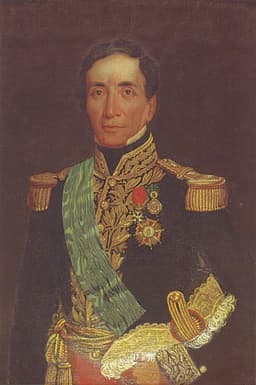
Andres de Santa Cruz
General · Modern
60.5Total
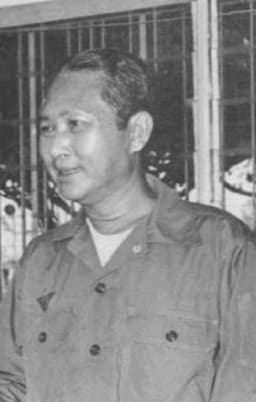
Lon Nol
General · Modern
41.5Total
Basic Information
Born
1792
1913
Died
1865
1985
Era
Modern
Modern
Nationality
Bolivia
Cambodia
Occupation
General
General
Civilization
Western
Eastern
Score Comparison
Military (10%)
67.5
25.9
Political (20%)
59.3
30.8
Influence (20%)
62.0
47.9
Legacy (20%)
50.0
38.3
Leadership (15%)
68.0
61.1
Strategy (15%)
66.3
35.7
TOTAL
60.5
41.5
Andres de Santa Cruz — Complete Timeline
1823 AD
Battle of ZepitaWar
Santa Cruz commanded Peruvian forces in a victory over Spanish royalists at Zepita during the Peruvian War of Independence. This battle enhanced his military reputation and contributed to the eventual liberation of Peru from Spanish rule.
Peruvian War of IndependenceBattleLiberation
Impact: regional
1826 AD
Presidency of PeruPolitical Action
Santa Cruz served as President of the Council of Government of Peru from 1826 to 1827, effectively ruling the country. His administration focused on centralizing power and organizing the state, but he was overthrown by a rebellion led by Agust
PresidencyPeruCentralization
Impact: national
1829 AD
Presidency of BoliviaPolitical Action◆ Major
Santa Cruz became President of Bolivia in 1829, serving until 1839. He implemented administrative reforms, stabilized the economy, and modernized the military, establishing Bolivia as a more coherent state after the chaos following independence.
PresidencyBoliviaReforms
Impact: nationalconstructive
1836 AD
War of the ConfederationWar◆ Major
Chile and Argentina declared war on the Peru-Bolivia Confederation, viewing it as a threat to the balance of power. Santa Cruz led the confederation's forces in a conflict that lasted until 1839, ultimately resulting in the confederation's defeat.
WarChileArgentinaConfederation
Impact: regional
Creation of the Peru-Bolivia ConfederationPolitical Action
Santa Cruz established the Peru-Bolivia Confederation, uniting Bolivia and Peru into a single state with himself as Supreme Protector. This confederation aimed to create a powerful Andean nation and challenged the regional influence of Chile and Argentina.
ConfederationUnificationAndean Power
Impact: regional
1839 AD
Battle of YungayWar
Santa Cruz's confederation forces were decisively defeated by the Chilean army at the Battle of Yungay. This defeat led to the dissolution of the Peru-Bolivia Confederation and forced Santa Cruz into exile, ending his political project.
BattleDefeatEnd of Confederation
Impact: regionaltragic
Exile and DeathPolitical Action
After the defeat at Yungay, Santa Cruz fled to Ecuador and later to France. He spent the rest of his life in exile, making unsuccessful attempts to return to power. He died in France in 1865, never regaining his former influence.
ExileDeathFailure
Impact: nationaltragic
Lon Nol — Complete Timeline
1970 AD
Coup against Norodom SihanoukPolitical Action
Lon Nol led a military coup that overthrew King Sihanouk while he was abroad. He established the Khmer Republic, ending the monarchy and aligning Cambodia with the United States during the Vietnam War.
CoupKhmer RepublicUS alliance
Impact: nationaldestructive
Declaration of the Khmer RepublicPolitical Action◆ Major
Lon Nol officially proclaimed the Khmer Republic, abolishing the monarchy. He became president and implemented a pro-American, anti-communist regime, which led to civil war with the Khmer Rouge and North Vietnamese forces.
RepublicRegime changeCivil War
Impact: national
1975 AD
Fall of Phnom PenhWar
Lon Nol's government collapsed as Khmer Rouge forces captured Phnom Penh. He fled into exile in the United States, ending the Khmer Republic and leading to the establishment of Democratic Kampuchea under Pol Pot.
Khmer Rouge victoryExileRegime collapse
Impact: nationaltragic
Expert Analysis
Andres de Santa Cruz vs Lon Nol
# The Dreamer and the Destroyer: Andrés de Santa Cruz and Lon Nol
On a sweltering January morning in 1970, Cambodia’s King Norodom Sihanouk boarded a plane in Phnom Penh, bound for France. He did not know he would never return as king. As his aircraft disappeared over the horizon, General Lon Nol was already setting in motion a coup that would topple a monarchy and plunge his nation into a nightmare. One hundred and thirty-four years earlier, in a very different corner of the world, another general—Andrés de Santa Cruz—had a dream of a different kind: to unite two nations into a single, powerful state. Both men were generals. Both seized power. But their paths, their visions, and their endings could not have been more different.
Origins
Andrés de Santa Cruz was born in 1792 in La Paz, Bolivia, into a world of colonial hierarchies. His father was a Spanish nobleman, his mother an indigenous Quechua woman. This mixed heritage—neither fully European nor fully native—shaped his worldview. He understood the fractures of South American society from the inside, and he believed that only unity could overcome them. Educated in Spanish military academies, he absorbed the Enlightenment ideals of order and progress, but also the simmering resentments of the colonized.
Lon Nol, born in 1913 in the Cambodian province of Prey Veng, came from a very different tradition. His father was a civil servant under French colonial rule, and young Lon Nol was raised in a world of deference—to the French, to the king, to the established order. He attended the Royal Military Academy in Phnom Penh, where discipline and hierarchy were absolute. There was no mixed blood here, no grand vision of remaking society. Cambodia was a small kingdom, fragile and dependent, and Lon Nol learned early that survival meant loyalty to power.
Rise to Power
Santa Cruz’s rise came through war. He fought alongside Simón Bolívar and Antonio José de Sucre in the wars of independence against Spain, proving himself a capable commander at the Battle of Zepita in 1823, where his forces routed Spanish royalists. By 1826, he was effectively ruling Peru as President of the Council of Government. When he became President of Bolivia in 1829, he inherited a bankrupt, chaotic state. But Santa Cruz was a builder, not just a soldier. He stabilized the economy, reformed the bureaucracy, and modernized the army. His ambition, however, was not limited to one country.
Lon Nol’s rise was quieter, more cautious. He served loyally under Sihanouk for years, rising through the ranks of the military and the government. He was Minister of Defense, then Prime Minister. Sihanouk trusted him—or at least thought he did. But by 1970, Cambodia was caught in the crossfire of the Vietnam War. Sihanouk’s balancing act between the United States and North Vietnam was unraveling. Lon Nol, backed by conservative elites and American intelligence, saw his moment. On March 18, 1970, while Sihanouk was abroad, he launched a bloodless coup. The monarchy was abolished. The Khmer Republic was born.
Leadership & Governance
Santa Cruz governed like a visionary technocrat. He drafted new legal codes, improved tax collection, and built roads and schools. His greatest achievement came in 1836, when he created the Peru-Bolivia Confederation, uniting Bolivia and Peru under a single state with himself as Supreme Protector. He believed that a large, stable federation could resist foreign domination—from Argentina, from Chile, from European powers. It was a grand, rational design, and for a few years, it worked.
Lon Nol, by contrast, governed like a cornered animal. The Khmer Republic was pro-American, anti-communist, and deeply unstable. He declared martial law, banned political opposition, and relied on U.S. military aid to fight both North Vietnamese forces and the growing Khmer Rouge insurgency. His leadership was erratic, his decisions impulsive. He once ordered his troops to wear magical amulets for protection, believing they would make them invulnerable. Where Santa Cruz built institutions, Lon Nol burned them.
Triumph & Tragedy
Santa Cruz’s triumph was the Confederation itself—a moment when his dream seemed real. He commanded respect across the Andes, and for a brief time, the Confederation was a serious power. But its existence threatened Chile and Argentina, who saw it as a violation of the balance of power. War came in 1836. Santa Cruz fought bravely, but at the Battle of Yungay in 1839, his forces were crushed by the Chilean army. The Confederation dissolved overnight. Santa Cruz fled to Ecuador, then to France, where he died in obscurity in 1865, still dreaming of what might have been.
Lon Nol’s tragedy was far more brutal. By 1975, his republic was a hollow shell. The Khmer Rouge surrounded Phnom Penh, and the U.S. had cut off aid. On April 17, 1975, the city fell. Lon Nol had already fled—first to Indonesia, then to the United States, where he lived in a modest house in Hawaii until his death in 1985. But his legacy was not his exile. It was the chaos he left behind: a country devastated by war, a monarchy destroyed, and a genocide waiting to begin.
Character & Destiny
Santa Cruz was a dreamer who believed that reason and order could remake the world. His failure was not a failure of vision, but of timing—the forces of nationalism and regional rivalry were simply too strong. Lon Nol was a survivor who never understood that survival was not enough. He had no vision beyond power, no plan beyond the next battle. His coup did not save Cambodia; it destroyed it.
Legacy
Santa Cruz is remembered in Bolivia and Peru as a flawed but significant figure—a man who tried to unite what history had divided. His name adorns streets and schools, and historians debate whether his Confederation could have succeeded under different circumstances. Lon Nol is remembered, if at all, as a footnote to catastrophe. The Khmer Rouge killed nearly two million Cambodians; Lon Nol’s coup was the door through which they entered.
Conclusion
Two generals, two centuries, two continents. One dreamed of unity and lost; the other seized power and lost everything. The difference between them is not in their scores or their battles, but in what they believed they were fighting for. Santa Cruz fought for an idea; Lon Nol fought for himself. In the end, history judges not by the power one holds, but by the world one leaves behind.
Rankings
🥇
Andres de Santa CruzLeader
Mil: 67.5Pol: 59.3Inf: 62.0
60.5
🥈
Lon Nol
Mil: 25.9Pol: 30.8Inf: 47.9
41.5
+19.0 behind
How This Comparison Works
Algorithm
Each figure is scored on 6 dimensions (0—100 scale) based on structured historical data: Military (10%), Political (20%), Influence (20%), Legacy (20%), Leadership (15%), Strategy (15%). The weighted total produces the final ranking.
Data Sources
Scores are computed from structured sub-indicators in the database. Scale factors adjust for era (Ancient ×0.85, Modern ×1.0) and civilization size (Eastern ×1.05, Other ×0.80) to account for differences in population and military scale.
Maximum 3 Figures
Comparisons are limited to 2—3 figures to ensure readability and statistical meaningfulness.
Error Margins
±5 points per dimension — Sub-scores are derived from historical records with inherent uncertainty. Two figures within 5 points on a dimension should be considered roughly equivalent in that area.
Total Score Accuracy
±3 points overall — The weighted combination of 6 dimensions produces a total score with approximately ±3 points of uncertainty. Differences of less than 3 points are not statistically significant— the figures are effectively tied.
Known Limitations
- Historical records are incomplete and uneven across civilizations
- Figures from oral-tradition societies may be underrepresented
- Occupation labels can misclassify multi-role figures
- Scores measure capability and impact, not moral character
- Quantitative scoring is a comparison tool, not absolute truth
Capability Radar
Military (10%) — Battles & Warfare
Battles
60
15
Win Rate
55
10
Expansion
55
5
Political (20%) — Governance & Reform
Reform
65
10
Diplomacy
60
15
Economy
55
5
Influence (20%) — Cultural & Global Reach
Cultural
45
5
Global
35
10
Legacy (20%) — Historical Impact
Historical
50
15
Longevity
40
5
Leadership (15%) — Power & Stability
Tenure
60
40
Stability
40
5
Strategy (15%) — Tactics & Innovation
Strategy
65
15
Tactics
60
20
Reform
50
10
Similar Comparisons
Comments & Discussion
云端猎史6/16/2026
"史诗级拱火人"——说难听点,洪森才是存活到最后的聪明人,而朗诺就是个被美国人当枪使的傻瓜。他还搞"高棉共和国"?拜托,你连高棉语都不会写标准公文!圣克鲁斯至少敢跟智利、阿根廷同时开战,朗诺打个游击队都要靠美帝空军支援——这差距等同于"用马刀砍坦克"和"用坦克压马刀"的差别。
思辨老鬼6/16/2026
"历史对称狂"——我站朗诺这边,至少他有自知之明!圣克鲁斯建国梦破碎后灰溜溜流亡法国,朗诺好歹死在夏威夷的海风里。而且圣克鲁斯搞的"联邦税"直接掏空秘鲁中产,朗诺虽然穷兵黩武,但柬埔寨农村传统没被官僚机器碾碎——说白了,一个想当南美拿破仑但没那能力,另一个从没做过拿破仑的梦!
FlankAndFile6/16/2026
"Peru-Bolivia Fanboy" — Look, Santa Cruz actually *built* something real: the Peru-Bolivian Confederation lasted three whole years with its own flag, constitution, and currency. By contrast, Lon Nol held power for five years and all he bequeathed Cambodia was the Khmer Rouge's killing fields. One man unified a continent; the other paved the road for genocide. Historical track records speak for themselves.
OldWarhorse6/16/2026
"Peruvian Separatist Apologist" — Let's be real: Santa Cruz's confederation was doomed by elite resentment, not military failure. Bolivia's own oligarchs begged Chile to invade them! Meanwhile, Lon Nol's 1970 coup was a masterclass in self-destruction. He literally expelled 150,000 Vietnamese civilians (including women and babies) to score nationalist points, then couldn't feed Phnom Penh. One was a grand strategist with bad allies; the other was a clown with American guns.