Loading...
Andreas Papandreou vs Cyril Ramaphosa
Andreas Papandreou leads by 13.9 pts · 2 figures compared
…
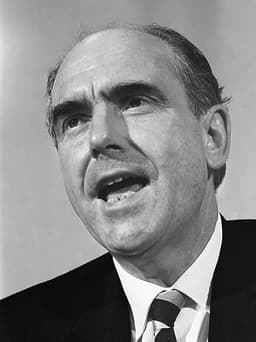
Andreas Papandreou
Politician · Modern
63.9Total

Cyril Ramaphosa
Politician · Modern
50.0Total
Basic Information
Born
1919
1952
Died
1996
—
Era
Modern
Modern
Nationality
Greece
South Africa
Occupation
Politician
Politician
Civilization
Western
Other
Score Comparison
Military (10%)
50.0
43.3
Political (20%)
65.0
45.0
Influence (20%)
82.0
60.0
Legacy (20%)
56.0
47.5
Leadership (15%)
68.0
53.2
Strategy (15%)
44.0
40.4
TOTAL
63.9
50.0
Andreas Papandreou — Complete Timeline
1974 AD
Founded the Panhellenic Socialist Movement (PASOK)Political Action◆ Major
Andreas Papandreou founded PASOK, a socialist political party that advocated for national independence, social justice, and democratic reforms. The party quickly became a major force in Greek politics, challenging the conservative establishment.
Political PartySocialismThird Way
Impact: nationalconstructive
1981 AD
Elected Prime Minister of GreecePolitical Action◆ Major
Papandreou led PASOK to a landslide victory in the 1981 elections, becoming the first socialist Prime Minister of Greece. His government implemented sweeping reforms, including the establishment of the National Health System and the legalization of civil marriage.
ElectionSocial ReformWelfare State
Impact: nationalconstructive
1982 AD
Legalized Civil MarriageReform◆ Major
Papandreou's government passed Law 1250/1982, which legalized civil marriage in Greece, ending the monopoly of the Orthodox Church over marriage. The reform was part of a broader secularization agenda that also included divorce reform.
SecularizationSocial ReformChurch-State Relations
Impact: nationalconstructive
1983 AD
Introduced the National Health System (ESY)Reform◆ Major
Papandreou's government established the National Health System (ESY), providing universal healthcare to all Greek citizens. The reform was a cornerstone of PASOK's social policy, significantly improving access to medical services.
HealthcareSocial PolicyReform
Impact: nationalconstructive
1985 AD
Economic Crisis and Austerity MeasuresPolitical Action◆ Major
Facing economic crisis, Papandreou's government implemented austerity measures, including wage freezes and currency devaluation. The policies caused internal party dissent and led to a decline in PASOK's popularity, though they stabilized the economy temporarily.
Economic PolicyAusterityCrisis
Impact: nationaldestructive
1989 AD
Imprisonment and Acquittal in Koskotas ScandalPolitical Action◆ Major
Papandreou was implicated in the Koskotas financial scandal, involving embezzlement and bribery. He was tried and acquitted in 1992, but the scandal damaged his reputation and contributed to PASOK's electoral defeat in 1989.
ScandalCorruptionTrial
Impact: nationaldestructive
Cyril Ramaphosa — Complete Timeline
1982 AD
Led NUM and Played Key Role in Anti-Apartheid StrugglePolitical Action◆ Major
Ramaphosa co-founded the National Union of Mineworkers (NUM) and became its General Secretary. He led strikes and negotiations, becoming a prominent figure in the anti-apartheid movement and the Congress of South African Trade Unions (COSATU).
Union LeadershipAnti-ApartheidSouth Africa
Impact: nationalconstructive
1994 AD
Chaired the Constitutional AssemblyPolitical Action
Ramaphosa chaired the Constitutional Assembly that drafted South Africa's post-apartheid constitution. The constitution, adopted in 1996, established a democratic framework and bill of rights.
ConstitutionDemocracySouth Africa
Impact: nationalconstructive
2018 AD
Elected President of South AfricaPolitical Action◆ Major
Cyril Ramaphosa was elected President of South Africa by the National Assembly after Jacob Zuma resigned. He had previously served as Deputy President and was seen as a reformist leader.
ElectionSouth AfricaSuccession
Impact: nationalconstructive
Launched 'Thuma Mina' PresidencyPolitical Action◆ Major
Ramaphosa launched his presidency with the 'Thuma Mina' (Send Me) initiative, emphasizing anti-corruption and economic revival. He pledged to restore the credibility of state institutions and attract investment.
PresidencySouth AfricaReform
Impact: nationalconstructive
Farm Attacks and Land Reform DebatePolitical Action◆ Major
Ramaphosa's government pursued land reform, including a constitutional amendment to allow expropriation without compensation. The policy sparked intense debate and was criticized by some as threatening property rights.
Land ReformSouth AfricaPolicy
Impact: national
2020 AD
COVID-19 Pandemic ResponsePolitical Action◆ Major
Ramaphosa's government implemented one of the strictest lockdowns in the world to combat COVID-19. The response included a massive economic stimulus package and social grants, but also faced criticism for enforcement and economic damage.
Pandemic ResponsePublic HealthSouth Africa
Impact: national
Expert Analysis
Origins
Andreas Papandreou was born in 1919 in Chios, Greece, into a political family; his father, Georgios Papandreou, served as prime minister. He studied in Athens and later at Harvard, earning a PhD in economics. His early career was academic, teaching at universities in the US and returning to Greece in 1959. In contrast, Cyril Ramaphosa was born in 1952 in Soweto, South Africa, to a middle-class family. He studied law at the University of the North and later at the University of South Africa. His early activism in the anti-apartheid struggle shaped his path, co-founding the National Union of Mineworkers (NUM) in 1982.
Rise to Power
Papandreou rose to prominence by founding the Panhellenic Socialist Movement (PASOK) in 1974, after the fall of the Greek junta. His party won a landslide victory in 1981, making him the first socialist prime minister of Greece. His rise was fueled by populist rhetoric and promises of change. Ramaphosa's rise came through trade unionism and anti-apartheid activism. He led NUM in major strikes and played a key role in negotiations to end apartheid. He chaired the Constitutional Assembly that drafted the 1996 constitution. After a period in business, he returned to politics, becoming deputy president under Jacob Zuma and then president in 2018 after Zuma's resignation.
Leadership & Governance
Papandreou's leadership style was charismatic and populist. His government implemented sweeping reforms: the National Health System (ESY) in 1983, providing universal healthcare; civil marriage legalization in 1982, reducing church influence; and educational reforms. However, his economic policies led to high inflation and debt. He scored 68.0 in leadership and 44.0 in strategy, reflecting vision but poor execution. Ramaphosa's leadership is more technocratic. He launched the 'Thuma Mina' initiative, focusing on anti-corruption and economic revival. His handling of the COVID-19 pandemic included strict lockdowns and a stimulus package. He scored 53.2 in leadership and 40.4 in strategy, indicating cautious governance but limited transformative impact.
Triumph & Tragedy
Papandreou's greatest triumph was founding PASOK and introducing social reforms that modernized Greece. The ESY remains a cornerstone of Greek welfare. His tragedy was the economic crisis of the 1980s, leading to austerity and a decline in living standards. He also faced scandals and was imprisoned briefly in 1989. Ramaphosa's triumph was his role in drafting South Africa's constitution, a global model for post-conflict reconciliation. His tragedy is the persistence of corruption and economic stagnation under his watch, including the 'Phala Phala' farm scandal. He has struggled to revive the economy, with growth below 2%.
Character & Destiny
Papandreou was bold and confrontational, often clashing with the US and NATO. His character shaped his fate: his populism brought him power but also instability. Historians note his divisive style. Ramaphosa is pragmatic and patient, a negotiator rather than a firebrand. His cautious approach has preserved stability but slowed change. He is seen as a reformer but constrained by party factions.
Legacy
Papandreou's legacy is mixed: he transformed Greek society but left a fragile economy. His influence score is 82.0, reflecting his role in shaping modern Greece. Ramaphosa's legacy is still unfolding. He is credited with preserving democratic institutions but criticized for slow progress. His influence score is 60.0, lower than Papandreou's. Both left lasting marks: Papandreou on Greek socialism, Ramaphosa on South African democracy.
Conclusion
Andreas Papandreou had a greater impact than Cyril Ramaphosa, with a total score of 63.9 versus 50.0. He fundamentally reshaped Greek society through landmark reforms, despite economic failures. Ramaphosa, while important in the anti-apartheid transition, has not matched that transformative effect. Papandreou's political influence and legacy score higher, making him the more consequential figure.
Rankings
🥇
Andreas PapandreouLeader
Mil: 50.0Pol: 65.0Inf: 82.0
63.9
🥈
Cyril Ramaphosa
Mil: 43.3Pol: 45.0Inf: 60.0
50.0
+13.9 behind
How This Comparison Works
Algorithm
Each figure is scored on 6 dimensions (0—100 scale) based on structured historical data: Military (10%), Political (20%), Influence (20%), Legacy (20%), Leadership (15%), Strategy (15%). The weighted total produces the final ranking.
Data Sources
Scores are computed from structured sub-indicators in the database. Scale factors adjust for era (Ancient ×0.85, Modern ×1.0) and civilization size (Eastern ×1.05, Other ×0.80) to account for differences in population and military scale.
Maximum 3 Figures
Comparisons are limited to 2—3 figures to ensure readability and statistical meaningfulness.
Error Margins
±5 points per dimension — Sub-scores are derived from historical records with inherent uncertainty. Two figures within 5 points on a dimension should be considered roughly equivalent in that area.
Total Score Accuracy
±3 points overall — The weighted combination of 6 dimensions produces a total score with approximately ±3 points of uncertainty. Differences of less than 3 points are not statistically significant— the figures are effectively tied.
Known Limitations
- Historical records are incomplete and uneven across civilizations
- Figures from oral-tradition societies may be underrepresented
- Occupation labels can misclassify multi-role figures
- Scores measure capability and impact, not moral character
- Quantitative scoring is a comparison tool, not absolute truth
Capability Radar
Military (10%) — Battles & Warfare
Battles
26
24
Win Rate
32
23
Expansion
32
27
Political (20%) — Governance & Reform
Reform
75
60
Diplomacy
70
65
Economy
60
55
Influence (20%) — Cultural & Global Reach
Cultural
55
40
Global
55
50
Legacy (20%) — Historical Impact
Historical
60
45
Longevity
50
30
Leadership (15%) — Power & Stability
Tenure
65
55
Stability
40
45
Strategy (15%) — Tactics & Innovation
Strategy
41
33
Tactics
40
31
Reform
47
39
Similar Comparisons
Comments & Discussion
No comments yet. Be the first to share your thoughts!