Loading...
Andreas Papandreou vs Sefik Dzaferovic
Andreas Papandreou leads by 16.5 pts · 2 figures compared
…
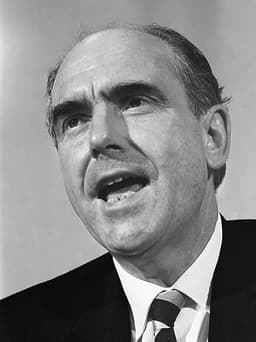
Andreas Papandreou
Politician · Modern
63.9Total

Sefik Dzaferovic
Politician · Modern
47.4Total
Basic Information
Born
1919
1957
Died
1996
—
Era
Modern
Modern
Nationality
Greece
Bosnia
Occupation
Politician
Politician
Civilization
Western
Western
Score Comparison
Military (10%)
50.0
50.0
Political (20%)
65.0
42.3
Influence (20%)
82.0
49.4
Legacy (20%)
56.0
39.2
Leadership (15%)
68.0
64.0
Strategy (15%)
44.0
43.1
TOTAL
63.9
47.4
Andreas Papandreou — Complete Timeline
1974 AD
Founded the Panhellenic Socialist Movement (PASOK)Political Action◆ Major
Andreas Papandreou founded PASOK, a socialist political party that advocated for national independence, social justice, and democratic reforms. The party quickly became a major force in Greek politics, challenging the conservative establishment.
Political PartySocialismThird Way
Impact: nationalconstructive
1981 AD
Elected Prime Minister of GreecePolitical Action◆ Major
Papandreou led PASOK to a landslide victory in the 1981 elections, becoming the first socialist Prime Minister of Greece. His government implemented sweeping reforms, including the establishment of the National Health System and the legalization of civil marriage.
ElectionSocial ReformWelfare State
Impact: nationalconstructive
1982 AD
Legalized Civil MarriageReform◆ Major
Papandreou's government passed Law 1250/1982, which legalized civil marriage in Greece, ending the monopoly of the Orthodox Church over marriage. The reform was part of a broader secularization agenda that also included divorce reform.
SecularizationSocial ReformChurch-State Relations
Impact: nationalconstructive
1983 AD
Introduced the National Health System (ESY)Reform◆ Major
Papandreou's government established the National Health System (ESY), providing universal healthcare to all Greek citizens. The reform was a cornerstone of PASOK's social policy, significantly improving access to medical services.
HealthcareSocial PolicyReform
Impact: nationalconstructive
1985 AD
Economic Crisis and Austerity MeasuresPolitical Action◆ Major
Facing economic crisis, Papandreou's government implemented austerity measures, including wage freezes and currency devaluation. The policies caused internal party dissent and led to a decline in PASOK's popularity, though they stabilized the economy temporarily.
Economic PolicyAusterityCrisis
Impact: nationaldestructive
1989 AD
Imprisonment and Acquittal in Koskotas ScandalPolitical Action◆ Major
Papandreou was implicated in the Koskotas financial scandal, involving embezzlement and bribery. He was tried and acquitted in 1992, but the scandal damaged his reputation and contributed to PASOK's electoral defeat in 1989.
ScandalCorruptionTrial
Impact: nationaldestructive
Sefik Dzaferovic — Complete Timeline
2018 AD
Election as Bosniak member of the PresidencyPolitical Action◆ Major
Dzaferovic was elected as the Bosniak member of the Presidency in 2018, representing the Party of Democratic Action (SDA). He campaigned on a platform of EU integration, anti-corruption, and strengthening state institutions.
PresidencyElectionSDA
Impact: nationalconstructive
2020 AD
Chairman of the PresidencyPolitical Action
Dzaferovic served as Chairman of the Presidency in 2020-2021, a rotating position. He focused on EU accession talks and managing the COVID-19 pandemic response, but faced challenges from ethnic divisions.
ChairmanshipEU accessionCOVID-19
Impact: national
Expert Analysis
Origins
Andreas Papandreou was born on February 5, 1919, on the island of Chios, Greece. He was the son of Georgios Papandreou, a prominent liberal politician and three-time prime minister. Andreas studied at the University of Athens and later earned a PhD in economics from Harvard University in 1943. He taught at several US universities, including the University of Minnesota and the University of California, Berkeley, becoming a naturalized US citizen. He returned to Greece in 1961 and entered politics, serving as a minister in his father's government. His early life was marked by exile during the Greek military junta (1967-1974), which shaped his anti-establishment views.
Sefik Dzaferovic was born on September 9, 1957, in Sjenica, SR Serbia, Yugoslavia (now Serbia). He is of Bosniak ethnicity. He graduated from the University of Sarajevo's Faculty of Architecture in 1982. He later worked as a journalist and editor for Bosnian Muslim newspapers. During the Bosnian War (1992-1995), he served as a member of the Bosnian Army's press center. He joined the Party of Democratic Action (SDA) in 1997 and held various government positions, including Deputy Minister of Human Rights and Refugees. His origins are rooted in the complex ethnic landscape of post-Yugoslav Bosnia.
Rise to Power
Andreas Papandreou rose to prominence by founding the Panhellenic Socialist Movement (PASOK) on September 3, 1974, after the fall of the Greek junta. He capitalized on anti-American sentiment and promises of national independence and social change. In the 1981 legislative election, PASOK won 48% of the vote and 172 of 300 seats, making Papandreou Greece's first socialist prime minister on October 21, 1981. His rise was fueled by his charisma, his opposition to NATO and the European Economic Community (EEC), and a platform of "Change" (Allagi).
Sefik Dzaferovic rose through the ranks of the SDA, a Bosniak nationalist party. He was elected to the Bosnian House of Representatives in 2002 and served as Deputy Minister of Security before being elected as the Bosniak member of the Presidency of Bosnia and Herzegovina in the 2018 general election, winning 36.6% of the vote. He took office on November 20, 2018. His rise was facilitated by his long party loyalty and the ethnic voting patterns in Bosnia.
Leadership & Governance
Papandreou's leadership style was populist and confrontational. He implemented sweeping reforms: Law 1250/1982 legalized civil marriage, ending the Orthodox Church's monopoly. He established the National Health System (ESY) in 1983, providing universal healthcare. He also expanded welfare, increased pensions, and gave land to farmers. However, his fiscal policies led to high deficits and inflation. By 1985, facing economic crisis, he imposed austerity measures, including wage freezes and a 15% devaluation of the drachma, causing internal dissent.
Dzaferovic's leadership was more constrained by Bosnia's complex tripartite presidency. He focused on EU integration, advocating for reforms to meet accession criteria. During his chairmanship in 2020-2021, he managed the COVID-19 pandemic response, securing vaccines and implementing lockdowns. He also pushed for anti-corruption measures, but progress was slow due to political gridlock. His governance score of 64.0 reflects his ability to navigate ethnic politics, while Papandreou's 68.0 reflects his transformative impact despite economic mismanagement.
Triumph & Tragedy
Papandreou's greatest triumph was founding PASOK and transforming Greek politics. His social reforms, like the ESY and civil marriage, modernized Greek society. He also secured Greece's entry into the EEC in 1981. However, his tragedies include the economic crisis of 1985, which forced U-turns on his socialist promises, and the 1989 Koskotas scandal, involving financial fraud that tarnished his government. He was acquitted but his reputation suffered. His total score of 63.9 reflects these mixed outcomes.
Dzaferovic's triumph is his role in maintaining stability in Bosnia's fragile power-sharing system. He successfully chaired the presidency during pandemic challenges. However, his tragedy is the lack of major reforms; Bosnia remains one of Europe's most corrupt and ethnically divided states. His legacy score of 39.2 indicates limited lasting impact.
Character & Destiny
Papandreou was a charismatic, decisive, and polarizing figure. His anti-Western rhetoric and socialist agenda appealed to many, but his authoritarian tendencies and economic mismanagement drew criticism. He was known for his fiery speeches and personal scandals, including his marriage to a much younger woman. His character shaped his destiny: his populism brought him to power but also led to policy failures.
Dzaferovic is seen as a moderate, consensus-building politician. He is less flamboyant than Papandreou, focusing on bureaucratic processes. His cautious character limited his ability to push through bold reforms, but it also prevented major conflicts. His destiny was to be a caretaker in a system that stifles change.
Legacy
Papandreou's legacy is profound in Greece. PASOK dominated Greek politics for decades, and his welfare state reforms shaped modern Greece. However, his economic policies are blamed for laying the groundwork for the 2009 debt crisis. His influence score of 82.0 reflects his lasting impact on Greek society and politics.
Dzaferovic's legacy is more modest. He is a footnote in Bosnia's post-war history, with few tangible achievements. His influence score of 49.4 indicates limited reach. He is unlikely to be remembered beyond his term.
Conclusion
Andreas Papandreou had a greater impact than Sefik Dzaferovic. His total score of 63.9 versus 47.4 reflects this. Papandreou fundamentally altered Greek society through universal healthcare and civil marriage, and his party reshaped the political landscape. Dzaferovic, while competent, operated within a system that prevented significant change. Papandreou's influence far exceeds Dzaferovic's, despite his economic failures. The data supports Papandreou as the more consequential leader.
Rankings
🥇
Andreas PapandreouLeader
Mil: 50.0Pol: 65.0Inf: 82.0
63.9
🥈
Sefik Dzaferovic
Mil: 50.0Pol: 42.3Inf: 49.4
47.4
+16.5 behind
How This Comparison Works
Algorithm
Each figure is scored on 6 dimensions (0—100 scale) based on structured historical data: Military (10%), Political (20%), Influence (20%), Legacy (20%), Leadership (15%), Strategy (15%). The weighted total produces the final ranking.
Data Sources
Scores are computed from structured sub-indicators in the database. Scale factors adjust for era (Ancient ×0.85, Modern ×1.0) and civilization size (Eastern ×1.05, Other ×0.80) to account for differences in population and military scale.
Maximum 3 Figures
Comparisons are limited to 2—3 figures to ensure readability and statistical meaningfulness.
Error Margins
±5 points per dimension — Sub-scores are derived from historical records with inherent uncertainty. Two figures within 5 points on a dimension should be considered roughly equivalent in that area.
Total Score Accuracy
±3 points overall — The weighted combination of 6 dimensions produces a total score with approximately ±3 points of uncertainty. Differences of less than 3 points are not statistically significant— the figures are effectively tied.
Known Limitations
- Historical records are incomplete and uneven across civilizations
- Figures from oral-tradition societies may be underrepresented
- Occupation labels can misclassify multi-role figures
- Scores measure capability and impact, not moral character
- Quantitative scoring is a comparison tool, not absolute truth
Capability Radar
Military (10%) — Battles & Warfare
Battles
26
26
Win Rate
32
32
Expansion
32
35
Political (20%) — Governance & Reform
Reform
75
30
Diplomacy
70
45
Economy
60
25
Influence (20%) — Cultural & Global Reach
Cultural
55
20
Global
55
15
Legacy (20%) — Historical Impact
Historical
60
20
Longevity
50
15
Leadership (15%) — Power & Stability
Tenure
65
40
Stability
40
35
Strategy (15%) — Tactics & Innovation
Strategy
41
35
Tactics
40
43
Reform
47
46
Similar Comparisons
Comments & Discussion
No comments yet. Be the first to share your thoughts!