Loading...
Alp Tigin vs Nyatsimba Mutota
Nyatsimba Mutota leads by 6.0 pts · 2 figures compared
…
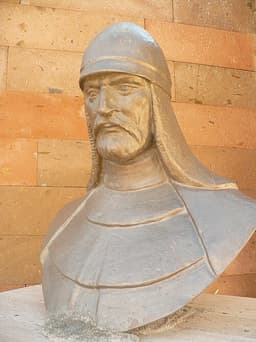
Alp Tigin
Emperor · Medieval
50.5Total

Nyatsimba Mutota
Emperor · Medieval
56.5Total
Basic Information
Born
911
1400
Died
963
1450
Era
Medieval
Medieval
Nationality
Ghaznavid Empire
Mozambique
Occupation
Emperor
Emperor
Civilization
Middle Eastern
Other
Score Comparison
Military (10%)
55.0
72.5
Political (20%)
33.6
68.0
Influence (20%)
56.4
59.0
Legacy (20%)
49.2
50.0
Leadership (15%)
50.7
40.0
Strategy (15%)
60.0
57.5
TOTAL
50.5
56.5
Alp Tigin — Complete Timeline
961 AD
Rebellion against the SamanidsPolitical Action◆ Major
Alp Tigin rebelled against the Samanid ruler Mansur I after being passed over for a governorship. He marched from Nishapur to Ghazni, defeating Samanid forces along the way, and established his own rule in eastern Afghanistan.
Impact: regional
963 AD
Consolidation of GhazniPolitical Action
Alp Tigin fortified Ghazni and organized a military state based on slave soldiers (ghilman). He established a stable administration that attracted scholars and merchants, turning Ghazni into a major regional power center.
Impact: regionalconstructive
Nyatsimba Mutota — Complete Timeline
1430 AD
Founding of the Mutapa EmpirePolitical Action
Nyatsimba Mutota led a migration north from Great Zimbabwe and founded the Mutapa Empire in the Zambezi valley. He established a new capital at Zvongombe and began territorial expansion.
Impact: regionalconstructive
1440 AD
Conquest of the TavaraWar◆ Major
Nyatsimba Mutota conquered the Tavara people in the Zambezi valley, incorporating their territory into the Mutapa Empire. This victory secured control over fertile agricultural lands and trade routes.
Impact: regional
1445 AD
Establishment of the Mwenemutapa TitlePolitical Action◆ Major
Nyatsimba Mutota adopted the title Mwenemutapa, meaning 'lord of the conquered lands,' formalizing the imperial structure. This title became hereditary and defined the ruler's authority over conquered peoples.
Impact: regionalconstructive
Expert Analysis
Alp Tigin vs Nyatsimba Mutota
# The Slave and the King
In the year 961, a Turkic slave commander named Alp Tigin marched his army from Nishapur, furious at being denied a governorship by his Samanid overlord. A continent away, in 1430, a Shona prince named Nyatsimba Mutota led his people north from Great Zimbabwe into the Zambezi valley, driven not by grievance but by vision. One founded a dynasty through rebellion; the other, through migration. Both built empires that would echo through centuries. But why did the slave’s creation crumble within decades, while the king’s endured for generations? The answer lies not in their circumstances, but in the men themselves.
Origins
Alp Tigin was born a slave in 911, likely somewhere in the Central Asian steppes, and sold into the Samanid military system. There, slave soldiers—ghilman—could rise to the highest ranks through loyalty and prowess, but they remained outsiders, dependent on their masters’ favor. His world was one of fragile patronage, where power came from the sword and could be lost with a single change of ruler. By contrast, Nyatsimba Mutota was born around 1400 into the ruling elite of Great Zimbabwe, a kingdom already rich from gold and trade. He inherited not a slave’s desperation but a prince’s confidence, shaped by a civilization that had built stone palaces and controlled Indian Ocean commerce. Where Alp Tigin learned to survive, Mutota learned to rule.
Rise to Power
Alp Tigin’s path was forged in crisis. When the Samanid emir Mansur I passed him over for the governorship of Khorasan in 961, the slight was existential: for a slave commander, favor was everything. He rebelled, marching from Nishapur with his personal army of ghilman. Defeated in open battle, he fled east to the remote fortress of Ghazni, a frontier outpost in modern Afghanistan. There, he seized control, defying the Samanids by fortifying the city and organizing a military state built entirely on slave soldiers. His rise was a gambler’s move—bold, desperate, and without a safety net.
Nyatsimba Mutota’s ascent was deliberate and ceremonial. Around 1430, he led a planned migration north from Great Zimbabwe, perhaps seeking new land or escaping overpopulation. He did not rebel; he expanded. In the Zambezi valley, he encountered the Tavara people, whom he conquered in 1440 through disciplined campaigns. By 1445, he had adopted the title Mwenemutapa—“lord of the conquered lands”—formalizing an empire that grew not from a personal grudge but from a dynastic ambition. His power came from consensus and conquest, not from a master’s whim.
Leadership & Governance
Alp Tigin ruled Ghazni like a warlord. He organized a state where the army—composed of Turkic slave soldiers—was both the instrument and the source of his authority. He was a capable administrator, consolidating control over a small territory, but his system was brittle: loyalty was bought with plunder, and succession depended on military strength, not legitimacy. His political score of 50.7 reflects a man who could seize power but struggled to institutionalize it. He was a general, not a statesman.
Nyatsimba Mutota, with a political score of 62.2 and a leadership score of 76.7, governed differently. He built the Mutapa Empire on a blend of military conquest and cultural integration. The Mwenemutapa title was not just a boast; it was a legal framework that bound conquered peoples through tribute and ritual. He maintained the gold trade routes that had made Great Zimbabwe wealthy, but he also extended control over the Zambezi’s agricultural and ivory resources. His leadership was charismatic and adaptive: he ruled through local chiefs, not slave soldiers, creating a stable, decentralized system that outlasted any single ruler.
Triumph & Tragedy
Alp Tigin’s greatest triumph was survival. From a slave’s rebellion, he carved a kingdom—Ghazni—that would later become the heart of the Ghaznavid Empire under his more famous successor, Mahmud. But his tragedy was personal: he died in 963, only two years after seizing power, leaving a fragile state that nearly collapsed. His legacy score of 62.1 is high only because of what came after him, not because of his own achievements.
Mutota’s triumph was the empire itself. By the time of his death in 1450, the Mutapa Empire stretched across the Zambezi valley, controlling gold, ivory, and trade routes that reached the Swahili coast. His tragedy was less dramatic but more profound: his successors would eventually face Portuguese encroachment, and the empire would fragment. Yet he died in power, his creation intact—a rare end for a founder.
Character & Destiny
Alp Tigin was a product of the slave-soldier system: ruthless, ambitious, and insecure. His rebellion was a response to humiliation, his governance a fortress mentality. He trusted only his ghilman, and that trust was a chain. His destiny was to be a catalyst, not a creator—to open a door that others would walk through. Nyatsimba Mutota was a king by birth and a builder by nature. He saw the Zambezi not as a refuge but as a canvas. His character was expansive, his destiny to found a dynasty that would bear his title for centuries. One man’s life was a fire that burned bright and brief; the other’s was a river that carved a valley.
Legacy
Alp Tigin is remembered as the founder of the Ghaznavid dynasty, but his name is overshadowed by Mahmud’s. His Ghazni became a Persianate cultural center, but his slave-based system was a time bomb. Nyatsimba Mutota is remembered as the first Mwenemutapa, a title that endured until the 20th century. The Mutapa Empire became a symbol of Shona resilience, its legacy woven into the identity of modern Zimbabwe and Mozambique.
Conclusion
What separates the slave from the king is not merely birth, but the kind of power they imagined. Alp Tigin saw power as a weapon to be held; Nyatsimba Mutota saw it as a structure to be built. One conquered a city; the other, a civilization. And in the end, the slave’s empire became a footnote in someone else’s story, while the king’s name became a title that outlived him. History rewards not just the ambitious, but those who build foundations deeper than their own ambition.
Rankings
🥇
Nyatsimba MutotaLeader
Mil: 72.5Pol: 68.0Inf: 59.0
56.5
🥈
Alp Tigin
Mil: 55.0Pol: 33.6Inf: 56.4
50.5
+6.0 behind
How This Comparison Works
Algorithm
Each figure is scored on 6 dimensions (0—100 scale) based on structured historical data: Military (10%), Political (20%), Influence (20%), Legacy (20%), Leadership (15%), Strategy (15%). The weighted total produces the final ranking.
Data Sources
Scores are computed from structured sub-indicators in the database. Scale factors adjust for era (Ancient ×0.85, Modern ×1.0) and civilization size (Eastern ×1.05, Other ×0.80) to account for differences in population and military scale.
Maximum 3 Figures
Comparisons are limited to 2—3 figures to ensure readability and statistical meaningfulness.
Error Margins
±5 points per dimension — Sub-scores are derived from historical records with inherent uncertainty. Two figures within 5 points on a dimension should be considered roughly equivalent in that area.
Total Score Accuracy
±3 points overall — The weighted combination of 6 dimensions produces a total score with approximately ±3 points of uncertainty. Differences of less than 3 points are not statistically significant— the figures are effectively tied.
Known Limitations
- Historical records are incomplete and uneven across civilizations
- Figures from oral-tradition societies may be underrepresented
- Occupation labels can misclassify multi-role figures
- Scores measure capability and impact, not moral character
- Quantitative scoring is a comparison tool, not absolute truth
Capability Radar
Military (10%) — Battles & Warfare
Battles
45
55
Win Rate
50
60
Expansion
50
65
Political (20%) — Governance & Reform
Reform
20
50
Diplomacy
30
55
Economy
20
50
Influence (20%) — Cultural & Global Reach
Cultural
30
45
Global
30
40
Legacy (20%) — Historical Impact
Historical
45
55
Longevity
40
50
Leadership (15%) — Power & Stability
Tenure
25
60
Stability
25
55
Strategy (15%) — Tactics & Innovation
Strategy
45
55
Tactics
40
50
Reform
30
40
Similar Comparisons
Comments & Discussion
1. **CavalryTactician88**6/16/2026
Comparing a disgruntled slave commander to a visionary king misses the point. Alp Tigin’s rebellion wasn’t petulance—it was strategic genius. He seized Ghazni in 962 with only 500 loyal ghilman, a textbook example of asymmetric warfare against a Samanid army ten times his size. His “crumbling” dynasty? It gave us Mahmud of Ghazni, who conquered Punjab. Mutota’s “endurance” looks more like stagnation—he just walked north and found room to expand. Which takes more balls?
2. **沙漠猎鹰**6/16/2026
作为一个军事史爱好者,我忍不住要怼那位说 Mutota 更伟大的仁兄。Alp Tigin 是个奴隶,出生在无依无靠的环境中,却靠刀剑打下了一个王朝——他的“崩溃”只是暂时的,他的精神传承给了加兹尼的马哈茂德,这个帝国最终吞并了整个北印度。而 Mutota 呢?他不过是带着一群人往北迁移,靠的是先辈留下的黄金和石头宫殿。谁更伟大?不是靠出身,而是靠逆袭。
3. **AncientTradeRoutes**6/16/2026
I’m with the data crowd on this one. Mutota’s empire didn’t “endure” because of his vision—it endured because he inherited a functioning gold trade network that tied Great Zimbabwe to Kilwa and the Indian Ocean. Alp Tigin’s Ghaznavid state had to build its economy from loot and raids, which is inherently unstable. Mutota’s success is 70% geography, 30% leadership. Tigin’s is 100% raw ambition. Both are impressive, but let’s not romanticize Mutota’s “kingly” inheritance.
4. **石刻考古学家**6/16/2026
我同意数据派,但换个角度:Mutota 的“持久性”其实是冷冰冰的经济事实。他的穆塔帕帝国控制了赞比西河谷的黄金和象牙,直接卖给阿拉伯商人,这种模式可持续几代人;而 Alp Tigin 的加兹尼王朝靠的是抢掠巴克特里亚,一旦打了败仗就崩盘。你倒是说说,哪个模式更聪明?不是谁更有血性,而是谁更懂钱袋子。
5. **PropagandaCritic**6/16/2026
Let’s cut the hero worship. Both narratives are propaganda: Alp Tigin’s “rebellion” was a slave coup that lucked into a power vacuum when the Samanids collapsed; Mutota’s “migration” was probably forced by drought in southern Zimbabwe around 1430. The sources are written centuries later, by courtiers who needed a founding myth. Don’t tell me about “vision”—show me the climate data and the casualty