Loading...
Alp Tigin vs Napoleon Bonaparte
Napoleon Bonaparte leads by 20.4 pts · 2 figures compared
…
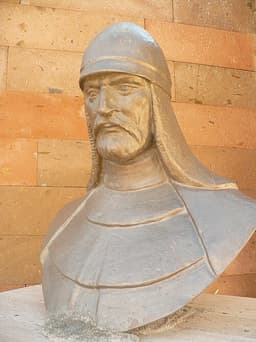
Alp Tigin
Emperor · Medieval
50.5Total

Napoleon Bonaparte
General · Modern
70.9Total
Basic Information
Born
911
1769
Died
963
1821
Era
Medieval
Modern
Nationality
Ghaznavid Empire
France
Occupation
Emperor
General
Civilization
Middle Eastern
Western
Score Comparison
Military (10%)
55.0
94.0
Political (20%)
33.6
72.0
Influence (20%)
56.4
40.0
Legacy (20%)
49.2
80.0
Leadership (15%)
50.7
78.0
Strategy (15%)
60.0
90.0
TOTAL
50.5
70.9
Alp Tigin — Complete Timeline
961 AD
Rebellion against the SamanidsPolitical Action◆ Major
Alp Tigin rebelled against the Samanid ruler Mansur I after being passed over for a governorship. He marched from Nishapur to Ghazni, defeating Samanid forces along the way, and established his own rule in eastern Afghanistan.
Impact: regional
963 AD
Consolidation of GhazniPolitical Action
Alp Tigin fortified Ghazni and organized a military state based on slave soldiers (ghilman). He established a stable administration that attracted scholars and merchants, turning Ghazni into a major regional power center.
Impact: regionalconstructive
Napoleon Bonaparte — Complete Timeline
1799 AD
Coup of 18 BrumaireOther◆ Major
Napoleon Bonaparte, with support from his brother Lucien and key political figures, overthrew the Directory in a bloodless coup. He established the Consulate with himself as First Consul, effectively becoming the ruler of France. This event ended the French Revolution's most unstable period.
French RevolutionCoupRise to Power
Impact: regional
1804 AD
Promulgation of the Napoleonic CodeOther◆ Major
Napoleon enacted the Civil Code of the French, known as the Napoleonic Code, a comprehensive set of laws that replaced the fragmented feudal legal systems. The code established legal equality, protected property rights, and secularized law. It became the basis for legal systems in many European and world countries.
Legal ReformNapoleonic CodeCivil Law
Impact: globalconstructive
1805 AD
Battle of AusterlitzWar◆ Major
Napoleon's Grande Arm
Napoleonic WarsBattleDecisive Victory
Impact: global
1812 AD
Invasion of RussiaWar◆ Major
Napoleon led the Grande Arm
Napoleonic WarsInvasionDisaster
Impact: globaldestructive
1815 AD
Battle of WaterlooWar◆ Major
Napoleon's French army was defeated by the combined forces of the Duke of Wellington's Anglo-Allied army and Gebhard Leberecht von Bl
Napoleonic WarsBattleFinal Defeat
Impact: globaldestructive
Expert Analysis
Napoleon Bonaparte vs Alp Tigin
The Emperor and the Slave
In the winter of 1812, Napoleon Bonaparte watched his Grand Army dissolve into the Russian snow, a catastrophe born of ambition that had once seemed limitless. A thousand years earlier, in the dust-choked passes of Central Asia, another commander—a Turkic slave named Alp Tigin—faced a very different kind of turning point: not a spectacular defeat, but a quiet rebellion that would found a dynasty. One man sought to conquer the world; the other, simply to claim a city. Their stories, separated by centuries and civilizations, ask a haunting question: what separates a titan from a footnote?
Origins
Napoleon Bonaparte was born in 1769 on the Mediterranean island of Corsica, a place recently annexed by France. His family belonged to the minor nobility, but their status was precarious—they were outsiders in a kingdom that had only just become French. This bred in young Napoleon a fierce ambition to prove himself, a hunger that would never be sated. He entered a French military academy at nine, and by the age of sixteen, he was a lieutenant. The French Revolution, erupting when he was twenty, shattered the old order and created a ladder for talent. Napoleon climbed it with ruthless speed.
Alp Tigin’s origins are far more obscure. Born around 911, he was a Turkic slave—likely captured as a child from the steppes north of the Oxus River. In the Samanid Empire of Persia, such slaves (known as *ghilman*) were trained as soldiers and administrators, their loyalty unencumbered by family or tribal ties. Alp Tigin rose through this system, becoming a general and eventually the governor of Khorasan, a vast province. Unlike Napoleon, he began with nothing—not even freedom—and his world was one of Islamic courts, Persian bureaucracy, and Turkic warriors. His era was medieval, his civilization Middle Eastern, and his path was defined by the logic of slavery and patronage, not revolution.
Rise to Power
Napoleon’s rise was a series of gambles that paid off. In 1793, at twenty-four, he drove British forces from the port of Toulon, earning promotion to brigadier general. In 1796, he took command of a starving, unpaid army in Italy and turned it into a conquering force, winning battles like Lodi and Arcole through speed, audacity, and personal courage. By 1799, he had overthrown the French government in a coup and installed himself as First Consul. Five years later, he crowned himself Emperor. His path was vertical, explosive, and public—a drama played out before all of Europe.
Alp Tigin’s rise was quieter, more patient, and ultimately more precarious. In 961, after decades of loyal service, he expected to be appointed governor of Khorasan. Instead, the new Samanid ruler, Mansur I, passed him over. This was an insult, but also a threat: in a slave-soldier system, favor was everything. Alp Tigin rebelled. He marched from Nishapur with his personal retinue of Turkic slaves and free warriors, heading east toward the Hindu Kush. He did not seek to topple the Samanids—only to carve out a domain where he could not be touched. After a series of sieges and negotiations, he seized the fortress city of Ghazni (in modern Afghanistan) in 963. His rise was a lateral move: a retreat into the mountains, not a march on a capital.
Leadership & Governance
As emperor, Napoleon was a whirlwind. He reformed French law into the Napoleonic Code, a rational system that abolished feudal privileges and enshrined meritocracy. He centralized the state, built roads and schools, and negotiated the Concordat with the Pope, stabilizing the Church after the Revolution’s chaos. His military genius was staggering: at Austerlitz in 1805, he destroyed a larger Austro-Russian army with a feigned retreat and a devastating flank attack. He led from the front, inspiring men with his presence. But his political wisdom was flawed—he alienated Spain, invaded Russia, and refused to compromise. His governance was a paradox: brilliant in design, brittle in execution.
Alp Tigin, by contrast, ruled a small, fortified kingdom. He consolidated Ghazni, turning it into a base for raiding into India and defending against the Samanids. He organized his state around the *ghilman* system—slave soldiers who were loyal only to him, not to tribal or family ties. This was the same system that had raised him, and he perfected it. His governance was pragmatic, not visionary: he collected taxes, built walls, and kept his army fed. He did not reform laws or build an empire. He simply held on.
Triumph & Tragedy
Napoleon’s greatest triumph was his empire’s peak in 1810–1811, when he controlled most of Europe from Spain to Poland. His greatest tragedy was the Russian campaign of 1812: 600,000 men marched east; fewer than 100,000 returned. He was exiled to Elba, escaped, and was finally defeated at Waterloo in 1815. His tragedy was one of overreach—a man who could not stop.
Alp Tigin’s triumph was survival itself. He died in 963, only months after seizing Ghazni, but his dynasty endured. His son-in-law, Sebuktigin, and later his grandson, Mahmud of Ghazni, would expand the kingdom into an empire stretching from Iran to India. Alp Tigin’s tragedy was that he never saw this. He died a rebel, not a conqueror, his name remembered only by historians.
Character & Destiny
Napoleon was driven by an insatiable ego. “Impossible is not a word in my dictionary,” he once said. He believed he could reshape reality through willpower. This made him brilliant on the battlefield but blind to limits. Alp Tigin, shaped by slavery and survival, was cautious and calculating. He knew when to retreat. His personality was not that of a world-beater but of a survivor. Destiny favored Napoleon with a revolutionary era that rewarded audacity; it gave Alp Tigin a medieval world where patience was the only path.
Legacy
Napoleon’s legacy is global. The Napoleonic Code influenced legal systems across Europe and the Americas. His wars redrew borders and spread nationalism. He is remembered as a genius and a tyrant, a liberator and a despot. Alp Tigin’s legacy is narrower but real: he founded the Ghaznavid dynasty, which brought Islam to northern India and created a Turkic-Persian synthesis that shaped the region for centuries. Yet his name is obscure, known mainly to specialists.
Conclusion
Standing at the edge of the Ghazni citadel, Alp Tigin could see the snow-dusted peaks of the Hindu Kush. Standing at the Kremlin in 1812, Napoleon saw the burning city of Moscow. One man looked at the horizon and saw a fortress; the other saw a continent. Their differences were not just of talent but of context. Napoleon lived in an age of revolution, where one man could remake the world. Alp Tigin lived in an age of empires, where survival was victory. Both were products of their time, and both shaped history—but one remains a legend, the other a ghost. The difference is not just in what they did, but in what they dared to dream.
Rankings
🥇
Napoleon BonaparteLeader
Mil: 94.0Pol: 72.0Inf: 40.0
70.9
🥈
Alp Tigin
Mil: 55.0Pol: 33.6Inf: 56.4
50.5
+20.4 behind
How This Comparison Works
Algorithm
Each figure is scored on 6 dimensions (0—100 scale) based on structured historical data: Military (10%), Political (20%), Influence (20%), Legacy (20%), Leadership (15%), Strategy (15%). The weighted total produces the final ranking.
Data Sources
Scores are computed from structured sub-indicators in the database. Scale factors adjust for era (Ancient ×0.85, Modern ×1.0) and civilization size (Eastern ×1.05, Other ×0.80) to account for differences in population and military scale.
Maximum 3 Figures
Comparisons are limited to 2—3 figures to ensure readability and statistical meaningfulness.
Error Margins
±5 points per dimension — Sub-scores are derived from historical records with inherent uncertainty. Two figures within 5 points on a dimension should be considered roughly equivalent in that area.
Total Score Accuracy
±3 points overall — The weighted combination of 6 dimensions produces a total score with approximately ±3 points of uncertainty. Differences of less than 3 points are not statistically significant— the figures are effectively tied.
Known Limitations
- Historical records are incomplete and uneven across civilizations
- Figures from oral-tradition societies may be underrepresented
- Occupation labels can misclassify multi-role figures
- Scores measure capability and impact, not moral character
- Quantitative scoring is a comparison tool, not absolute truth
Capability Radar
Military (10%) — Battles & Warfare
Battles
45
95
Win Rate
50
90
Expansion
50
95
Political (20%) — Governance & Reform
Reform
20
95
Diplomacy
30
80
Economy
20
85
Influence (20%) — Cultural & Global Reach
Cultural
30
85
Global
30
90
Legacy (20%) — Historical Impact
Historical
45
95
Longevity
40
90
Leadership (15%) — Power & Stability
Tenure
25
85
Stability
25
70
Strategy (15%) — Tactics & Innovation
Strategy
45
95
Tactics
40
98
Reform
30
92
Similar Comparisons
Comments & Discussion
THE_GHULAM_GAMBIT6/16/2026
Napoleon’s story is one of meritocracy, sure—but Alp Tigin’s is the real power move. Napoleon inherited a European military tradition and a revolutionary state in collapse. Alp Tigin? A steppe slave in a Persian court, no family, no name, no rights. He didn't just climb a ladder—he built one from scratch, then torched it. Founding the Ghaznavid dynasty from a mutiny in Ghazni wasn't a footnote; it's the blueprint for every self-made empire from Delhi to the Deccan. Titans, please.
兵棋推演者6/16/2026
拿破仑败于俄国寒冬,是大战略的溃败;阿尔普·特勤的胜利,靠的是战术精算和人心把握。拿皇在博罗季诺耗尽了骑兵,却幻想莫斯科会投降——这是典型的资源错配。反观阿尔普·特勤,他先用一千名精锐在加兹尼城外打了个闪电突袭,然后用三年时间挖沟蓄粮、收买当地地主,硬是把一座小城变成了王朝堡垒。一个靠士气赌博,一个靠后勤布局:谁是真正的军人,一目了然。
VIVE_LA_HISTOIRE6/16/2026
Comparing the "slave" Alp Tigin to "master" Napoleon is ahistorical romanticism. Alp Tigin was always part of a system—Samanid bureaucracy, Turkic military patronage networks—that produced dozens of similar commanders. His "dynasty" only outlived him because his successor Sebuktigin was exceptional. Napoleon, for all his flaws, reshaped an entire continent's laws, warfare, and borders within a single lifetime. One created the Napoleonic Code; the other conquered a dusty fort. Put down the steppe
圣伯纳德回顾者6/16/2026
说什么拿破仑野心无限放大了灾难,这不是废话吗?1796年意大利战役时,他带着四万饥兵翻越阿尔卑斯山,用炮兵掩护步兵穿插,三天内击溃了奥地利三倍于己的兵力——这才是真正的军事天才。阿尔普·特勤在呼罗珊的所谓"叛乱",不过是一次地方军阀的内斗,连周边绿洲领主都没吓住。史书给了他面子,因为后世的加兹尼王朝需要祖先神话。别拿山寇和帝王比,格局不是同个物种。
数据敲钟人6/16/2026
把"拿破仑失败"和"阿尔普·特勤成功"当一对儿谈,是叙事偏差的样板戏。拿破仑的损失率:60万大军挺进俄国,最终只有不到3万活着回来——这是人类史上最惨的军事灾难之一,但我们记得他的法典和政敌。阿尔普·特勤的损失率呢?史料里根本找不到数字——