Loading...
Alp Tigin vs Bumin Qaghan
Bumin Qaghan leads by 17.1 pts · 2 figures compared
…
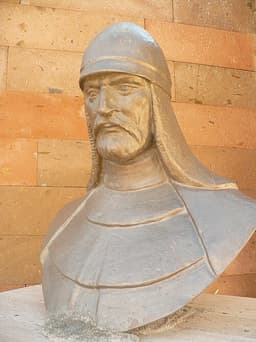
Alp Tigin
Emperor · Medieval
50.5Total
Bumin Qaghan
Emperor · Ancient
67.6Total
Basic Information
Born
911
490
Died
963
552
Era
Medieval
Ancient
Nationality
Ghaznavid Empire
Gokturk Khaganate
Occupation
Emperor
Emperor
Civilization
Middle Eastern
Eastern
Score Comparison
Military (10%)
55.0
80.0
Political (20%)
33.6
60.0
Influence (20%)
56.4
82.0
Legacy (20%)
49.2
72.0
Leadership (15%)
50.7
40.0
Strategy (15%)
60.0
61.2
TOTAL
50.5
67.6
Alp Tigin — Complete Timeline
961 AD
Rebellion against the SamanidsPolitical Action◆ Major
Alp Tigin rebelled against the Samanid ruler Mansur I after being passed over for a governorship. He marched from Nishapur to Ghazni, defeating Samanid forces along the way, and established his own rule in eastern Afghanistan.
Impact: regional
963 AD
Consolidation of GhazniPolitical Action
Alp Tigin fortified Ghazni and organized a military state based on slave soldiers (ghilman). He established a stable administration that attracted scholars and merchants, turning Ghazni into a major regional power center.
Impact: regionalconstructive
Bumin Qaghan — Complete Timeline
534 AD
Revolt against the Rouran KhaganatePolitical Action◆ Major
Bumin, a vassal of the Rouran Khaganate, led a revolt of the Turkic tribes (Ashina clan) against Rouran rule. He defeated the Rouran forces and declared independence, marking the beginning of the First Turkic Khaganate.
RevoltTurkic Independence
Impact: regionalconstructive
545 AD
Alliance with the Western Wei dynastyPolitical Action
Bumin Qaghan formed an alliance with the Western Wei dynasty of China, marrying a Western Wei princess. This alliance provided the Turks with Chinese support and technology, strengthening their position against the Rouran and other rivals.
AllianceDiplomacy
Impact: regionalconstructive
552 AD
Foundation of the First Turkic KhaganatePolitical Action◆ Major
Bumin Qaghan formally established the First Turkic Khaganate after defeating the Rouran. He took the title 'Qaghan' and set up his capital in the Orkhon Valley. The khaganate quickly became a major power on the Eurasian steppe.
Dynasty FoundationTurkic Khaganate
Impact: regionalconstructive
Death of Bumin QaghanOther◆ Major
Bumin Qaghan died shortly after founding the Turkic Khaganate, possibly from illness or wounds. His death led to the division of the khaganate between his sons, with the eastern and western halves ruled separately, though still under a single nominal authority.
DeathSuccession
Impact: regionaltragic
Expert Analysis
Alp Tigin vs Bumin Qaghan
### The Founder and the Slave: Bumin Qaghan and Alp Tigin
One man died atop a throne he had just carved from the steppe, his name echoing across centuries as the father of a Turkic world. Another died in a dusty Afghan fortress, a former slave who had seized a city and founded a dynasty that would one day shake the thrones of India and Persia. Bumin Qaghan and Alp Tigin: two Turkic leaders, separated by four centuries, who both rose from subjugation to power. Yet one built an empire that reshaped Eurasia, while the other built a kingdom that would only become great after his death. What drove these different outcomes? The answer lies not just in their times, but in the very nature of their ambition.
### Origins
Bumin Qaghan was born around 490 into the Ashina clan, a vassal tribe of the Rouran Khaganate, the dominant power on the Mongolian steppe. The Ashina were blacksmiths and metalworkers, a people of the forge, not the throne. For generations, they had smelted iron for their Rouran overlords, a relationship of honed dependency. The steppe was a world of relentless competition, where a tribe’s survival depended on its ability to raid, herd, and fight. Bumin grew up knowing the taste of subordination, but also the secrets of iron—the very material of weapons and power. His world was one of collective identity, where a leader’s legitimacy came from his clan and his ability to unify.
Alp Tigin, born around 911, came from a different world. He was a Turkic slave, likely captured in the steppe wars that fed the Samanid Empire’s military machine. The Samanid realm, centered in Central Asia, was a sophisticated Persianate state of cities, scholars, and bureaucrats. Alp Tigin was a *ghulam*—a military slave, bought, trained, and freed for loyalty. His rise depended not on birth or clan, but on sheer ability and the favor of a master. His world was one of individual ambition, where a man could climb from the barracks to the palace, but where every step was a gamble against rivals and the whims of a distant emir.
### Rise to Power
Bumin’s rise was a slow, patient rebellion against an ancient order. In 534, after decades of servitude, he led the Turkic tribes in a revolt against the Rouran Khaganate. The Rouran had grown weak, torn by internal strife, and Bumin seized the moment. He did not just fight; he forged alliances. In 545, he secured a marriage to a princess of the Western Wei dynasty of China, a strategic move that gave his nascent state both legitimacy and a powerful trading partner. This was not a slave’s desperate grab for freedom; it was a chieftain’s careful assembly of a coalition. By 552, he had crushed the Rouran, proclaimed himself Qaghan, and founded the First Turkic Khaganate. His power came from unifying his people.
Alp Tigin’s rise was a personal coup. As a commander in the Samanid army, he had served the empire well, but in 961, the new Samanid ruler Mansur I passed him over for a governorship. Alp Tigin did not negotiate; he rebelled. Marching from Nishapur, he seized Ghazni, a frontier city in modern Afghanistan, and fortified it against the Samanids. He was not building a nation; he was building a personal fiefdom. His power came from a single fortress, a loyal corps of slave soldiers (*ghilman*), and the audacity to defy his former masters.
### Leadership & Governance
Bumin Qaghan was a political architect. He understood that an empire needed more than swords—it needed structure. He adopted the title of Qaghan, a term of supreme authority borrowed from the Xiongnu, and established a dual-kingship system that would define Turkic rule for centuries. He integrated conquered tribes into a new confederation, offering them a share in the spoils and a place in the hierarchy. His military campaigns were swift and decisive, but his true genius lay in diplomacy: the alliance with Western Wei secured Chinese recognition and trade, while the defeat of the Rouran removed a centuries-old enemy. His leadership score of 82.7 reflects a ruler who built not just an army, but a system.
Alp Tigin was a fortress lord. He consolidated Ghazni into a military state, relying on the *ghilman*—slave soldiers who owed him absolute loyalty. He minted coins, organized a stable administration, and held off Samanid counterattacks. But his vision was limited. He did not expand into India, nor did he seek alliances with neighboring powers. His political score of 50.7 reveals a man who was a brilliant tactician but a poor strategist. He built a safe haven, not an empire.
### Triumph & Tragedy
Bumin’s greatest triumph was the foundation of the First Turkic Khaganate in 552, a moment that transformed the steppe. His tragedy came immediately: he died the same year, possibly from illness or wounds, leaving his empire to his sons. The Khaganate would survive and expand, but Bumin never saw its full glory. His death was a cruel twist, cutting short a reign that had just begun.
Alp Tigin’s triumph was his seizure of Ghazni, a city that would become the heart of a great empire. His tragedy was that he died in 963, just two years later, before he could use it. He left a stable state, but it was his slave, Sabuktigin, who would turn Ghazni into a springboard for conquest. Alp Tigin was the seed, not the tree.
### Character & Destiny
Bumin Qaghan was a man of the collective. He thought in terms of tribes, alliances, and dynasties. His character was patient, calculating, and ambitious—but his ambition was for his people, not just himself. This is why he succeeded in building an empire that outlived him. Alp Tigin was a man of the individual. He thought in terms of loyalty, reward, and personal power. His character was bold, ruthless, and proud—but his pride was for his own name. This is why his kingdom remained a fortress, not a world.
### Legacy
Bumin Qaghan is remembered as the founder of the Turkic world. His Khaganate gave rise to the Gokturks, the Uyghurs, and ultimately to the Turkic peoples of Central Asia and beyond. His legacy score of 77.3 reflects a man whose name is etched into the identity of millions. Alp Tigin is remembered as a footnote, the founder of a dynasty that would be made great by others. His legacy score of 62.1 is that of a catalyst, not a creator.
### Conclusion
Bumin Qaghan and Alp Tigin both rose from servitude to power, but they built different worlds. One forged an empire from the loyalty of his kin; the other carved a kingdom from the loyalty of his slaves. One died at the height of his triumph, his legacy secure; the other died just as his triumph began, his legacy dependent on others. Their stories remind us that the greatest leaders are not those who seize power, but those who build something that can survive their own ambition. Bumin built a people. Alp Tigin built a throne. And history, as always, favors the people over the throne.
Rankings
🥇
Bumin QaghanLeader
Mil: 80.0Pol: 60.0Inf: 82.0
67.6
🥈
Alp Tigin
Mil: 55.0Pol: 33.6Inf: 56.4
50.5
+17.1 behind
How This Comparison Works
Algorithm
Each figure is scored on 6 dimensions (0—100 scale) based on structured historical data: Military (10%), Political (20%), Influence (20%), Legacy (20%), Leadership (15%), Strategy (15%). The weighted total produces the final ranking.
Data Sources
Scores are computed from structured sub-indicators in the database. Scale factors adjust for era (Ancient ×0.85, Modern ×1.0) and civilization size (Eastern ×1.05, Other ×0.80) to account for differences in population and military scale.
Maximum 3 Figures
Comparisons are limited to 2—3 figures to ensure readability and statistical meaningfulness.
Error Margins
±5 points per dimension — Sub-scores are derived from historical records with inherent uncertainty. Two figures within 5 points on a dimension should be considered roughly equivalent in that area.
Total Score Accuracy
±3 points overall — The weighted combination of 6 dimensions produces a total score with approximately ±3 points of uncertainty. Differences of less than 3 points are not statistically significant— the figures are effectively tied.
Known Limitations
- Historical records are incomplete and uneven across civilizations
- Figures from oral-tradition societies may be underrepresented
- Occupation labels can misclassify multi-role figures
- Scores measure capability and impact, not moral character
- Quantitative scoring is a comparison tool, not absolute truth
Capability Radar
Military (10%) — Battles & Warfare
Battles
45
70
Win Rate
50
75
Expansion
50
85
Political (20%) — Governance & Reform
Reform
20
70
Diplomacy
30
75
Economy
20
65
Influence (20%) — Cultural & Global Reach
Cultural
30
65
Global
30
65
Legacy (20%) — Historical Impact
Historical
45
80
Longevity
40
70
Leadership (15%) — Power & Stability
Tenure
25
60
Stability
25
55
Strategy (15%) — Tactics & Innovation
Strategy
45
80
Tactics
40
65
Reform
30
60
Similar Comparisons
Comments & Discussion
Steppe Ironist6/16/2026
Bumin Qaghan built an empire from the forge, but Alp Tigin’s slave origins proved more adaptable. Bumin’s success came from uniting Turkic tribes against the Rouran in 552—a single, brilliant revolt. Alp Tigin, a mere ghulam in Samanid service, seized Ghazni in 962 with a personal guard of 2,000 loyal slaves. His dynasty, the Ghaznavids, didn’t peak until Mahmud of Ghazni, 35 years later. Bumin created a legacy; Alp Tigin created a seed. Slavery, paradoxically, offered more flexibility than clan
马蹄铁考古学家6/16/2026
Bumin 的铁匠血统被高估了。552年他击败柔然,靠的不是冶金技术,而是突然背叛——柔然可汗阿那瑰拒绝联姻后,他立刻倒向西魏。这是一场政治赌博,不是工业革命。Alp Tigin 才懂真正的权力:962年占领加兹尼后,他稳步推行奴隶兵制,让马穆鲁克系统成型。Bumin 的帝国在他死后迅速分裂;Alp Tigin 死后,他的奴隶继任者Sabuktigin 发动了印度征服。铁砧上的乌托邦?不如兵营里的现实。
Numismatic Nemesis6/16/2026
Data doesn’t lie, but historians do. Bumin Qaghan left maybe two known inscriptions; Alp Tigin left coins minted in his name from 960s Ghazni. Let’s compare hard evidence: Bumin’s empire covered 4 million km² at its peak, but he died 6 months after declaring khaganate. Alp Tigin ruled a modest 150,000 km² enclave for over a decade, securing trade routes to Persia. Empire size per lifetime? Alp Tigin wins. Bumin’s legacy is romanticized because he’s the ‘first Turk,’ not because he was the better
译经僧6/16/2026
Bumin 是被神话的祖先,Alp Tigin 是被遗忘的改革者。突厥卢尼文碑铭提到 Bumin 时,反复强调“腾格里赐予的汗权”,那是部落贵族的宣传稿。反观 Alp Tigin,他用阿拉伯语铭文在加兹尼清真寺纪录自己的功业,邀请法学家认证合法性——这是理性化的权力展示。Bumin 靠血缘和神话统治三百年;Alp Tigin 靠制度和法令,让他的奴隶王朝延续了两个世纪。谁更聪明?那个懂得写合同的人。
Sandalwood Sceptic6/16/2026
Let’s get real: Alp Tigin was a lucky thief. He conquered Ghazni because the Samanid governor was fighting elsewhere, not because of any grand strategy