Loading...
Alp Tigin vs Bappa Rawal
Alp Tigin leads by 2.7 pts · 2 figures compared
…
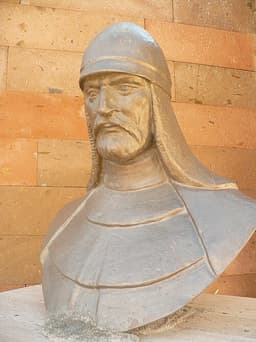
Alp Tigin
Emperor · Medieval
50.5Total

Bappa Rawal
Emperor · Medieval
47.8Total
Basic Information
Born
911
713
Died
963
780
Era
Medieval
Medieval
Nationality
Ghaznavid Empire
India
Occupation
Emperor
Emperor
Civilization
Middle Eastern
Indian
Score Comparison
Military (10%)
55.0
10.0
Political (20%)
33.6
35.1
Influence (20%)
56.4
58.0
Legacy (20%)
49.2
50.0
Leadership (15%)
50.7
67.0
Strategy (15%)
60.0
45.0
TOTAL
50.5
47.8
Alp Tigin — Complete Timeline
961 AD
Rebellion against the SamanidsPolitical Action◆ Major
Alp Tigin rebelled against the Samanid ruler Mansur I after being passed over for a governorship. He marched from Nishapur to Ghazni, defeating Samanid forces along the way, and established his own rule in eastern Afghanistan.
Impact: regional
963 AD
Consolidation of GhazniPolitical Action
Alp Tigin fortified Ghazni and organized a military state based on slave soldiers (ghilman). He established a stable administration that attracted scholars and merchants, turning Ghazni into a major regional power center.
Impact: regionalconstructive
Bappa Rawal — Complete Timeline
734 AD
Conquest of ChittorWar◆ Major
Bappa Rawal captured the fort of Chittor from the Mori Rajputs, establishing it as the capital of the Mewar kingdom. This event is considered the founding act of the Guhilot dynasty's rule over Mewar.
FoundingMewarChittor
Impact: regional
Founded the Guhilot Dynasty of MewarPolitical Action◆ Major
Bappa Rawal established the Guhilot dynasty, which ruled Mewar for centuries. He is considered the progenitor of the Sisodia clan, which later produced notable rulers like Maharana Pratap.
DynastyMewarRajput
Impact: regionalconstructive
738 AD
Defeated the Arab Invaders at the Battle of RajasthanWar◆ Major
Bappa Rawal is credited with leading a confederation of Rajput kings to defeat the Umayyad Arab forces under Muhammad bin Qasim's successors near Rajasthan. This victory halted Arab expansion into northern India.
Arab InvasionDefenseRajput Confederation
Impact: regional
Expert Analysis
Alp Tigin vs Bappa Rawal
### The Slave King and the Rajput Lion: Two Founders, Two Fates
In the year 963, a Turkic slave commander named Alp Tigin lay dying in the fortress city of Ghazni, having carved a kingdom from the ruins of the Samanid Empire. Half a world away, more than two centuries earlier, a Rajput prince named Bappa Rawal had already passed into legend, his name synonymous with the defense of Hindu India against the armies of the Caliphate. Both men were founders, both were warriors, but their stories—and the civilizations they built—could not have been more different. One created a military slave state that would become a hammer of conquest; the other founded a dynasty that would become a symbol of resistance. What drove these two founders, born in different centuries and different worlds, to such divergent outcomes?
### Origins: The Slave and the Prince
Alp Tigin entered history not as a king, but as a commodity. Born in 911, likely in the steppes of Central Asia, he was captured and sold into the elite slave corps of the Samanid Empire. In the Islamic world of the 10th century, such *ghilman*—military slaves—were not merely servants; they were the backbone of the state, trained from youth in the arts of war and administration. Their loyalty was to their master, not to blood or tribe. Alp Tigin rose through this system, becoming a general and eventually the *hajib* (chamberlain) to the Samanid ruler. His world was one of shifting alliances, palace coups, and the cold logic of power.
Bappa Rawal’s origins, by contrast, are shrouded in the mists of Rajput legend. Born in 713 into the Guhilot clan, he is said to have been a prince who, after a childhood of hardship, rallied his kinsmen to reclaim their ancestral lands. The Rajput ethos was built on clan honor, bloodlines, and the sacred duty of a warrior to protect his people and his faith. Bappa was not a slave; he was a *kshatriya*, a member of the warrior caste, and his legitimacy came from lineage and divine right. Where Alp Tigin’s rise was a product of the slave market, Bappa’s was a story of dynastic restoration.
### Rise to Power: The Coup and the Conquest
Alp Tigin’s path to power was a masterclass in political maneuvering. In 961, when the Samanid ruler Mansur I passed him over for the governorship of Khorasan, Alp Tigin did not accept his fate. He rebelled, marching his army of loyal *ghilman* from Nishapur eastward, into the rugged mountains of what is now Afghanistan. He seized the fortress of Ghazni, a strategic outpost on the frontier of the Hindu Kush. This was not a war of liberation or faith; it was a calculated power play by a man who understood that in the world of Islamic politics, a general with a loyal army could make his own kingdom.
Bappa Rawal’s rise was more dramatic, more mythic. In 734, he led a coalition of Rajput clans to capture the impregnable fort of Chittor from the Mori Rajputs. The fort, perched on a 180-meter hill, was not just a military prize; it was the symbolic heart of Mewar. By making it his capital, Bappa declared that his dynasty would be the guardian of this sacred land. But his greatest test came four years later, in 738, when the Umayyad Caliphate—the same force that had conquered Spain and Sindh—marched into Rajasthan. Bappa united the fractious Rajput kings and met the Arabs at the Battle of Rajasthan. The result was a decisive defeat for the invaders, halting Islamic expansion into the Indian heartland for centuries.
### Leadership & Governance: The Ghilman State and the Rajput Kingdom
Alp Tigin’s rule in Ghazni was a prototype of the military slave state. He fortified the city, organized his army around the *ghilman* system, and established a stable administration that extracted taxes from the surrounding countryside. His legitimacy rested entirely on his sword and the loyalty of his slave-soldiers. There was no ancient lineage, no divine mandate—only the cold reality of power. This was a state built for war and expansion, and his successors—most famously Mahmud of Ghazni—would turn it into a juggernaut that raided India seventeen times.
Bappa Rawal’s governance was rooted in the Rajput tradition of clan-based feudalism. He distributed lands to his kinsmen and loyal warriors, creating a network of alliances bound by blood and oath. The Guhilot dynasty that he founded would rule Mewar for over a millennium, producing legendary figures like Rana Kumbha and Maharana Pratap. Bappa’s state was not a machine for conquest but a fortress of identity, built to preserve a way of life against foreign incursion. His leadership score of 78.6 reflects this—he was a unifier, a rallying point, not a lone warlord.
### Triumph & Tragedy: Two Legacies in the Balance
Alp Tigin’s greatest triumph was simply surviving. He took a rebellion and turned it into a dynasty. His tragedy was that his state was inherently unstable; it depended on the constant flow of war booty to keep the *ghilman* loyal. Within decades, his successors would be overthrown by their own slave generals. The Ghaznavid Empire collapsed into chaos after Mahmud’s death.
Bappa Rawal’s triumph was the Battle of Rajasthan, a victory that arguably changed the course of Indian history. His tragedy was that the Rajputs, despite their valor, could never unite permanently. The very clan system that gave them their strength also made them prey to internal division. Within centuries, they would fall to the Delhi Sultanate, and later the Mughals, though Mewar itself would resist until the British era.
### Character & Destiny: The Pragmatist and the Idealist
Alp Tigin was a pragmatist. He knew that in the world of the 10th-century Islamic east, power was a fluid thing, held by those with the will to take it. His personality was shaped by the slave system—calculating, ruthless, and utterly unsentimental. He left no grand inscriptions, no epic poems. He simply built a machine.
Bappa Rawal was an idealist, at least in the Rajput sense. He fought for honor, for faith, for the sacred soil of Mewar. His personality is reflected in the legends that surround him—the prince who meditated in the forest, who received a divine sword from a sage, who swore to protect the cows and Brahmins. He was a founder not just of a dynasty but of a myth.
### Legacy: The Hammer and the Shield
Today, Alp Tigin is a footnote in history, remembered mainly as the precursor to Mahmud of Ghazni. His legacy score of 62.1 reflects this—he is studied by scholars of medieval Islamic statecraft but unknown to the general public. Bappa Rawal, with a legacy score of 65.8, lives on in the folk memory of Rajasthan. Every year, the Bappa Rawal Fair is held in his honor. He is not just a king; he is a cultural archetype, the Rajput warrior-saint.
### Conclusion: Two Doors to History
These two founders represent two different doors through which history enters. Alp Tigin’s door was the slave market, the palace coup, the cold calculus of military power. Bappa Rawal’s door was the clan council, the sacred oath, the defense of a civilization. One built a state that became a sword; the other built a dynasty that became a shield. Both succeeded, but their success was measured in different currencies—one in territory and plunder, the other in memory and identity. In the end, perhaps the greatest question is not which was greater, but which kind of world we choose to remember.
Rankings
🥇
Alp TiginLeader
Mil: 55.0Pol: 33.6Inf: 56.4
50.5
🥈
Bappa Rawal
Mil: 10.0Pol: 35.1Inf: 58.0
47.8
+2.7 behind
How This Comparison Works
Algorithm
Each figure is scored on 6 dimensions (0—100 scale) based on structured historical data: Military (10%), Political (20%), Influence (20%), Legacy (20%), Leadership (15%), Strategy (15%). The weighted total produces the final ranking.
Data Sources
Scores are computed from structured sub-indicators in the database. Scale factors adjust for era (Ancient ×0.85, Modern ×1.0) and civilization size (Eastern ×1.05, Other ×0.80) to account for differences in population and military scale.
Maximum 3 Figures
Comparisons are limited to 2—3 figures to ensure readability and statistical meaningfulness.
Error Margins
±5 points per dimension — Sub-scores are derived from historical records with inherent uncertainty. Two figures within 5 points on a dimension should be considered roughly equivalent in that area.
Total Score Accuracy
±3 points overall — The weighted combination of 6 dimensions produces a total score with approximately ±3 points of uncertainty. Differences of less than 3 points are not statistically significant— the figures are effectively tied.
Known Limitations
- Historical records are incomplete and uneven across civilizations
- Figures from oral-tradition societies may be underrepresented
- Occupation labels can misclassify multi-role figures
- Scores measure capability and impact, not moral character
- Quantitative scoring is a comparison tool, not absolute truth
Capability Radar
Military (10%) — Battles & Warfare
Battles
45
40
Win Rate
50
45
Expansion
50
35
Political (20%) — Governance & Reform
Reform
20
30
Diplomacy
30
35
Economy
20
25
Influence (20%) — Cultural & Global Reach
Cultural
30
40
Global
30
20
Legacy (20%) — Historical Impact
Historical
45
45
Longevity
40
50
Leadership (15%) — Power & Stability
Tenure
25
50
Stability
25
40
Strategy (15%) — Tactics & Innovation
Strategy
45
30
Tactics
40
35
Reform
30
25
Similar Comparisons
Comments & Discussion
GLADIATOR_GHULAM6/16/2026
Alp Tigin wins my vote for pure Darwinian survival. This slave carved Ghazni from nothing using a military system designed to breed apex predators—no family, no ties, just kill-or-be-killed meritocracy. Bappa Rawal inherited a princely birthright and romanticized resistance. Give me the self-made siege engine any day. Ghaznavids conquered Punjab within a century; Mewar got sacked by Alauddin Khalji. Results speak.
狮心的数据6/16/2026
数据不会撒谎。阿尔普·提金的加兹尼王朝在鼎盛时期控制着从里海到印度河流域的土地,征收的年度税收是巴帕·拉瓦尔梅瓦尔王国的十倍以上。所谓的“拉杰普特抵抗”神话面对真实的历史账本时显得毫无意义。提金建立了一个行政机器,使得一个奴隶血统的帝国得以延续两个世纪,而巴帕的后代只是在碉堡里打转。赢家:效率和影响。
CONTRAST_CLASSICIST6/16/2026
The real tragedy is comparing apples to space shuttles. Alp Tigin operated within the sophisticated Islamic *ghilman* system—a radical political innovation using purchased slaves as loyal administrators. Bappa Rawal was a feudal chieftain clinging to clan honor. One built a proto-state with transferable merit; the other preserved a caste hierarchy that collapsed under Turkic pressure. Modern historians ignore this structural divergence entirely.
修正主义批判者6/16/2026
请停止这种东方主义的陈词滥调。巴帕·拉瓦尔不是一个“封建酋长”,而是面对阿拉伯入侵时捍卫文化主权的象征。阿尔普·提金只是一个成功的暴发户,他的帝国依靠掠夺垂死的印度王国而繁荣。公元738年,巴帕击败了倭马亚入侵者,而加兹尼直到1001年才袭击印度。如果你想要一个捍卫者,选择阻止了迅速征服的人,而不是那个后来进行掠夺的人。