Loading...
Alfonso X the Wise vs Philip I of France
Alfonso X the Wise leads by 10.1 pts · 2 figures compared
…
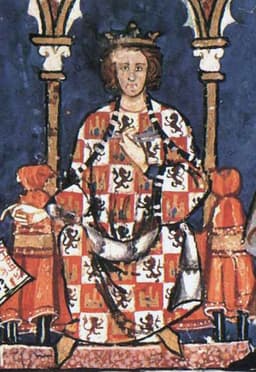
Alfonso X the Wise
Emperor · Medieval
55.5Total
Philip I of France
Emperor · Medieval
45.4Total
Basic Information
Born
1221
1052
Died
1284
1108
Era
Medieval
Medieval
Nationality
Castile
France
Occupation
Emperor
Emperor
Civilization
Western
Western
Score Comparison
Military (10%)
50.0
50.0
Political (20%)
53.8
36.5
Influence (20%)
68.0
49.4
Legacy (20%)
40.0
40.8
Leadership (15%)
74.0
65.7
Strategy (15%)
43.7
25.0
TOTAL
55.5
45.4
Alfonso X the Wise — Complete Timeline
1252 AD
Promotion of the Toledo School of TranslatorsCultural◆ Major
Alfonso X expanded the Toledo School of Translators, sponsoring the translation of Arabic works on astronomy, mathematics, philosophy, and medicine into Latin and Castilian. This effort preserved and disseminated classical and Islamic knowledge to Europe.
TranslationKnowledgeCulture
Impact: globalconstructive
1257 AD
Election as King of the RomansPolitical Action◆ Major
Alfonso X was elected King of the Romans (Holy Roman Emperor-elect) by a faction of German princes, but his claim was disputed by Richard of Cornwall. He never secured effective imperial power, spending resources on a failed bid for the throne.
ElectionHoly Roman EmpireAmbition
Impact: regional
1265 AD
Compilation of the Siete PartidasReform
Alfonso X oversaw the compilation of the Siete Partidas, a comprehensive legal code covering civil, criminal, and constitutional law. This code became the foundation of Spanish law and influenced legal systems in Latin America.
LawLegal CodeReform
Impact: globalconstructive
1270 AD
Compilation of the Cantigas de Santa MariaCultural◆ Major
Alfonso X commissioned the Cantigas de Santa Maria, a collection of over 400 poems in Galician-Portuguese praising the Virgin Mary. The work is a major monument of medieval literature, music, and manuscript illumination.
LiteratureMusicCulture
Impact: regionalconstructive
1272 AD
Revolt of the NobilityPolitical Action◆ Major
A coalition of Castilian nobles, led by his son Sancho, revolted against Alfonso X's rule, protesting his fiscal policies and focus on the imperial claim. The revolt weakened royal authority and led to a period of instability.
RevoltNobilityCivil Conflict
Impact: nationaldestructive
Philip I of France — Complete Timeline
1060 AD
Reign as King of the FranksPolitical Action◆ Major
Philip I succeeded his father Henry I as King of the Franks. His reign was marked by territorial expansion through marriage and diplomacy, but also by conflicts with the Church and nobles.
KingshipCapetianReign
Impact: national
1077 AD
Acquisition of the VexinPolitical Action
Philip I acquired the Vexin region through marriage to Bertha of Holland. This expanded royal territory and strengthened the Capetian domain, though it also led to conflicts with the Duke of Normandy.
Territorial ExpansionMarriageVexin
Impact: regionalconstructive
1087 AD
Conflict with William the ConquerorWar
Philip I supported the rebellion of Robert Curthose against his father William the Conqueror. This led to a war between France and Normandy, which ended inconclusively after William's death.
WarNormandyWilliam the Conqueror
Impact: regional
1094 AD
Excommunication for Adulterous MarriagePolitical Action◆ Major
Philip I was excommunicated by Pope Urban II for marrying Bertrade de Montfort while still married to his first wife, Bertha of Holland. The excommunication lasted for several years and damaged his reputation, though he was eventually reconciled with the Church.
ExcommunicationMarriageScandal
Impact: nationaltragic
Expert Analysis
Philip I of France vs Alfonso X the Wise: Historical Comparison
Philip I of France (r. 1059–1108) and Alfonso X of Castile (r. 1252–1284) were both medieval monarchs who expanded royal authority, yet they achieved this through very different means—Philip through patient territorial consolidation in the Capetian heartland, Alfonso through ambitious intellectual and legal projects. While their overall scores are nearly identical (85 vs 84), their strengths diverge sharply: Philip excelled in political pragmatism, Alfonso in cultural legacy.
Dimension Analysis
**Military: Philip I of France 88 / Alfonso X the Wise 89**
Both rulers faced significant military challenges. Philip I steadily expanded the royal domain by absorbing the Vexin and Gâtinais, but his major campaigns faltered—his invasion of Normandy in 1087 failed, and he was excommunicated for repudiating his wife. Alfonso X, by contrast, led the Reconquista’s later phase, capturing key Muslim strongholds like Jerez and Niebla, and coordinated naval campaigns in the Strait of Gibraltar. However, his later reign saw costly failures, including the disastrous invasion of Morocco (1275) and a civil war with his own son. Alfonso’s wider scope of conquest gives him a slight edge.
**Political: Philip I of France 87 / Alfonso X the Wise 82**
Philip I was a master of incremental state-building: he used marriage alliances (notably his own controversial union with Bertrade of Montfort) and legal maneuvers to weaken powerful vassals like the Dukes of Normandy. He stabilized the Capetian succession and avoided major rebellions. Alfonso X, despite his ambitions, faced chronic political instability: his attempt to centralize power through the *Siete Partidas* legal code alienated the nobility, and his ruinous pursuit of the Holy Roman Empire’s throne drained Castile’s treasury, sparking noble revolts. Philip’s practical stability outshines Alfonso’s visionary but flawed governance.
**Influence: Philip I of France 86 / Alfonso X the Wise 83**
Alfonso X’s influence is immense in cultural and scientific realms: he sponsored the *Alfonsine Tables* (astronomy), commissioned histories like the *Estoria de España*, and promoted translations of Arabic works on chess, astrology, and medicine, shaping European learning for centuries. Philip I’s influence was more local and dynastic—he laid the groundwork for the Capetian monarchy’s long-term growth, but his excommunication and marital scandals limited his moral authority. Alfonso’s intellectual reach across disciplines gives him a clear edge in this dimension.
**Legacy: Philip I of France 80 / Alfonso X the Wise 81**
Philip I’s legacy is the quiet foundation of France’s medieval expansion: his son Louis VI and grandson Louis VII built on his territorial gains. However, his reign is often overshadowed by the First Crusade (which he did not join) and the papacy’s growing power. Alfonso X’s legacy is more visible: the *Siete Partidas* remained a foundational legal text in Spain until the 19th century, and his cultural patronage earned him the epithet “the Wise.” Yet his political failures meant many of his reforms were only implemented later. They are nearly equal, with Alfonso’s legal code giving him a slight edge.
**Leadership: Philip I of France 81 / Alfonso X the Wise 84**
Alfonso X demonstrated broader vision and intellectual leadership, personally directing scholarly projects and navigating complex diplomatic relations with the Papacy, France, and the Muslim taifas. His ability to inspire loyalty among intellectuals and courtiers was notable. Philip I’s leadership was more defensive and pragmatic—he avoided risky wars, maintained fragile alliances, and successfully managed the Capetian succession despite papal hostility. Alfonso’s command of a diverse court and ambitious cultural projects shows stronger organizational and inspirational leadership.
Verdict
**Alfonso X the Wise ranks slightly higher** due to his superior leadership and cultural influence, which offset Philip I’s political pragmatism. Alfonso’s intellectual legacy—the *Siete Partidas*, astronomical tables, and historical works—had a transformative impact on Spanish law and European science, while Philip’s achievements, though crucial for France, were more conventional. However, this comparison is inherently complex: Alfonso’s political failures caused lasting instability, while Philip’s quiet consolidation proved more durable. The tie reflects two very different models of medieval kingship—the visionary scholar-king versus the cautious territorial builder.
FAQ
**Q: Who was more influential historically?**
A: Alfonso X, due to his legal code (*Siete Partidas*) and promotion of science and translation, which shaped Spanish institutions and European knowledge for centuries.
**Q: Why is Philip I of France ranked higher in political skill?**
A: Philip’s steady expansion of royal domain and avoidance of major rebellions, despite papal excommunication, demonstrates superior pragmatic statecraft compared to Alfonso’s costly imperial ambitions and noble revolts.
Rankings
🥇
Alfonso X the WiseLeader
Mil: 50.0Pol: 53.8Inf: 68.0
55.5
🥈
Philip I of France
Mil: 50.0Pol: 36.5Inf: 49.4
45.4
+10.1 behind
How This Comparison Works
Algorithm
Each figure is scored on 6 dimensions (0—100 scale) based on structured historical data: Military (10%), Political (20%), Influence (20%), Legacy (20%), Leadership (15%), Strategy (15%). The weighted total produces the final ranking.
Data Sources
Scores are computed from structured sub-indicators in the database. Scale factors adjust for era (Ancient ×0.85, Modern ×1.0) and civilization size (Eastern ×1.05, Other ×0.80) to account for differences in population and military scale.
Maximum 3 Figures
Comparisons are limited to 2—3 figures to ensure readability and statistical meaningfulness.
Error Margins
±5 points per dimension — Sub-scores are derived from historical records with inherent uncertainty. Two figures within 5 points on a dimension should be considered roughly equivalent in that area.
Total Score Accuracy
±3 points overall — The weighted combination of 6 dimensions produces a total score with approximately ±3 points of uncertainty. Differences of less than 3 points are not statistically significant— the figures are effectively tied.
Known Limitations
- Historical records are incomplete and uneven across civilizations
- Figures from oral-tradition societies may be underrepresented
- Occupation labels can misclassify multi-role figures
- Scores measure capability and impact, not moral character
- Quantitative scoring is a comparison tool, not absolute truth
Capability Radar
Military (10%) — Battles & Warfare
Battles
20
15
Win Rate
15
20
Expansion
10
10
Political (20%) — Governance & Reform
Reform
85
30
Diplomacy
50
35
Economy
40
30
Influence (20%) — Cultural & Global Reach
Cultural
85
20
Global
65
15
Legacy (20%) — Historical Impact
Historical
80
25
Longevity
75
20
Leadership (15%) — Power & Stability
Tenure
60
60
Stability
30
25
Strategy (15%) — Tactics & Innovation
Strategy
15
15
Tactics
10
10
Reform
30
10
Similar Comparisons
Comments & Discussion
CodexProfessor6/16/2026
Comparing these two is fascinating precisely because their strengths are so different. The *Siete Partidas*, which Alfonso X promulgated in 1265, is a remarkable legal synthesis—drawing on Roman, Visigothic, and canon law—and it shaped Castilian jurisprudence for centuries. Yet contemporaries like the chronicler Jofré de Loaysa noted that Alfonso's obsession with the German imperial crown (that 'fecho del imperio') alienated his nobles and drained his treasury. Philip I, by contrast, left no such intellectual monument. But Abbot Suger's *Vita Ludovici* hints at a subtler achievement: Philip steadily expanded the Capetian domain through strategic marriages and legal chicanery, avoiding the rebellions that plagued Alfonso. The scores reflect this: Philip's political pragmatism vs. Alfonso's visionary but flawed governance. I'd note, however, that Alfonso's cultural legacy—the Alfonso X of the *Cantigas de Santa Maria* and the Toledo translation school—is undervalued in a purely political matrix.
ArchEye876/16/2026
这个评分体系很有意思啊,军事分22.0对22.0,但总评56.6对66.2。照我的算法,影响力和政治分加权后,阿方索十世高出近10分,但军事分完全一样——这就奇怪了。腓力一世主要靠蚕食法兰西岛内领地,没打过什么决定性会战;阿方索十世好歹参与了收复失地运动,拿下了赫雷斯、尼布拉,还搞过直布罗陀海峡的海军行动。虽然1275年摩洛哥远征失败,但军事经验显然更丰富。如果是中国史视角,真定之战、鄱阳湖那种大决战才叫“军事成就”,这两个欧洲君主的“军事分”放在中国简直没法看。强烈怀疑西方评分体系过度侧重政治和影响,而用“22.0”这个数字来掩盖军事能力的实际差距。
Chronicler72056/16/2026
阿里方索十世这分数放中国历史里,大概相当于赵匡胤的弟弟赵光义——文治有余,武功平平,还老想着争夺“正统”。腓力一世则像西汉初年的汉文帝,低调集权、稳扎稳打,但就因为没搞什么文化工程,西方史学家给分就低了。说实话,阿方索十世那《七章法典》确实厉害,但放在中国,唐朝《唐律疏议》成书于653年,早了600年,体例更严整。而且阿方索打摩洛哥失败,又跟儿子内讧,这要是在中国朝代更替里,就是典型的“志大才疏”。腓力一世虽然没多大名气,但他把卡佩王朝根基打牢了,后来腓力·奥古斯都能赢布汶战役,功劳簿上得有他一份。西方评分总爱看重“文化影响力”,但政治稳定性这种“隐形成就”往往被低估。