Loading...
Alexios I Komnenos vs Ferdinand I of Leon
Alexios I Komnenos leads by 19.2 pts · 2 figures compared
…
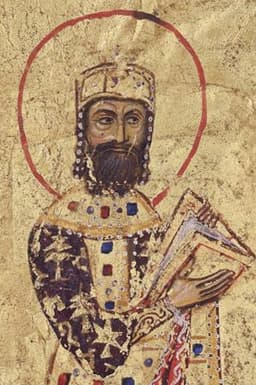
Alexios I Komnenos
Emperor · Medieval
78.4Total
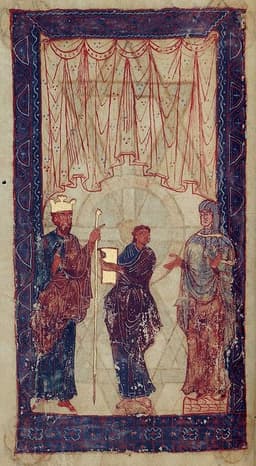
Ferdinand I of Leon
Emperor · Medieval
59.2Total
Basic Information
Born
1048
1015
Died
1118
1065
Era
Medieval
Medieval
Nationality
Byzantine Empire
Leon
Occupation
Emperor
Emperor
Civilization
Western
Western
Score Comparison
Military (10%)
61.7
70.0
Political (20%)
78.0
68.0
Influence (20%)
88.0
56.4
Legacy (20%)
80.0
49.2
Leadership (15%)
78.0
66.0
Strategy (15%)
68.0
57.5
TOTAL
78.4
59.2
Alexios I Komnenos — Complete Timeline
1081 AD
Battle of DyrrhachiumWar◆ Major
Alexios I Komnenos was defeated by the Norman army under Robert Guiscard at Dyrrhachium. The Byzantine forces were routed, and Alexios barely escaped. This loss allowed the Normans to occupy much of the western Balkans, though Alexios later recovered some territory.
Norman InvasionDefeatBalkans
Impact: regionaltragic
1090 AD
Reforms of the Byzantine Military and EconomyReform◆ Major
Alexios I implemented a series of reforms to restore Byzantine power. He reorganized the army by relying more on foreign mercenaries, reformed the currency (the hyperpyron), and granted tax exemptions to the Church. These measures stabilized the empire after decades of decline.
Military ReformEconomic ReformKomnenian Restoration
Impact: nationalconstructive
1095 AD
Appeal to the West: Council of PiacenzaPolitical Action
Alexios I sent envoys to Pope Urban II at the Council of Piacenza, requesting military aid against the Seljuk Turks. This appeal contributed to Urban's call for the First Crusade at the Council of Clermont later that year, initiating the Crusader movement.
First CrusadePope Urban IISeljuk Turks
Impact: global
1097 AD
First Crusade: Siege of NicaeaWar◆ Major
Alexios I cooperated with the Crusader army to besiege and capture Nicaea from the Seljuk Turks. The city was surrendered to Byzantine control, and Alexios used the Crusaders to recover key territories in Anatolia, though tensions later arose over land claims.
First CrusadeNicaeaByzantine-Crusader Relations
Impact: regionalconstructive
Ferdinand I of Leon — Complete Timeline
1029 AD
Inheritance of the County of CastilePolitical Action◆ Major
Ferdinand I inherited the County of Castile from his father Sancho III of Navarre. He later expanded his territory through conquest and marriage, laying the foundation for the Kingdom of Castile.
Impact: regionalconstructive
1037 AD
Conquest of LeónWar◆ Major
Ferdinand I defeated and killed King Bermudo III of Le
Impact: regional
1056 AD
First Emperor of SpainPolitical Action◆ Major
Ferdinand I was crowned 'Imperator totius Hispaniae' (Emperor of all Spain) in 1056, claiming suzerainty over all Christian and Muslim rulers in Iberia. This title reflected his military dominance and political ambition.
Impact: regional
1065 AD
Division of the kingdomPolitical Action◆ Major
Upon his death, Ferdinand I divided his kingdom among his sons: Sancho II received Castile, Alfonso VI received Le
Impact: regionaldestructive
Expert Analysis
Ferdinand I of Leon vs Alexios I Komnenos
# The Emperor Who Brought the West East, and the King Who United Spain from Within
In the autumn of 1095, a desperate Byzantine emperor stood before the Council of Piacenza, his envoys pleading for mercenaries against the Seljuk Turks. Half a continent away, four decades earlier, a Leonese king had knelt in the Cathedral of León to receive a crown no one had worn before: Emperor of All Spain. Alexios I Komnenos and Ferdinand I of León both claimed the title of emperor, both fought to preserve Christian realms against Muslim expansion, and both reshaped the political map of Europe. Yet one opened the door to a millennium of East-West conflict, while the other laid the foundation for a unified Spanish kingdom. Why did their paths diverge so dramatically?
Origins
Alexios Komnenos was born into the Byzantine military aristocracy in 1048, a world where the Roman Empire still breathed—but barely. The empire he inherited in 1081 was a hollowed shell: Normans had swallowed southern Italy, Pechenegs raided the Balkans, and the Seljuk Turks had taken Anatolia, the empire’s heartland. His father had been a general, his uncle an emperor, and Alexios himself had led armies since adolescence. He knew that survival meant improvisation.
Ferdinand of León, born in 1015, grew up in a very different Christian frontier. The Kingdom of León was one of several small Iberian states locked in the *Reconquista*—a centuries-long struggle against the Moorish taifa kingdoms. Ferdinand’s father, Sancho III of Navarre, had united much of Christian Spain through marriage and war, but when he died in 1035, he divided his lands among his sons. Ferdinand received only the County of Castile, a rugged border territory of castles and shepherds. He had to build his empire from scratch, not inherit it.
Rise to Power
Alexios seized the throne through a military coup in 1081, at age thirty-three. He was a general first, an emperor second. His path was violent and direct: he marched on Constantinople, bribed the Varangian Guard, and forced the abdication of the incompetent Nikephoros III. But his first major test nearly destroyed him. At the Battle of Dyrrhachium in 1081, the Norman warlord Robert Guiscard routed his army, and Alexios barely escaped with his life. He learned that day that Byzantine tactics—heavy infantry, archers, and discipline—could not match Norman shock cavalry. He would never forget that lesson.
Ferdinand’s rise was slower and more strategic. In 1029, he inherited Castile from his father, but his real opportunity came in 1037. The King of León, Bermudo III, was young and inexperienced. Ferdinand married Bermudo’s sister, then challenged him for the throne. At the Battle of Tamarón, Bermudo was killed—according to legend, thrown from his horse and trampled. Ferdinand claimed León by right of conquest and marriage, uniting the two kingdoms. He did not need to storm a capital; he needed only to win one battle and then legitimize his victory through law and lineage.
Leadership & Governance
Alexios governed through crisis management. He reformed the Byzantine military by relying on foreign mercenaries—Normans, Franks, even Turks—because the native army had collapsed. He debased the currency to pay them, then introduced the *pronoiā* system, granting land in exchange for military service, creating a feudal-like structure that would outlast him. His political genius lay in diplomacy: he played the Seljuks against each other, allied with Venice for naval support, and—most fatefully—appealed to the Pope for help. At the Council of Piacenza in 1095, he asked for a few hundred knights. He got the First Crusade.
Ferdinand ruled through consolidation. He did not seek foreign allies; he sought to dominate his neighbors. He campaigned relentlessly against the Moorish taifas of Toledo, Badajoz, and Zaragoza, extracting tribute (*parias*) that filled his treasury. But he also understood that conquest required legitimacy. In 1056, he had himself crowned "Imperator totius Hispaniae"—Emperor of All Spain—a title that claimed suzerainty over both Christian and Muslim rulers. This was not empty rhetoric: it meant that all Iberian kings, Moorish or Christian, owed him homage. He was creating a legal framework for unity, not just military domination.
Triumph & Tragedy
Alexios’s greatest triumph was the First Crusade—and his greatest tragedy was also the First Crusade. In 1097, he cooperated with the Crusaders to besiege Nicaea, the Seljuk capital. The city surrendered to him, not the Crusaders, a diplomatic masterstroke. But the Crusaders soon ignored their oaths to return conquered lands to the empire. They carved out their own kingdoms in Antioch and Jerusalem, and Alexios watched helplessly as a force he had summoned became a rival. He died in 1118, having restored some stability but lost Anatolia forever.
Ferdinand’s triumph was the unification of León and Castile, and his tragedy was his death. In 1065, as he lay dying, he divided his kingdom among his three sons: Sancho received Castile, Alfonso received León, and García received Galicia. This was the old Frankish custom, but it was catastrophic. Within a decade, his sons were at war. Ferdinand had built a united Spain, then shattered it with his own hands. He died knowing his life’s work would be undone.
Character & Destiny
Alexios was a pragmatist, a survivor. He lied to the Crusaders, broke promises to the Pope, and sacrificed principles for survival. His personality was shaped by constant threat: he trusted no one, not even his own generals. This made him effective but shortsighted. He solved today’s crisis without thinking about tomorrow’s consequences. The Crusades were a perfect example: he got the help he needed, but he unleashed forces he could not control.
Ferdinand was a builder, a lawgiver. He was ruthless in war but methodical in peace. He codified laws, patronized the Church, and promoted the cult of Saint James (Santiago) as a unifying symbol. His personality reflected his environment: the *Reconquista* was a slow, grinding war of attrition, not a desperate defense. He could afford to think in decades, not days. But his fatal flaw was tradition: he followed the old custom of dividing his kingdom because he could not imagine a different way.
Legacy
Alexios I Komnenos founded a dynasty that ruled for a century, but his legacy is the Crusades. He is remembered as the emperor who called the West to save the East—and inadvertently set in motion the Fourth Crusade, which sacked Constantinople in 1204. His name is synonymous with Byzantine resilience and Byzantine tragedy.
Ferdinand I of León is less known, but his legacy is Spain. He was the first to claim the title Emperor of Spain, and his successors—Alfonso VI, the Catholic Monarchs—would fulfill his dream. He proved that Iberian unity was possible, that Christian and Muslim could coexist under a single sovereign, and that the *Reconquista* could be a political project, not just a holy war.
Conclusion
Both Alexios and Ferdinand faced the same fundamental question: how to defend a Christian realm against a powerful Islamic enemy. Alexios answered by reaching outward, appealing to a distant West that did not share his interests. Ferdinand answered by reaching inward, consolidating his own kingdom and imposing his will on neighbors. One created a conflict that would define the Middle Ages; the other created a nation that would define the modern world. Their stories remind us that the most fateful decisions are not about what we fight for, but whom we choose to call for help.
Rankings
🥇
Alexios I KomnenosLeader
Mil: 61.7Pol: 78.0Inf: 88.0
78.4
🥈
Ferdinand I of Leon
Mil: 70.0Pol: 68.0Inf: 56.4
59.2
+19.2 behind
How This Comparison Works
Algorithm
Each figure is scored on 6 dimensions (0—100 scale) based on structured historical data: Military (10%), Political (20%), Influence (20%), Legacy (20%), Leadership (15%), Strategy (15%). The weighted total produces the final ranking.
Data Sources
Scores are computed from structured sub-indicators in the database. Scale factors adjust for era (Ancient ×0.85, Modern ×1.0) and civilization size (Eastern ×1.05, Other ×0.80) to account for differences in population and military scale.
Maximum 3 Figures
Comparisons are limited to 2—3 figures to ensure readability and statistical meaningfulness.
Error Margins
±5 points per dimension — Sub-scores are derived from historical records with inherent uncertainty. Two figures within 5 points on a dimension should be considered roughly equivalent in that area.
Total Score Accuracy
±3 points overall — The weighted combination of 6 dimensions produces a total score with approximately ±3 points of uncertainty. Differences of less than 3 points are not statistically significant— the figures are effectively tied.
Known Limitations
- Historical records are incomplete and uneven across civilizations
- Figures from oral-tradition societies may be underrepresented
- Occupation labels can misclassify multi-role figures
- Scores measure capability and impact, not moral character
- Quantitative scoring is a comparison tool, not absolute truth
Capability Radar
Military (10%) — Battles & Warfare
Battles
75
55
Win Rate
70
60
Expansion
60
60
Political (20%) — Governance & Reform
Reform
85
50
Diplomacy
90
55
Economy
70
45
Influence (20%) — Cultural & Global Reach
Cultural
70
40
Global
75
30
Legacy (20%) — Historical Impact
Historical
85
45
Longevity
80
40
Leadership (15%) — Power & Stability
Tenure
80
65
Stability
75
50
Strategy (15%) — Tactics & Innovation
Strategy
85
55
Tactics
80
50
Reform
75
40
Similar Comparisons
Comments & Discussion
LEGIO_X_GEMINA6/16/2026
Ferdinand was the pragmatic emperor who built from within, while Alexios gambled everything on foreign intervention. Ferdinand’s battlefield successes against the taifas—exacting massive parias tribute from Seville and Toledo—show a king who weaponized economics as effectively as steel. Alexios’s plea at Piacenza fundamentally misread the Latin West, treating crusaders as mercenaries when they were ideologues. One integrated his kingdom; the other imported his empire’s destruction.
数字考古学家6/16/2026
别被表面相似性骗了。亚历克修斯实际控制的人力财力远胜斐迪南——拜占庭帝国在1081年仍有约1.5万正规军,而莱昂王国能动员的骑士不过几百。但数据不能撒谎:斐迪南的科英布拉围城战(1064)通过封锁经济使穆斯林投降,而亚历克修斯在杜拉佐(1081)以2万精兵败给诺曼人6000骑兵。军事效率的对比说明一切:斐迪南用最小代价实现了最大整合。
THE_CHRYSOTRIKLINOS6/16/2026
Let's be clear: Alexios faced an extinction-level event that Ferdinand never knew. By 1091, Alexios had crushed Pechenegs at Levounion with Komnenian combined arms—Varangians, Turkish horse archers, and Frankish lancers fighting in coordinated phases. Ferdinand's 1054 victory over the taifa of Badajoz was a border raid against a fractured emirate. One man rebuilt an empire from a single province; the other inherited a kingdom his father had already made dominant.
废墟译者6/16/2026
斐迪南自称‘全西班牙皇帝’时可悲地忽视了穆斯林统治的庞大现实——科尔多瓦哈里发虽已崩溃,但塞维利亚、格拉纳达等泰法王国仍有数十万人口。而亚历克修斯至少承认拜占庭已是残垣断壁,他的战略撤退保存了帝国核心。更讽刺的是:斐迪南的‘统一’被其子瓜分,西班牙再次分裂;亚历克修斯却通过继承法和内战,保住了曼努埃尔时代的辉煌。谁才是真正的帝国建设者?