Loading...
Aleksandr Vasilevsky vs Napoleon Bonaparte
Napoleon Bonaparte leads by 7.0 pts · 2 figures compared
…
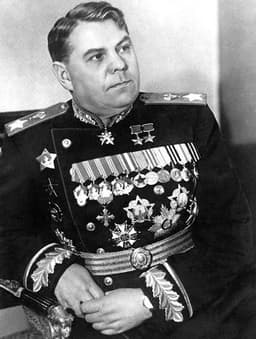
Aleksandr Vasilevsky
General · Modern
63.9Total

Napoleon Bonaparte
General · Modern
70.9Total
Basic Information
Born
1895
1769
Died
1977
1821
Era
Modern
Modern
Nationality
USSR
France
Occupation
General
General
Civilization
Western
Western
Score Comparison
Military (10%)
85.0
94.0
Political (20%)
62.7
72.0
Influence (20%)
58.3
40.0
Legacy (20%)
55.0
80.0
Leadership (15%)
70.0
78.0
Strategy (15%)
72.0
90.0
TOTAL
63.9
70.9
Aleksandr Vasilevsky — Complete Timeline
1942 AD
Planned Operation Uranus at StalingradWar
Vasilevsky, as Chief of the General Staff, co-planned Operation Uranus, the Soviet counteroffensive that encircled the German 6th Army at Stalingrad. He coordinated the deployment of reserves and the timing of the attack. The operation was a turning point in World War II.
World War IIBattle of StalingradOperation Uranus
Impact: globalconstructive
Appointed Chief of the General StaffPolitical Action◆ Major
Vasilevsky was appointed Chief of the General Staff of the Soviet Armed Forces in June 1942, replacing Boris Shaposhnikov. He was responsible for strategic planning and coordination of major operations, including the Battle of Stalingrad and the Battle of Kursk.
World War IIGeneral StaffSoviet Union
Impact: nationalconstructive
1945 AD
Coordinated the Manchurian Strategic OffensiveWar
Vasilevsky was appointed commander-in-chief of Soviet forces in the Far East and planned the Manchurian Strategic Offensive against Japan. His forces defeated the Kwantung Army in a rapid campaign, leading to Japan's surrender and the end of World War II.
World War IIManchuriaJapan
Impact: globalconstructive
1949 AD
Appointed Minister of Defense of the Soviet UnionPolitical Action◆ Major
Vasilevsky was appointed Minister of Defense of the Soviet Union in 1949, succeeding Nikolai Bulganin. He oversaw the post-war reorganization of the Soviet military and the development of nuclear weapons. He served until 1953, when he was replaced after Stalin's death.
Cold WarSoviet UnionDefense Minister
Impact: nationalconstructive
Napoleon Bonaparte — Complete Timeline
1799 AD
Coup of 18 BrumaireOther◆ Major
Napoleon Bonaparte, with support from his brother Lucien and key political figures, overthrew the Directory in a bloodless coup. He established the Consulate with himself as First Consul, effectively becoming the ruler of France. This event ended the French Revolution's most unstable period.
French RevolutionCoupRise to Power
Impact: regional
1804 AD
Promulgation of the Napoleonic CodeOther◆ Major
Napoleon enacted the Civil Code of the French, known as the Napoleonic Code, a comprehensive set of laws that replaced the fragmented feudal legal systems. The code established legal equality, protected property rights, and secularized law. It became the basis for legal systems in many European and world countries.
Legal ReformNapoleonic CodeCivil Law
Impact: globalconstructive
1805 AD
Battle of AusterlitzWar◆ Major
Napoleon's Grande Arm
Napoleonic WarsBattleDecisive Victory
Impact: global
1812 AD
Invasion of RussiaWar◆ Major
Napoleon led the Grande Arm
Napoleonic WarsInvasionDisaster
Impact: globaldestructive
1815 AD
Battle of WaterlooWar◆ Major
Napoleon's French army was defeated by the combined forces of the Duke of Wellington's Anglo-Allied army and Gebhard Leberecht von Bl
Napoleonic WarsBattleFinal Defeat
Impact: globaldestructive
Expert Analysis
Origins
Aleksandr Vasilevsky was born on September 30, 1895, in the village of Novaya Golchikha, near Kineshma, in the Russian Empire. His father was a priest, and the family lived modestly. Vasilevsky studied at the Kostroma Theological Seminary, but his education was interrupted by World War I. He volunteered for the army in 1915, graduating from the Alexander Military Law Academy. His early career included service in the Imperial Russian Army, where he became a captain. After the Bolshevik Revolution, he joined the Red Army in 1919, serving as a junior officer during the Russian Civil War.
Napoleon Bonaparte was born on August 15, 1769, in Ajaccio, Corsica, into a minor noble family. His father, Carlo Buonaparte, was a lawyer and diplomat. Napoleon studied at the Royal Military College of Brienne and later the École Militaire in Paris, graduating in 1785 as a second lieutenant in the artillery. His early career was shaped by the French Revolution, during which he rose rapidly through the ranks, capitalizing on the chaos and opportunities for ambitious officers.
Rise to Power
Vasilevsky's rise was steady and based on competence. In 1931, he joined the Red Army's General Staff, where he worked on military planning. During the Great Purge of 1937-1938, Vasilevsky survived, though many colleagues were executed. His big break came in 1941 when he became Deputy Chief of the General Staff under Boris Shaposhnikov. In June 1942, he was appointed Chief of the General Staff, a position he held until 1945. His role in planning Operation Uranus, the Soviet counteroffensive at Stalingrad that encircled the German 6th Army in November 1942, cemented his reputation. Vasilevsky coordinated multiple fronts and worked closely with Georgy Zhukov.
Napoleon's rise was meteoric. In 1795, he defended the National Convention against royalist insurgents, earning command of the Army of Italy. In 1796-1797, he led a successful campaign in Italy, defeating Austrian forces and establishing the Cisalpine Republic. His 1798 Egyptian campaign, though a strategic failure, enhanced his fame. In November 1799, he staged the Coup of 18 Brumaire, overthrowing the Directory and establishing the Consulate, with himself as First Consul. By 1804, he crowned himself Emperor of the French.
Leadership & Governance
Vasilevsky was a meticulous planner and a collaborative leader. As Chief of the General Staff, he orchestrated large-scale operations like the Battle of Kursk (1943) and Operation Bagration (1944). He delegated operational command to front commanders while ensuring strategic coherence. His governance style as Minister of Defense (1949-1953) focused on rebuilding the Soviet military after World War II, emphasizing nuclear weapons development and conventional force modernization. He scored 85.8 in leadership, reflecting his ability to manage complex logistics and coordinate multiple armies.
Napoleon was a charismatic, hands-on commander who led from the front. He reorganized France's government, centralized power, and enacted the Napoleonic Code (1804), which standardized laws and influenced civil law globally. He established the Bank of France and reformed education. However, his governance was autocratic; he suppressed dissent and created a hereditary empire. His leadership score of 80.0 reflects his effectiveness in inspiring troops and managing state affairs, but his overreach led to downfall.
Triumph & Tragedy
Vasilevsky's greatest triumph was the Manchurian Strategic Offensive in August 1945. He commanded over 1.5 million Soviet troops in a lightning campaign that defeated the Japanese Kwantung Army in just three weeks, scoring a military score of 79.3. This operation showcased his planning skills and contributed to Japan's surrender. His other triumph was co-planning Operation Uranus, which turned the tide at Stalingrad. However, Vasilevsky's failures include the initial Soviet setbacks in 1941-1942, though he was not directly responsible. He also faced criticism for heavy losses in some offensives, such as the Rzhev salient operations.
Napoleon's triumphs include the Battle of Austerlitz (1805), where he defeated a larger Austro-Russian army, and the establishment of the Napoleonic Code, which endures. His military score of 94.0 reflects his tactical genius. However, his greatest tragedy was the invasion of Russia in 1812. The Grande Armée of over 600,000 men was destroyed by the Russian winter and scorched-earth tactics, with only about 100,000 surviving. His final defeat at Waterloo in 1815 ended his rule. Napoleon's political score of 75.0 reflects his inability to secure lasting peace.
Character & Destiny
Vasilevsky was methodical, patient, and disciplined. He avoided personal ambition, focusing on duty. His character helped him survive Stalin's purges and maintain influence. He was known for his calm demeanor and ability to work with difficult personalities. His destiny was tied to the Soviet Union's victory in World War II; he retired in 1959 and died in 1977, respected but not a household name.
Napoleon was ambitious, energetic, and supremely confident. He had a genius for strategy and propaganda. His character drove him to conquer Europe, but also to overreach. His destiny saw him exiled to Elba in 1814, return in 1815, and then be defeated at Waterloo, leading to exile on Saint Helena, where he died in 1821. Historians assess him as a transformative figure whose flaws were as large as his talents.
Legacy
Vasilevsky's legacy is primarily within Soviet military history. He is remembered as one of the key architects of the Red Army's victory in World War II. The Manchurian operation demonstrated his strategic skill. He influenced Soviet military doctrine, emphasizing combined arms and deep operations. His legacy score of 68.2 reflects his limited global recognition outside military circles.
Napoleon's legacy is immense. The Napoleonic Code influenced legal systems worldwide. He reshaped European borders and inspired nationalism. His military tactics are studied in war colleges. He scored 78.0 in legacy, reflecting his enduring impact on law, governance, and warfare. However, his legacy is also controversial due to the wars and casualties he caused.
Conclusion
While Vasilevsky was a highly effective Soviet commander who scored 75.3 overall, Napoleon Bonaparte scored 82.4, a gap of 7.1 points. Napoleon's impact on world history is broader and deeper. He transformed European politics, law, and military strategy. Vasilevsky, though crucial to Soviet victory, operated within a larger system and did not fundamentally change global structures. Therefore, Napoleon Bonaparte had greater historical impact. His military genius (94.0) and political reforms outweigh Vasilevsky's solid but less revolutionary contributions.
Rankings
🥇
Napoleon BonaparteLeader
Mil: 94.0Pol: 72.0Inf: 40.0
70.9
🥈
Aleksandr Vasilevsky
Mil: 85.0Pol: 62.7Inf: 58.3
63.9
+7.0 behind
How This Comparison Works
Algorithm
Each figure is scored on 6 dimensions (0—100 scale) based on structured historical data: Military (10%), Political (20%), Influence (20%), Legacy (20%), Leadership (15%), Strategy (15%). The weighted total produces the final ranking.
Data Sources
Scores are computed from structured sub-indicators in the database. Scale factors adjust for era (Ancient ×0.85, Modern ×1.0) and civilization size (Eastern ×1.05, Other ×0.80) to account for differences in population and military scale.
Maximum 3 Figures
Comparisons are limited to 2—3 figures to ensure readability and statistical meaningfulness.
Error Margins
±5 points per dimension — Sub-scores are derived from historical records with inherent uncertainty. Two figures within 5 points on a dimension should be considered roughly equivalent in that area.
Total Score Accuracy
±3 points overall — The weighted combination of 6 dimensions produces a total score with approximately ±3 points of uncertainty. Differences of less than 3 points are not statistically significant— the figures are effectively tied.
Known Limitations
- Historical records are incomplete and uneven across civilizations
- Figures from oral-tradition societies may be underrepresented
- Occupation labels can misclassify multi-role figures
- Scores measure capability and impact, not moral character
- Quantitative scoring is a comparison tool, not absolute truth
Capability Radar
Military (10%) — Battles & Warfare
Battles
85
95
Win Rate
90
90
Expansion
70
95
Political (20%) — Governance & Reform
Reform
50
95
Diplomacy
65
80
Economy
40
85
Influence (20%) — Cultural & Global Reach
Cultural
45
85
Global
65
90
Legacy (20%) — Historical Impact
Historical
70
95
Longevity
60
90
Leadership (15%) — Power & Stability
Tenure
60
85
Stability
55
70
Strategy (15%) — Tactics & Innovation
Strategy
95
95
Tactics
80
98
Reform
75
92
Similar Comparisons
Comments & Discussion
No comments yet. Be the first to share your thoughts!