Loading...
Alan Brooke vs Ernest J. King
Ernest J. King leads by 5.1 pts · 2 figures compared
…
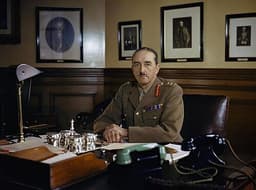
Alan Brooke
General · Modern
64.5Total

Ernest J. King
General · Modern
69.6Total
Basic Information
Born
1883
1878
Died
1963
1956
Era
Modern
Modern
Nationality
United Kingdom
United States
Occupation
General
General
Civilization
Western
Western
Score Comparison
Military (10%)
55.0
65.0
Political (20%)
72.0
70.3
Influence (20%)
61.0
65.0
Legacy (20%)
55.0
68.0
Leadership (15%)
80.0
78.0
Strategy (15%)
72.0
76.0
TOTAL
64.5
69.6
Alan Brooke — Complete Timeline
1941 AD
Appointed Chief of the Imperial General StaffOther◆ Major
In December 1941, Alan Brooke was appointed Chief of the Imperial General Staff (CIGS), the professional head of the British Army. He served in this role throughout World War II, overseeing military strategy and operations, and was a key member of the Chiefs of Staff Committee that advised Prime Minister Winston Churchill.
World War IIBritish ArmyMilitary Leadership
Impact: global
1943 AD
Participated in the Casablanca ConferenceOther◆ Major
In January 1943, Brooke attended the Casablanca Conference with Churchill and Roosevelt, where Allied strategy for the remainder of World War II was discussed. The conference agreed on the policy of 'unconditional surrender' for the Axis powers and the invasion of Sicily, with Brooke playing a key role in shaping military plans.
World War IIAllied StrategyCasablanca
Impact: global
Attended the Tehran ConferenceOther◆ Major
In November-December 1943, Brooke attended the Tehran Conference with Churchill, Roosevelt, and Stalin. The conference coordinated Allied military strategy against Germany, including the timing of the cross-channel invasion (Operation Overlord) and the Soviet offensive, with Brooke providing military advice on the feasibility of operations.
World War IIAllied StrategyTehran
Impact: global
1944 AD
Oversaw the D-Day PlanningOther◆ Major
As CIGS, Brooke was instrumental in planning the Normandy landings (D-Day) on June 6, 1944. He coordinated with Allied commanders to develop the invasion strategy, including the selection of landing beaches and the allocation of forces, which led to the successful liberation of Western Europe from Nazi occupation.
World War IID-DayNormandy Invasion
Impact: globalconstructive
Promoted to Field MarshalOther◆ Major
On January 1, 1944, Alan Brooke was promoted to the rank of Field Marshal, the highest rank in the British Army. This promotion recognized his exceptional service as CIGS and his contributions to Allied victory in World War II.
World War IIPromotionField Marshal
Impact: nationalconstructive
Ernest J. King — Complete Timeline
1941 AD
Appointment as Commander-in-Chief, US FleetPolitical Action◆ Major
King was appointed Commander-in-Chief of the US Fleet (COMINCH) in December 1941, following the attack on Pearl Harbor. He was given authority over all naval operations in the Atlantic and Pacific theaters.
World War IINaval CommandPearl Harbor
Impact: globalconstructive
1942 AD
Victory at the Battle of MidwayWar
Under King's strategic direction, the US Navy decisively defeated the Japanese fleet at the Battle of Midway. The victory turned the tide in the Pacific War, destroying four Japanese aircraft carriers and shifting the strategic initiative to the Allies.
World War IIPacific WarNaval Battle
Impact: globalconstructive
Appointment as Chief of Naval OperationsPolitical Action◆ Major
King was appointed Chief of Naval Operations (CNO) in March 1942, combining the roles of COMINCH and CNO. He became the single most powerful naval officer in US history, directing all aspects of the Navy's war effort.
World War IINaval CommandUnified Command
Impact: globalconstructive
1944 AD
Promotion to Fleet AdmiralPolitical Action◆ Major
King was promoted to the newly created rank of Fleet Admiral (five-star rank) in December 1944. He was one of only four US naval officers to hold this rank during World War II.
World War IIPromotionFive-Star Rank
Impact: nationalconstructive
Expert Analysis
Origins
Alan Brooke was born on July 23, 1883, in Bagnères-de-Bigorre, France, into an Anglo-Irish military family. He was educated at the Royal Military Academy, Woolwich, and commissioned into the Royal Artillery in 1902. His early career included service in India and on the Western Front in World War I, where he earned a reputation for meticulous planning.
Ernest J. King was born on November 23, 1878, in Lorain, Ohio, to a Scottish-American family. He entered the United States Naval Academy in 1897 and graduated in 1901. King served in the Spanish-American War and later in World War I as a staff officer. He specialized in submarines and naval aviation, becoming one of the few officers qualified in both.
Rise to Power
Brooke's rise accelerated during World War II. In 1939, he commanded II Corps in France, overseeing the evacuation at Dunkirk. His performance led to his appointment as Commander-in-Chief, Home Forces in 1940, where he organized Britain's defenses against invasion. In December 1941, he became Chief of the Imperial General Staff (CIGS), the professional head of the British Army, a position he held until 1946.
King's rise was marked by his appointment as Commander-in-Chief, U.S. Fleet (COMINCH) in December 1941, just after Pearl Harbor. In March 1942, he also became Chief of Naval Operations (CNO), consolidating authority over the Navy. He was promoted to Fleet Admiral in December 1944. His aggressive leadership style and strategic vision propelled him to the top of the naval hierarchy.
Leadership & Governance
Brooke's leadership style was methodical and detail-oriented. He managed the British Army's global commitments, balancing resources between theaters. He served as Churchill's primary military advisor, often tempering Churchill's more ambitious ideas. Brooke played a key role in the Casablanca Conference (January 1943), where the Allies agreed on the 'Germany First' strategy, and the Tehran Conference (November-December 1943), which coordinated the D-Day invasion. His governance focused on coalition warfare, requiring diplomacy with American and Soviet counterparts.
King's leadership was decisive and uncompromising. He centralized control over the Navy, streamlining command structures. He advocated for an aggressive Pacific strategy, pushing for early offensives at Guadalcanal and the Central Pacific drive. King's governance included prioritizing the defeat of Japan while supporting the European theater. His political skills scored 70.3, enabling him to secure resources and maintain strategic autonomy.
Triumph & Tragedy
Brooke's greatest triumph was overseeing the planning and execution of the Normandy landings (D-Day, June 6, 1944). His coordination with Allied commanders ensured the success of the largest amphibious invasion in history. However, his greatest failure was the initial setbacks in North Africa and the Mediterranean, where he underestimated Axis capabilities. Additionally, his strained relationship with General Bernard Montgomery sometimes hindered operations.
King's triumph was the victory at the Battle of Midway (June 1942), where under his strategic direction, the U.S. Navy destroyed four Japanese carriers, turning the tide in the Pacific. His failure included the early losses in the Solomon Islands campaign, where inadequate coordination led to heavy casualties at Guadalcanal. King also faced criticism for not fully supporting the Atlantic anti-submarine campaign early in the war.
Character & Destiny
Brooke was known for his sharp intellect and temper. He was often pessimistic about Allied prospects, which clashed with Churchill's optimism. His diaries reveal a man frustrated by political interference but devoted to duty. His character shaped his destiny as a steady hand in crisis, but his lack of charisma limited his public recognition.
King was abrasive and autocratic, earning the nickname 'Ernie King' for his tough demeanor. He was a workaholic who demanded results. His character drove the Navy's transformation into a modern fighting force, but his bluntness created enemies. His destiny was to lead the Navy to victory, yet his legacy is overshadowed by more charismatic figures like Nimitz.
Legacy
Brooke's legacy lies in his role as the architect of British Army strategy in WWII. His influence scored 61.0, reflecting his impact on Allied planning. He was instrumental in creating the Combined Chiefs of Staff system, which coordinated Allied strategy. After the war, he wrote his memoirs, 'The Turn of the Tide,' which shaped historical understanding. However, his reputation is less known than that of field commanders.
King's legacy is more prominent. His military score of 65.0 and influence score of 65.0 reflect his role in building the world's most powerful navy. He established the framework for postwar naval strategy and the unified command structure. King's legacy endures in the U.S. Navy's operational doctrines. He is remembered as the driving force behind the Pacific victory.
Conclusion
While both leaders were essential to Allied victory, Ernest J. King had greater impact. His strategic vision transformed the U.S. Navy from a defensive force into an offensive juggernaut, securing dominance in the Pacific. King scored 69.6 total compared to Brooke's 64.5, reflecting higher scores in military, influence, and legacy. Brooke's contributions as a staff officer were critical, but King's direct command of naval forces and his role in shaping the postwar world order give him the edge. The score gap of 5.1 points underscores King's superior overall impact.
Rankings
🥇
Ernest J. KingLeader
Mil: 65.0Pol: 70.3Inf: 65.0
69.6
🥈
Alan Brooke
Mil: 55.0Pol: 72.0Inf: 61.0
64.5
+5.1 behind
How This Comparison Works
Algorithm
Each figure is scored on 6 dimensions (0—100 scale) based on structured historical data: Military (10%), Political (20%), Influence (20%), Legacy (20%), Leadership (15%), Strategy (15%). The weighted total produces the final ranking.
Data Sources
Scores are computed from structured sub-indicators in the database. Scale factors adjust for era (Ancient ×0.85, Modern ×1.0) and civilization size (Eastern ×1.05, Other ×0.80) to account for differences in population and military scale.
Maximum 3 Figures
Comparisons are limited to 2—3 figures to ensure readability and statistical meaningfulness.
Error Margins
±5 points per dimension — Sub-scores are derived from historical records with inherent uncertainty. Two figures within 5 points on a dimension should be considered roughly equivalent in that area.
Total Score Accuracy
±3 points overall — The weighted combination of 6 dimensions produces a total score with approximately ±3 points of uncertainty. Differences of less than 3 points are not statistically significant— the figures are effectively tied.
Known Limitations
- Historical records are incomplete and uneven across civilizations
- Figures from oral-tradition societies may be underrepresented
- Occupation labels can misclassify multi-role figures
- Scores measure capability and impact, not moral character
- Quantitative scoring is a comparison tool, not absolute truth
Capability Radar
Military (10%) — Battles & Warfare
Battles
60
85
Win Rate
55
90
Expansion
20
85
Political (20%) — Governance & Reform
Reform
60
80
Diplomacy
80
75
Economy
50
70
Influence (20%) — Cultural & Global Reach
Cultural
30
60
Global
65
80
Legacy (20%) — Historical Impact
Historical
75
80
Longevity
60
70
Leadership (15%) — Power & Stability
Tenure
70
70
Stability
85
85
Strategy (15%) — Tactics & Innovation
Strategy
90
95
Tactics
75
80
Reform
85
90
Similar Comparisons
Comments & Discussion
No comments yet. Be the first to share your thoughts!