Loading...
Alan Brooke vs Julius Caesar
Julius Caesar leads by 18.3 pts · 2 figures compared
…
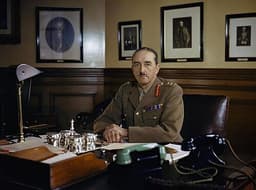
Alan Brooke
General · Modern
64.5Total

Julius Caesar
General · Ancient
82.8Total
Basic Information
Born
1883
-100
Died
1963
-44
Era
Modern
Ancient
Nationality
United Kingdom
Roman Republic
Occupation
General
General
Civilization
Western
Western
Score Comparison
Military (10%)
55.0
88.0
Political (20%)
72.0
78.0
Influence (20%)
61.0
85.0
Legacy (20%)
55.0
82.0
Leadership (15%)
80.0
80.0
Strategy (15%)
72.0
85.0
TOTAL
64.5
82.8
Alan Brooke — Complete Timeline
1941 AD
Appointed Chief of the Imperial General StaffOther◆ Major
In December 1941, Alan Brooke was appointed Chief of the Imperial General Staff (CIGS), the professional head of the British Army. He served in this role throughout World War II, overseeing military strategy and operations, and was a key member of the Chiefs of Staff Committee that advised Prime Minister Winston Churchill.
World War IIBritish ArmyMilitary Leadership
Impact: global
1943 AD
Participated in the Casablanca ConferenceOther◆ Major
In January 1943, Brooke attended the Casablanca Conference with Churchill and Roosevelt, where Allied strategy for the remainder of World War II was discussed. The conference agreed on the policy of 'unconditional surrender' for the Axis powers and the invasion of Sicily, with Brooke playing a key role in shaping military plans.
World War IIAllied StrategyCasablanca
Impact: global
Attended the Tehran ConferenceOther◆ Major
In November-December 1943, Brooke attended the Tehran Conference with Churchill, Roosevelt, and Stalin. The conference coordinated Allied military strategy against Germany, including the timing of the cross-channel invasion (Operation Overlord) and the Soviet offensive, with Brooke providing military advice on the feasibility of operations.
World War IIAllied StrategyTehran
Impact: global
1944 AD
Oversaw the D-Day PlanningOther◆ Major
As CIGS, Brooke was instrumental in planning the Normandy landings (D-Day) on June 6, 1944. He coordinated with Allied commanders to develop the invasion strategy, including the selection of landing beaches and the allocation of forces, which led to the successful liberation of Western Europe from Nazi occupation.
World War IID-DayNormandy Invasion
Impact: globalconstructive
Promoted to Field MarshalOther◆ Major
On January 1, 1944, Alan Brooke was promoted to the rank of Field Marshal, the highest rank in the British Army. This promotion recognized his exceptional service as CIGS and his contributions to Allied victory in World War II.
World War IIPromotionField Marshal
Impact: nationalconstructive
Julius Caesar — Complete Timeline
58 BC
Gallic WarsWar◆ Major
Caesar, as proconsul of Gaul, launched a series of campaigns that conquered all of Gaul (modern France, Belgium, and parts of Switzerland). He fought numerous battles, including against the Helvetii, the Belgae, and the Gallic chieftain Vercingetorix. The wars brought immense wealth and a loyal army to Caesar.
Gallic WarsConquestRoman Expansion
Impact: regional
49 BC
Crossing the RubiconPolitical Action◆ Major
Caesar led Legio XIII across the Rubicon River into Italy, defying the Roman Senate's order to disband his army. This act triggered a civil war against Pompey and the Optimates, ultimately leading to Caesar's dictatorship and the end of the Roman Republic.
Roman Civil WarEnd of RepublicPower Struggle
Impact: global
48 BC
Battle of PharsalusWar◆ Major
Caesar's outnumbered army defeated the larger forces of Pompey the Great at Pharsalus in Greece. Caesar's tactical use of a reserve line to counter Pompey's cavalry charge proved decisive. Pompey fled to Egypt, where he was assassinated, leaving Caesar as the undisputed master of the Roman world.
Roman Civil WarBattleDecisive Victory
Impact: regional
44 BC
Appointment as Dictator for LifePolitical Action◆ Major
The Roman Senate appointed Caesar dictator perpetuo (dictator for life), granting him unprecedented personal power. This move concentrated military, legislative, and judicial authority in one person, effectively ending the Roman Republic's traditional system of checks and balances and alarming many senators.
DictatorshipEnd of RepublicPower Consolidation
Impact: regionaldestructive
Assassination on the Ides of MarchPolitical Action◆ Major
A group of Roman senators, led by Marcus Junius Brutus and Gaius Cassius Longinus, stabbed Caesar to death at a meeting of the Senate in the Theatre of Pompey. The assassination was intended to restore the Republic, but instead triggered another civil war that led to the rise of the Roman Empire.
AssassinationRoman PoliticsEnd of Republic
Impact: globaldestructive
Expert Analysis
alan-brooke-vs-julius-caesar
# The General and the Strategist: Caesar and Brooke Across the Ages
On a January morning in 49 BCE, a fifty-year-old Roman general stood at the edge of a small river in northern Italy. The Rubicon was little more than a stream, yet crossing it with an armed legion meant civil war—a direct challenge to the Senate and the Republic itself. He hesitated, then gave the order. Two thousand years later, in a London bunker during the darkest days of 1941, another general sat through endless meetings, wrestling not with a single decisive moment but with the grinding machinery of global conflict. One man would die by the dagger; the other would live to see victory. Both shaped history, but in profoundly different ways.
Origins
Julius Caesar was born into a patrician family in 100 BCE, during the twilight of the Roman Republic. His uncle was Gaius Marius, a populist general, and his aunt was Marius’s wife. This placed Caesar in the volatile crossfire of Roman politics, where noble birth meant little without military glory or popular support. He grew up in a world of crumbling traditions, where senatorial corruption and street violence were the norm. Caesar learned early that survival required audacity.
Alan Brooke, born in 1883 in France to an Anglo-Irish family, came of age in a very different world—the height of the British Empire, when wars were fought by professional armies in faraway colonies. He attended the Royal Military Academy at Woolwich and served in India and South Africa. Where Caesar grew up amid civil strife, Brooke grew up amid imperial stability. His world was one of order, hierarchy, and careful planning. The contrast is striking: Caesar was forged in chaos; Brooke was shaped by structure.
Rise to Power
Caesar’s ascent was a study in calculated risk. He borrowed heavily to fund political campaigns, won the office of pontifex maximus, and secured a governorship in Spain. But his real breakthrough came in 58 BCE when he obtained command of Gaul. Over eight years, he conquered a vast territory, built a loyal army, and amassed immense wealth. When the Senate ordered him to disband his legions, he chose instead to cross the Rubicon in 49 BCE. The gamble worked: within four years, he was dictator for life.
Brooke’s rise was more methodical. He distinguished himself in World War I as a staff officer, then spent the interwar years teaching tactics and writing manuals. By 1939, he commanded a corps in France, and when disaster struck in 1940, he organized the evacuation at Dunkirk. His big moment came in December 1941, when he became Chief of the Imperial General Staff—the top military advisor to Prime Minister Winston Churchill. Unlike Caesar, Brooke did not seize power; he was appointed to it, during a crisis that demanded not a conqueror but a coordinator.
Leadership & Governance
Caesar governed as a revolutionary. He reformed the calendar, granted citizenship to provincials, and launched massive public works. His military genius lay in speed and decisiveness: at Alesia (52 BCE), he built siege works around a Gallic army while simultaneously repelling a relief force—a feat of logistics and nerve. Yet his political wisdom was flawed. He pardoned enemies too readily, centralized power too openly, and ignored the republican traditions that still mattered to Rome’s elite. His reforms were brilliant, but his style alienated the Senate.
Brooke governed as a manager of coalitions. As Churchill’s chief strategist, he navigated the competing demands of Americans, Soviets, and British commanders. His military skill lay in planning: he shaped the D-Day invasion, the Mediterranean campaign, and the defeat of the U-boats. But his leadership was tested by Churchill’s impulsiveness. Brooke often clashed with the prime minister, writing in his diary that Churchill “knows no details” and “can never see a whole operation.” Where Caesar commanded by force of personality, Brooke commanded by force of argument—patient, persistent, and often exhausted.
Triumph & Tragedy
Caesar’s greatest triumph was the conquest of Gaul, which doubled Rome’s territory and made him the most powerful man in the Mediterranean. His greatest tragedy was his assassination on March 15, 44 BCE—the Ides of March. He had ignored warnings, disbanded his bodyguard, and walked into the Senate chamber unarmed. Sixty senators stabbed him to death. His reforms survived, but his murder plunged Rome into another civil war.
Brooke’s greatest triumph was the Allied victory in Europe. He saw the war through from its lowest point—when Britain stood alone in 1941—to the unconditional surrender of Germany in 1945. His greatest tragedy was the personal cost: he was exhausted, often ill, and deeply frustrated by Churchill’s interference. After the war, he was made a viscount, but he never achieved the fame of his wartime peers. He died in 1963, largely forgotten by the public.
Character & Destiny
Caesar was driven by ambition, charisma, and a belief in his own destiny. He wrote his own commentaries, cultivated his image, and took risks that would have destroyed lesser men. His personality—arrogant, generous, ruthless—shaped every decision. He once said, “It is easier to find men who will volunteer to die, than to find those who are willing to endure pain with patience.” That impatience, that need for dramatic action, led him to greatness—and to his death.
Brooke was driven by duty, method, and a quiet sense of responsibility. He was introverted, blunt, and prone to depression. His diary reveals a man who doubted himself even as he directed armies. Where Caesar saw history as a stage for his own performance, Brooke saw it as a problem to be solved. He once wrote, “I have to keep the whole picture in my mind, and it is a terrible strain.” That strain—the burden of endless, unglamorous work—defined his destiny.
Legacy
Caesar’s legacy is immense. His name became a title—Kaiser, Tsar—and his military tactics are still studied. He transformed Rome from a republic into an empire, and his writings shaped Western literature. He is remembered as a genius, a tyrant, and a martyr.
Brooke’s legacy is quieter but no less real. He helped save Britain from defeat, organized the defeat of Nazi Germany, and laid the foundations for NATO. Yet his name is unknown to most. He is remembered not for a single dramatic act, but for years of steady, brilliant staff work.
Conclusion
Standing at the Rubicon, Caesar saw a moment of glory. Sitting in a London bunker, Brooke saw a long, grinding ascent. One man changed the world in a flash; the other changed it inch by inch. Both were generals, but they represent two poles of military leadership: the conqueror and the architect. Caesar’s story is a tragedy of ambition; Brooke’s is a tragedy of obscurity. Together, they remind us that history is not made only by those who cross rivers—but also by those who build the bridges.
Rankings
🥇
Julius CaesarLeader
Mil: 88.0Pol: 78.0Inf: 85.0
82.8
🥈
Alan Brooke
Mil: 55.0Pol: 72.0Inf: 61.0
64.5
+18.3 behind
How This Comparison Works
Algorithm
Each figure is scored on 6 dimensions (0—100 scale) based on structured historical data: Military (10%), Political (20%), Influence (20%), Legacy (20%), Leadership (15%), Strategy (15%). The weighted total produces the final ranking.
Data Sources
Scores are computed from structured sub-indicators in the database. Scale factors adjust for era (Ancient ×0.85, Modern ×1.0) and civilization size (Eastern ×1.05, Other ×0.80) to account for differences in population and military scale.
Maximum 3 Figures
Comparisons are limited to 2—3 figures to ensure readability and statistical meaningfulness.
Error Margins
±5 points per dimension — Sub-scores are derived from historical records with inherent uncertainty. Two figures within 5 points on a dimension should be considered roughly equivalent in that area.
Total Score Accuracy
±3 points overall — The weighted combination of 6 dimensions produces a total score with approximately ±3 points of uncertainty. Differences of less than 3 points are not statistically significant— the figures are effectively tied.
Known Limitations
- Historical records are incomplete and uneven across civilizations
- Figures from oral-tradition societies may be underrepresented
- Occupation labels can misclassify multi-role figures
- Scores measure capability and impact, not moral character
- Quantitative scoring is a comparison tool, not absolute truth
Capability Radar
Military (10%) — Battles & Warfare
Battles
60
95
Win Rate
55
92
Expansion
20
97
Political (20%) — Governance & Reform
Reform
60
90
Diplomacy
80
85
Economy
50
82
Influence (20%) — Cultural & Global Reach
Cultural
30
88
Global
65
94
Legacy (20%) — Historical Impact
Historical
75
95
Longevity
60
96
Leadership (15%) — Power & Stability
Tenure
70
75
Stability
85
60
Strategy (15%) — Tactics & Innovation
Strategy
90
94
Tactics
75
96
Reform
85
88
Similar Comparisons
Comments & Discussion
No comments yet. Be the first to share your thoughts!