Loading...
Alan Brooke vs Napoleon Bonaparte
Napoleon Bonaparte leads by 6.4 pts · 2 figures compared
…
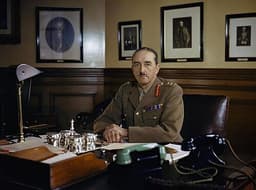
Alan Brooke
General · Modern
64.5Total

Napoleon Bonaparte
General · Modern
70.9Total
Basic Information
Born
1883
1769
Died
1963
1821
Era
Modern
Modern
Nationality
United Kingdom
France
Occupation
General
General
Civilization
Western
Western
Score Comparison
Military (10%)
55.0
94.0
Political (20%)
72.0
72.0
Influence (20%)
61.0
40.0
Legacy (20%)
55.0
80.0
Leadership (15%)
80.0
78.0
Strategy (15%)
72.0
90.0
TOTAL
64.5
70.9
Alan Brooke — Complete Timeline
1941 AD
Appointed Chief of the Imperial General StaffOther◆ Major
In December 1941, Alan Brooke was appointed Chief of the Imperial General Staff (CIGS), the professional head of the British Army. He served in this role throughout World War II, overseeing military strategy and operations, and was a key member of the Chiefs of Staff Committee that advised Prime Minister Winston Churchill.
World War IIBritish ArmyMilitary Leadership
Impact: global
1943 AD
Participated in the Casablanca ConferenceOther◆ Major
In January 1943, Brooke attended the Casablanca Conference with Churchill and Roosevelt, where Allied strategy for the remainder of World War II was discussed. The conference agreed on the policy of 'unconditional surrender' for the Axis powers and the invasion of Sicily, with Brooke playing a key role in shaping military plans.
World War IIAllied StrategyCasablanca
Impact: global
Attended the Tehran ConferenceOther◆ Major
In November-December 1943, Brooke attended the Tehran Conference with Churchill, Roosevelt, and Stalin. The conference coordinated Allied military strategy against Germany, including the timing of the cross-channel invasion (Operation Overlord) and the Soviet offensive, with Brooke providing military advice on the feasibility of operations.
World War IIAllied StrategyTehran
Impact: global
1944 AD
Oversaw the D-Day PlanningOther◆ Major
As CIGS, Brooke was instrumental in planning the Normandy landings (D-Day) on June 6, 1944. He coordinated with Allied commanders to develop the invasion strategy, including the selection of landing beaches and the allocation of forces, which led to the successful liberation of Western Europe from Nazi occupation.
World War IID-DayNormandy Invasion
Impact: globalconstructive
Promoted to Field MarshalOther◆ Major
On January 1, 1944, Alan Brooke was promoted to the rank of Field Marshal, the highest rank in the British Army. This promotion recognized his exceptional service as CIGS and his contributions to Allied victory in World War II.
World War IIPromotionField Marshal
Impact: nationalconstructive
Napoleon Bonaparte — Complete Timeline
1799 AD
Coup of 18 BrumaireOther◆ Major
Napoleon Bonaparte, with support from his brother Lucien and key political figures, overthrew the Directory in a bloodless coup. He established the Consulate with himself as First Consul, effectively becoming the ruler of France. This event ended the French Revolution's most unstable period.
French RevolutionCoupRise to Power
Impact: regional
1804 AD
Promulgation of the Napoleonic CodeOther◆ Major
Napoleon enacted the Civil Code of the French, known as the Napoleonic Code, a comprehensive set of laws that replaced the fragmented feudal legal systems. The code established legal equality, protected property rights, and secularized law. It became the basis for legal systems in many European and world countries.
Legal ReformNapoleonic CodeCivil Law
Impact: globalconstructive
1805 AD
Battle of AusterlitzWar◆ Major
Napoleon's Grande Arm
Napoleonic WarsBattleDecisive Victory
Impact: global
1812 AD
Invasion of RussiaWar◆ Major
Napoleon led the Grande Arm
Napoleonic WarsInvasionDisaster
Impact: globaldestructive
1815 AD
Battle of WaterlooWar◆ Major
Napoleon's French army was defeated by the combined forces of the Duke of Wellington's Anglo-Allied army and Gebhard Leberecht von Bl
Napoleonic WarsBattleFinal Defeat
Impact: globaldestructive
Expert Analysis
alan-brooke-vs-napoleon-bonaparte
# The General and the Strategist
On a June evening in 1815, Napoleon Bonaparte stood on a ridge near Waterloo, watching his elite Imperial Guard march into the muzzles of British muskets. Less than 130 years later, in a cramped underground war room in London, Alan Brooke sat across from Winston Churchill, calmly explaining why a proposed invasion of Norway would be a logistical catastrophe. One man commanded armies that shook a continent; the other commanded the minds that shaped a global war. Both were soldiers. But their paths, their triumphs, and their tragedies reveal how military greatness can take radically different forms.
Origins
Napoleon was born in 1769 on the island of Corsica, a place that had only recently become French. His family was minor nobility, poor and resentful of the mainland. As a boy, he spoke Italian-accented French and was mocked by classmates at military school. This outsider status forged something in him: a desperate hunger for recognition, a belief that he alone could remake his world. By his twenties, the French Revolution had shattered the old order, and the young artillery officer saw opportunity in chaos.
Alan Brooke was born in 1883 into the Anglo-Irish aristocracy, a world of country estates and military tradition. His father was a British Army officer; his uncles had served the Empire. Unlike Napoleon, Brooke never doubted his place in the world. But he was not born into glory. He entered the Royal Military Academy at Woolwich in 1900, a quiet, serious boy who preferred mathematics to poetry. The Victorian confidence of his upbringing would give him a different kind of strength: patience, discipline, and an unshakeable sense of duty.
Rise to Power
Napoleon’s rise was a thunderbolt. In 1793, at age 24, he drove British forces from Toulon with a brilliant use of artillery. By 1796, he commanded the Army of Italy, where he won a string of victories that stunned Europe. In 1799, he staged a coup and made himself First Consul. In 1804, he crowned himself Emperor. Each step was a gamble, each victory a foundation for the next. He understood that in revolutionary France, speed and audacity were the only currencies that mattered.
Brooke’s ascent was the opposite: slow, methodical, forged in the trenches of the First World War. He served on the Western Front, where he learned the terrible cost of poor planning. By 1939, he was a corps commander in France, and when the German blitzkrieg shattered the Allied armies in 1940, he organized the desperate evacuation from Dunkirk. That experience—watching a well-equipped enemy outthink and outmaneuver the British—sealed his belief that war was won not by courage alone, but by intelligence and preparation. In 1941, Churchill appointed him Chief of the Imperial General Staff.
Leadership & Governance
Napoleon ruled as a conqueror. His military genius was undeniable: he revolutionized warfare with mobile artillery, rapid marches, and the corps system that allowed him to concentrate overwhelming force at decisive points. At Austerlitz in 1805, he destroyed a larger Austro-Russian army through a masterful feint. His political reforms were equally ambitious. The Napoleonic Code standardized French law, abolished feudal privileges, and spread revolutionary ideals across Europe. But he could not stop conquering. Every victory demanded another, and his empire became a machine that consumed itself.
Brooke never commanded troops in battle after 1940. His power was different. As Churchill’s chief military advisor, he shaped the grand strategy that won the Second World War. He fought to delay the cross-channel invasion until the Allies had overwhelming strength, insisting on the Mediterranean campaign first. He managed Churchill’s impulsive brilliance, guiding him away from disasters like a proposed invasion of the Balkans. His leadership was invisible to the public, but without it, the D-Day landings of 1944 might have ended in catastrophe.
Triumph & Tragedy
Napoleon’s greatest moment was Austerlitz, where he crushed the Third Coalition in a single day. His worst was the invasion of Russia in 1812, a disaster born of overreach. He marched 600,000 men into the snow; fewer than 100,000 returned. Exiled to Elba in 1814, he escaped and raised another army, only to meet final defeat at Waterloo in 1815. His tragedy was that he could not stop. His genius required war, and war destroyed him.
Brooke’s triumph was invisible to history’s spotlight. He never won a battle in the traditional sense. But he helped win a war. His greatest failure was perhaps his own nature: he was so reserved, so coldly analytical, that even Churchill sometimes resented him. He left no stirring speeches, no battlefield legends. He left something quieter: a war won without unnecessary slaughter, a strategy that worked.
Character & Destiny
Napoleon was driven by ambition, ego, and a belief that he was destiny’s instrument. “I am not a man,” he once said, “but a thing.” He saw himself as a force of nature, and he acted accordingly—brilliant, ruthless, and ultimately self-destructive. Brooke was driven by duty. He wrote in his diary that he felt “a terrible responsibility” for every decision. He was not a man of destiny; he was a man of process.
Their scores reflect this contrast. Napoleon’s military rating of 94 and strategy of 93 speak to his battlefield genius. Brooke’s military rating of 59 is deceptively low—it measures his role as a commander, not his strategic mind, which earned a 79.5. Politically, Brooke scored 78.8 to Napoleon’s 75.0, because Brooke navigated the treacherous politics of coalition warfare better than Napoleon ever managed the politics of empire.
Legacy
Napoleon’s legacy is a paradox. He spread the ideals of the French Revolution—equality before the law, meritocracy, secular government—across Europe, but he did so through conquest and bloodshed. His name still evokes both glory and tyranny. His total score of 82.4 reflects a figure of immense but deeply flawed achievement.
Brooke’s legacy is quieter. He is remembered by historians and military professionals, not by the public. His score of 71.5 suggests a man of solid, not spectacular, achievement. But that number misses something: he helped save civilization from fascism, not by conquering, but by thinking. In the annals of war, the man who prevents disaster is often forgotten, while the man who causes one is remembered forever.
Conclusion
Napoleon and Brooke represent two poles of military greatness. The first is the conqueror, who reshapes the world through will and violence. The second is the organizer, who preserves it through wisdom and restraint. Napoleon’s story is a tragedy of excess; Brooke’s is a quiet triumph of competence. Both are necessary. But perhaps, in an age of total war, the lesson of the 20th century is that the world needs more Alan Brookes—and fewer Napoleons. The brilliant general may win a battle; the brilliant strategist may save a generation.
Rankings
🥇
Napoleon BonaparteLeader
Mil: 94.0Pol: 72.0Inf: 40.0
70.9
🥈
Alan Brooke
Mil: 55.0Pol: 72.0Inf: 61.0
64.5
+6.4 behind
How This Comparison Works
Algorithm
Each figure is scored on 6 dimensions (0—100 scale) based on structured historical data: Military (10%), Political (20%), Influence (20%), Legacy (20%), Leadership (15%), Strategy (15%). The weighted total produces the final ranking.
Data Sources
Scores are computed from structured sub-indicators in the database. Scale factors adjust for era (Ancient ×0.85, Modern ×1.0) and civilization size (Eastern ×1.05, Other ×0.80) to account for differences in population and military scale.
Maximum 3 Figures
Comparisons are limited to 2—3 figures to ensure readability and statistical meaningfulness.
Error Margins
±5 points per dimension — Sub-scores are derived from historical records with inherent uncertainty. Two figures within 5 points on a dimension should be considered roughly equivalent in that area.
Total Score Accuracy
±3 points overall — The weighted combination of 6 dimensions produces a total score with approximately ±3 points of uncertainty. Differences of less than 3 points are not statistically significant— the figures are effectively tied.
Known Limitations
- Historical records are incomplete and uneven across civilizations
- Figures from oral-tradition societies may be underrepresented
- Occupation labels can misclassify multi-role figures
- Scores measure capability and impact, not moral character
- Quantitative scoring is a comparison tool, not absolute truth
Capability Radar
Military (10%) — Battles & Warfare
Battles
60
95
Win Rate
55
90
Expansion
20
95
Political (20%) — Governance & Reform
Reform
60
95
Diplomacy
80
80
Economy
50
85
Influence (20%) — Cultural & Global Reach
Cultural
30
85
Global
65
90
Legacy (20%) — Historical Impact
Historical
75
95
Longevity
60
90
Leadership (15%) — Power & Stability
Tenure
70
85
Stability
85
70
Strategy (15%) — Tactics & Innovation
Strategy
90
95
Tactics
75
98
Reform
85
92
Similar Comparisons
Comments & Discussion
No comments yet. Be the first to share your thoughts!