Loading...
Ernest J. King vs Qin Shi Huang
Qin Shi Huang leads by 15.6 pts · 2 figures compared
…

Ernest J. King
General · Modern
69.6Total
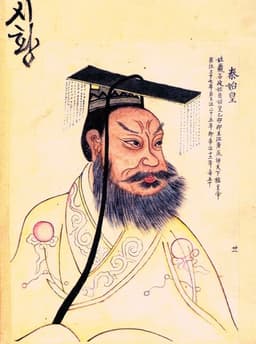
Qin Shi Huang
Emperor · Ancient
85.2Total
Basic Information
Born
1878
-259
Died
1956
-210
Era
Modern
Ancient
Nationality
United States
China
Occupation
General
Emperor
Civilization
Western
Eastern
Score Comparison
Military (10%)
65.0
80.0
Political (20%)
70.3
90.0
Influence (20%)
65.0
85.0
Legacy (20%)
68.0
90.0
Leadership (15%)
78.0
78.0
Strategy (15%)
76.0
82.0
TOTAL
69.6
85.2
Ernest J. King — Complete Timeline
1941 AD
Appointment as Commander-in-Chief, US FleetPolitical Action◆ Major
King was appointed Commander-in-Chief of the US Fleet (COMINCH) in December 1941, following the attack on Pearl Harbor. He was given authority over all naval operations in the Atlantic and Pacific theaters.
World War IINaval CommandPearl Harbor
Impact: globalconstructive
1942 AD
Victory at the Battle of MidwayWar
Under King's strategic direction, the US Navy decisively defeated the Japanese fleet at the Battle of Midway. The victory turned the tide in the Pacific War, destroying four Japanese aircraft carriers and shifting the strategic initiative to the Allies.
World War IIPacific WarNaval Battle
Impact: globalconstructive
Appointment as Chief of Naval OperationsPolitical Action◆ Major
King was appointed Chief of Naval Operations (CNO) in March 1942, combining the roles of COMINCH and CNO. He became the single most powerful naval officer in US history, directing all aspects of the Navy's war effort.
World War IINaval CommandUnified Command
Impact: globalconstructive
1944 AD
Promotion to Fleet AdmiralPolitical Action◆ Major
King was promoted to the newly created rank of Fleet Admiral (five-star rank) in December 1944. He was one of only four US naval officers to hold this rank during World War II.
World War IIPromotionFive-Star Rank
Impact: nationalconstructive
Qin Shi Huang — Complete Timeline
246 BC
Construction of the Mausoleum and Terracotta ArmyOther◆ Major
Qin Shi Huang commissioned a vast mausoleum complex near Xi'an, guarded by thousands of life-sized terracotta soldiers, horses, and chariots. The project employed hundreds of thousands of workers and reflected his obsession with immortality and imperial power.
Impact: global
230 BC
Conquest of the Six Warring StatesWar
From 230 to 221 BCE, Ying Zheng led the Qin state in a series of campaigns that conquered the Han, Zhao, Wei, Chu, Yan, and Qi states. This unified China under a single ruler for the first time, ending the Warring States period.
Impact: global
221 BC
Standardization of Writing, Currency, and MeasurementsReform◆ Major
Qin Shi Huang ordered the standardization of Chinese script, currency, and weights and measures across the unified empire. This facilitated administration, trade, and cultural integration, laying a foundation for future dynasties.
Impact: globalconstructive
Proclamation of the Qin DynastyPolitical Action
After conquering the last independent state, Ying Zheng declared himself Shi Huangdi (First Emperor), founding the Qin Dynasty. He adopted a new title to signify his supreme authority and initiated centralized imperial rule.
Impact: global
214 BC
Initiation of the Great Wall ConstructionOther◆ Major
Qin Shi Huang ordered the connection and extension of existing northern fortifications to create a unified defensive wall against nomadic Xiongnu raids. This project involved massive conscripted labor and became the precursor to the later Great Wall.
Impact: regional
213 BC
Burning of Books and Burying of ScholarsPolitical Action◆ Major
On the advice of Li Si, Qin Shi Huang ordered the burning of historical records and philosophical texts not aligned with Legalist doctrine. He also had 460 Confucian scholars buried alive to suppress dissent and consolidate ideological control.
Impact: nationaldestructive
Expert Analysis
ernest-j-king-vs-qin-shi-huang
# The Emperor and the Admiral: Two Titans of Unification and War
On a cold December morning in 1941, as the smoke still rose from the wreckage of Pearl Harbor, a stern-faced man with a jaw like a granite cliff walked into his new office in Washington, D.C. Ernest J. King had just been handed command of the entire United States Navy in the most desperate hour of American history. Two thousand years earlier and half a world away, another man had stood atop a conquered city wall, watching his enemies fall one by one, and declared himself the First Emperor of a unified China. Qin Shi Huang and Ernest King never met, never shared a language or a continent, yet both faced the same fundamental challenge: how to forge order from chaos, how to command vast forces across impossible distances, and how to leave a mark that would outlast their own brief lives.
Origins
Qin Shi Huang was born in 259 BC, a prince of the Qin state during the chaotic Warring States period. His childhood was steeped in violence and intrigue—his father was a hostage in another state, his mother a concubine who later took a lover who would try to seize power. The boy learned early that trust was a luxury, and absolute control the only security. By thirteen, he was king of Qin, surrounded by advisors who taught him the ruthless philosophy of Legalism: that human nature was inherently selfish, and only harsh law and severe punishment could maintain order.
Ernest King, born in 1878 in Lorain, Ohio, came from a very different world—a young, confident America rising toward global power. His father was a railroad worker, his mother a homemaker; there was no throne waiting for him. But King possessed the same fierce ambition. At the Naval Academy, he was brilliant and arrogant, known for his sharp tongue and relentless drive. He chose submarines when they were dangerous new machines, then aviation when it was still a gamble. By the 1930s, he was already known as a man who could drink, curse, and work harder than anyone around him—but also as someone who made enemies as easily as he made decisions.
Rise to Power
Qin Shi Huang’s path was one of conquest. Between 230 and 221 BC, he led his armies in a series of campaigns that devoured six rival kingdoms one by one. He did not simply defeat them; he absorbed them, dismantling their noble families, confiscating their weapons, and forcing their elites to live in his capital under his watchful eye. When the last kingdom fell, he took a new title: Shi Huangdi, the First Emperor—a name that declared he was not merely a king but the beginning of a new age of unity.
King’s rise was slower, more bureaucratic, but no less decisive. For decades, he climbed the Navy’s ladder, earning a reputation as its sharpest strategist and most difficult personality. When Pearl Harbor exploded, President Franklin Roosevelt needed the toughest man available. King was fifty-six years old, already past normal retirement, but he was given two jobs at once: Commander-in-Chief of the US Fleet and Chief of Naval Operations. He became the single most powerful naval officer in American history, responsible for a war that spanned the Atlantic and Pacific simultaneously.
Leadership & Governance
The First Emperor governed through absolute standardization. He ordered that all writing across China use the same characters, that all carts have axles the same width to fit the same ruts, that all coins be cast in the same shape. He built roads and canals to bind his empire together, and he began linking the northern walls into what would become the Great Wall. But his rule had a dark side: he burned books that did not agree with his philosophy and buried scholars alive who criticized him. He believed unity required uniformity, and uniformity required terror.
King governed through ruthless prioritization. In 1942, with the Navy reeling from Pearl Harbor, he faced impossible choices: protect the supply lines to Britain, defend Australia, or hold Hawaii? He chose to gamble everything on the Pacific, pushing for an offensive at Midway that would break Japanese naval power. His leadership style was abrasive—“He shaves with a blowtorch,” one officer said—but he was never indecisive. He fought bureaucratic battles with the Army and the British allies as fiercely as he fought the Japanese, insisting that the Navy’s voice be heard in every strategic decision.
Triumph & Tragedy
Qin Shi Huang’s greatest triumph was also his most haunting. He commissioned a mausoleum guarded by thousands of life-sized terracotta soldiers, each face unique, each weapon real. It was a monument to his power that would not be discovered until 1974, over two thousand years after his death. But his tragedy was that he could not conquer death itself. He became obsessed with immortality, sending expeditions for magical elixirs and consuming mercury pills that may have killed him at age forty-nine. His empire, so carefully unified, collapsed within four years of his death.
King’s triumph was the Battle of Midway in June 1942, where his strategic direction helped sink four Japanese aircraft carriers in a single day, turning the tide of the Pacific War. His tragedy was more personal: he was so feared and disliked that when the war ended, he was quickly pushed aside, his advice ignored in the postwar reorganization of the military. He died in 1956, largely forgotten by the public he had helped save.
Character & Destiny
Both men were shaped by a deep, almost paranoid belief that only they could see the truth. Qin Shi Huang traveled constantly, inspecting his empire, sleeping in a different palace each night so no one could predict his location. King drank heavily, worked eighteen-hour days, and trusted almost no one. Both were lonely at the top, convinced that the weight of history rested on their shoulders alone. Yet their personalities drove different outcomes: the Emperor’s isolation led him to seek magical solutions and ignore real threats; the Admiral’s isolation made him focus obsessively on concrete military problems.
Legacy
Qin Shi Huang’s legacy is the very idea of China as a unified state. The standardization he imposed—the writing, the measurements, the coinage—became the foundation of every Chinese dynasty that followed. The Great Wall, though rebuilt many times, still bears his stamp. He is remembered as both a unifier and a tyrant, the man who made China possible and the man who tried to erase its diversity.
King’s legacy is quieter but no less real. The Navy he built won the greatest naval war in history. The command structure he created—a unified fleet under a single chief—survives today. He is remembered by historians as the architect of victory in the Pacific, but his name rarely appears in popular memory.
Conclusion
Standing at the edge of the Terracotta Army, looking at those silent soldiers who have watched for two millennia, one cannot help but think of Ernest King in his Washington office, staring at maps of an ocean he had to cross. Both men understood that power is not about the present—it is about the future. Qin Shi Huang built an empire that would outlast him by two thousand years. King built a navy that would keep the seas open for generations. One ruled through terror and standardization, the other through strategy and sheer force of will. They never met, never could have understood each other’s worlds, yet they answered the same eternal question: What does it take to bend history to your will? The answer, it seems, is everything—and nothing at all.
Rankings
🥇
Qin Shi HuangLeader
Mil: 80.0Pol: 90.0Inf: 85.0
85.2
🥈
Ernest J. King
Mil: 65.0Pol: 70.3Inf: 65.0
69.6
+15.6 behind
How This Comparison Works
Algorithm
Each figure is scored on 6 dimensions (0—100 scale) based on structured historical data: Military (10%), Political (20%), Influence (20%), Legacy (20%), Leadership (15%), Strategy (15%). The weighted total produces the final ranking.
Data Sources
Scores are computed from structured sub-indicators in the database. Scale factors adjust for era (Ancient ×0.85, Modern ×1.0) and civilization size (Eastern ×1.05, Other ×0.80) to account for differences in population and military scale.
Maximum 3 Figures
Comparisons are limited to 2—3 figures to ensure readability and statistical meaningfulness.
Error Margins
±5 points per dimension — Sub-scores are derived from historical records with inherent uncertainty. Two figures within 5 points on a dimension should be considered roughly equivalent in that area.
Total Score Accuracy
±3 points overall — The weighted combination of 6 dimensions produces a total score with approximately ±3 points of uncertainty. Differences of less than 3 points are not statistically significant— the figures are effectively tied.
Known Limitations
- Historical records are incomplete and uneven across civilizations
- Figures from oral-tradition societies may be underrepresented
- Occupation labels can misclassify multi-role figures
- Scores measure capability and impact, not moral character
- Quantitative scoring is a comparison tool, not absolute truth
Capability Radar
Military (10%) — Battles & Warfare
Battles
85
85
Win Rate
90
90
Expansion
85
90
Political (20%) — Governance & Reform
Reform
80
95
Diplomacy
75
75
Economy
70
90
Influence (20%) — Cultural & Global Reach
Cultural
60
95
Global
80
85
Legacy (20%) — Historical Impact
Historical
80
95
Longevity
70
95
Leadership (15%) — Power & Stability
Tenure
70
70
Stability
85
65
Strategy (15%) — Tactics & Innovation
Strategy
95
85
Tactics
80
80
Reform
90
95
Similar Comparisons
Comments & Discussion
CINCUS HATER6/17/2026
King was a brilliant strategist but an absolutely toxic leader. He openly said "when they get into trouble, they send for the sons of bitches" about his own reputation. Meanwhile Qin Shi Huang built an actual unified state with standardized writing and roads. King just got lucky with industrial capacity. Give the First Emperor a Pacific Fleet and he'd conquer Japan by lunch. Qin wins on legacy every time.|
兵马俑数据党6/17/2026
对比之下King就是个拿着现代资源乱挥的莽夫。秦始皇统一度量衡的文字记录就在睡虎地秦简里,人家是真靠制度创新统治了六国。King呢?1942年中途岛之前指挥混乱,要不是密码破译救场,太平洋舰队都得完蛋。始皇帝的郡县制影响了两千年,King只是二战时期的一个工具人而已。|
LEGALIST LEE6/17/2026
You can't compare a naval bureaucrat to the man who literally connected the Great Wall. King's "Germany First" strategy was just following orders from FDR and Churchill. Qin Shi Huang crushed six kingdoms, each with different languages and armies, and made them one China. King never built anything—he just managed what others created. The Emperor's terracotta army has more tactical genius than King's entire career.|
紫禁城战略家6/17/2026
从军事角度看,King在太平洋的跳岛战术算是聪明,但这和秦始皇的军事革新比就是小巫见大巫。始皇帝引入了标准化弩机零件,让前线士兵能直接替换损坏部件——这是真正的后勤革命。King的舰队再强也得靠纽波特纽斯的造船厂。论对战争艺术的持久影响,King连给始皇帝提鞋都不配。|
FIRST EMPEROR FANBOY6/17/2026
Let's be real: King fought a four-year war with a pre-existing industrial base and allies. Qin Shi Huang fought for twenty-five years against multiple unified states while simultaneously building infrastructure that lasted millennia. King's nickname was "Reykjavik Hitler" for his drinking—hardly inspiring. The First Emperor's title means "First August Divine Emperor." Case closed on who's more impressive.|
帝国统一论者6/17/2026
什么狗屁对比。King指挥海军时美国已经是世界最大经济体,有英国和苏联做盟友。秦始皇统一中国时,秦国只是七雄之一,而且面对的是同样强大的赵、楚、齐等国。King打了四年仗,始皇帝打了二十五年,还统一文字、货币、度量衡。King的遗产就是几艘航母命名,秦始皇的遗产是China本身。高低立判。|