Loading...
Al-Mutasim vs Stefan Uros IV Dusan
Al-Mutasim leads by 0.7 pts · 2 figures compared
…

Al-Mutasim
Emperor · Medieval
63.6Total
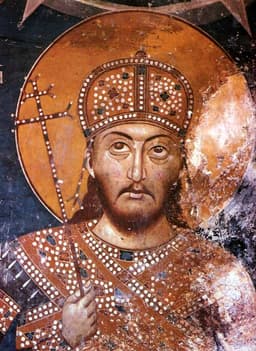
Stefan Uros IV Dusan
Emperor · Medieval
62.9Total
Basic Information
Born
796
1308
Died
842
1355
Era
Medieval
Medieval
Nationality
Abbasid Caliphate
Serbia
Occupation
Emperor
Emperor
Civilization
Middle Eastern
Western
Score Comparison
Military (10%)
82.0
76.0
Political (20%)
68.0
69.2
Influence (20%)
56.7
55.0
Legacy (20%)
52.0
55.0
Leadership (15%)
74.0
72.0
Strategy (15%)
69.1
65.9
TOTAL
63.6
62.9
Al-Mutasim — Complete Timeline
830 AD
Recruitment of Turkish Slave SoldiersReform
Al-Mutasim began systematically recruiting Turkish slave soldiers (ghilman) into the Abbasid army. This policy created a new military elite loyal to the caliph but later led to the decline of Abbasid power as the Turks gained influence.
Military ReformTurkish Guard
Impact: regional
836 AD
Foundation of SamarraPolitical Action◆ Major
Al-Mutasim moved the Abbasid capital from Baghdad to the new city of Samarra. This relocation was intended to separate the caliph from the Baghdad populace and house his Turkish guard, but it weakened central control.
Capital MoveUrban Foundation
Impact: regional
838 AD
Campaign against the ByzantinesWar◆ Major
Al-Mutasim led a major campaign against the Byzantine Empire, including the sack of the city of Amorium. This victory was celebrated in the Abbasid world and demonstrated the military power of the Turkish guard.
Arab-Byzantine WarsMilitary Campaign
Impact: regional
Stefan Uros IV Dusan — Complete Timeline
1346 AD
Coronation as Emperor of Serbs and GreeksPolitical Action
Stefan Dušan was crowned Emperor (Tsar) of Serbs and Greeks in Skopje by the newly elevated Serbian Patriarch Joanikije II. This coronation asserted Serbian imperial ambitions over Byzantine territories. The act created the Serbian Empire, claiming succession to the Byzantine Empire and challenging Constantinople's authority.
Imperial coronationSerbian EmpireByzantine succession
Impact: regionalconstructive
Elevation of the Serbian Archbishopric to PatriarchatePolitical Action◆ Major
Dušan convened a church council in Skopje that elevated the Serbian Archbishopric to a Patriarchate, with Joanikije II as the first Patriarch. This act was done without Constantinople's approval, causing a schism. The Serbian Patriarchate provided ecclesiastical independence for the empire and legitimized Dušan's imperial coronation.
Patriarchate establishmentChurch independenceSchism
Impact: regionalconstructive
1348 AD
Conquest of Macedonia and EpirusWar◆ Major
Dušan's armies conquered most of Macedonia, including the cities of Serres, Drama, and Kavala, as well as Epirus and Thessaly. These conquests expanded the Serbian Empire to its greatest territorial extent, covering much of the Balkan Peninsula. The acquisitions gave Serbia access to the Aegean Sea and control over key trade routes.
Territorial expansionMacedoniaAegean access
Impact: regional
1349 AD
Promulgation of Dušan's Code (Zakonik)Reform◆ Major
Dušan issued the Zakonik, a comprehensive legal code consisting of 201 articles. The code regulated all aspects of society, including feudal relations, church rights, and criminal law. It was based on Byzantine law but adapted to Serbian conditions. The code remained in use until the Ottoman conquest and influenced later Balkan legal systems.
Legal codeByzantine influenceFeudal regulation
Impact: regionalconstructive
1355 AD
Death and collapse of the Serbian EmpireOther
Dušan died suddenly at age 47, possibly from poisoning or illness, near Constantinople while preparing a campaign against the Byzantine capital. His death left the Serbian Empire without a strong successor. His son Stefan Uroš V proved unable to control the nobility, leading to the empire's fragmentation into rival principalities within two decades.
Empire collapseSuccession crisisFragmentation
Impact: regionaltragic
Expert Analysis
Origins
Al-Mutasim (born 796) was the eighth son of Caliph Harun al-Rashid, born to a Turkic concubine. He grew up in the Abbasid court in Baghdad, receiving a traditional Islamic education but also developing a keen interest in military affairs. His early career included commanding campaigns against the Byzantines and dealing with rebellions in the provinces. Al-Mutasim's background as a younger son meant he had to rely on his own military prowess and political maneuvering to rise, rather than being the designated heir.
Stefan Uros IV Dusan (born 1308) was the son of King Stefan Uros III Decanski of Serbia. He was raised in a period of Serbian expansion, with his father consolidating power against the Byzantine Empire and Bulgaria. Dusan received a courtly education, learning diplomacy, law, and warfare. His early life was marked by the execution of his father, an event Dusan himself orchestrated, which set the stage for his ambitious rule.
Rise to Power
Al-Mutasim became caliph in 833 after the death of his brother al-Ma'mun. His rise was facilitated by his military command and control of the Turkish slave soldiers (ghilman), whom he had recruited during his brother's reign. Al-Mutasim cultivated these troops as his power base, using them to suppress rebellions and secure his succession. The key turning point was his decision to move the capital to Samarra in 836, distancing himself from the established Baghdad elites and relying on his Turkish guard for protection.
Stefan Dusan seized power in 1331 by overthrowing and executing his father, King Stefan Uros III. He had been sent to Constantinople as a hostage earlier, which gave him firsthand knowledge of Byzantine politics. After his father's defeat in a civil war, Dusan was crowned king and immediately began expanding Serbian territory. His coronation as Emperor of Serbs and Greeks in 1346 was a pivotal moment, asserting Serbian independence and imperial ambition.
Leadership & Governance
Al-Mutasim ruled as an autocrat, relying heavily on his Turkish military slaves (ghilman) to enforce his authority. He reformed the army by creating a separate corps of Turkish soldiers, which improved military effectiveness but alienated traditional Arab and Persian elites. His governance was centralized, with Samarra serving as a new administrative capital. Al-Mutasim also promoted the Mutazilite doctrine, imposing religious orthodoxy through the mihna (inquisition), which created resentment among Sunni scholars.
Stefan Dusan combined military conquest with legal and administrative reforms. He promulgated Dusan's Code (Zakonik) in 1349, a comprehensive legal framework that standardized laws across his empire, regulating feudalism, property rights, and social hierarchy. He also elevated the Serbian Archbishopric to a Patriarchate in 1346, strengthening the Serbian Orthodox Church as a pillar of his state. Dusan's leadership style was more inclusive of local elites, integrating Byzantine nobles into his administration.
Triumph & Tragedy
Al-Mutasim's greatest triumph was the sack of Amorium in 838, a major Byzantine city. This victory avenged previous Byzantine incursions and demonstrated the power of his Turkish troops. He also successfully suppressed the Babak rebellion in Azerbaijan, consolidating Abbasid control. However, his reliance on Turkish slaves created a long-term problem: the ghilman grew too powerful, leading to instability after his death. His policy of moving the capital to Samarra isolated the caliph from the populace, contributing to the eventual decline of the Abbasid Caliphate.
Stefan Dusan's triumphs include the conquest of Macedonia, Epirus, and Thessaly, making Serbia the dominant power in the Balkans. His legal code, Dusan's Code, was a sophisticated document that influenced later Balkan legal systems. However, his sudden death in 1355 at age 47, while preparing a campaign against Constantinople, led to the rapid collapse of his empire. His son Stefan Uros V was weak, and the empire fragmented into feudal lordships within years.
Character & Destiny
Al-Mutasim was pragmatic and militaristic, prioritizing loyalty from his Turkish troops over traditional ties. His character was decisive, as seen in his swift relocation of the capital and his persecution of dissidents. However, his short-term military focus undermined long-term stability. He scored 74.0 in leadership, reflecting his ability to command loyalty, but his political score of 68.0 indicates his failure to balance factions.
Stefan Dusan was ambitious and visionary, with a talent for state-building. His legal code and ecclesiastical reforms show strategic thinking. He scored 72.0 in leadership and 69.2 in politics, reflecting his ability to consolidate power and govern effectively. However, his ambition may have overreached; his death left an empire that depended on his personal authority.
Legacy
Al-Mutasim's recruitment of Turkish slave soldiers set a precedent for Islamic states, influencing the Mamluk system in Egypt and beyond. His capital Samarra became a center of Islamic art and architecture, but his policies weakened the caliphate, leading to its fragmentation. His overall score is 63.6, with influence at 56.7 and legacy at 52.0.
Stefan Dusan's legacy is more positive: his legal code is a landmark in Serbian history, and his empire is remembered as the 'Serbian Golden Age.' His influence on Balkan state-building is significant, but his empire's collapse limited his long-term impact. He scores 62.9 overall, with influence at 55.0 and legacy at 55.0.
Conclusion
While Al-Mutasim had a higher overall score (63.6 vs 62.9), Stefan Dusan's impact on Serbian statehood and law is more enduring. Al-Mutasim's military innovations had far-reaching consequences but also contributed to Abbasid decline. Dusan's legal code and imperial vision shaped Serbian identity for centuries. Therefore, Stefan Dusan had a greater positive impact on his nation's history.
Rankings
🥇
Al-MutasimLeader
Mil: 82.0Pol: 68.0Inf: 56.7
63.6
🥈
Stefan Uros IV Dusan
Mil: 76.0Pol: 69.2Inf: 55.0
62.9
+0.7 behind
How This Comparison Works
Algorithm
Each figure is scored on 6 dimensions (0—100 scale) based on structured historical data: Military (10%), Political (20%), Influence (20%), Legacy (20%), Leadership (15%), Strategy (15%). The weighted total produces the final ranking.
Data Sources
Scores are computed from structured sub-indicators in the database. Scale factors adjust for era (Ancient ×0.85, Modern ×1.0) and civilization size (Eastern ×1.05, Other ×0.80) to account for differences in population and military scale.
Maximum 3 Figures
Comparisons are limited to 2—3 figures to ensure readability and statistical meaningfulness.
Error Margins
±5 points per dimension — Sub-scores are derived from historical records with inherent uncertainty. Two figures within 5 points on a dimension should be considered roughly equivalent in that area.
Total Score Accuracy
±3 points overall — The weighted combination of 6 dimensions produces a total score with approximately ±3 points of uncertainty. Differences of less than 3 points are not statistically significant— the figures are effectively tied.
Known Limitations
- Historical records are incomplete and uneven across civilizations
- Figures from oral-tradition societies may be underrepresented
- Occupation labels can misclassify multi-role figures
- Scores measure capability and impact, not moral character
- Quantitative scoring is a comparison tool, not absolute truth
Capability Radar
Military (10%) — Battles & Warfare
Battles
75
75
Win Rate
80
80
Expansion
70
85
Political (20%) — Governance & Reform
Reform
60
88
Diplomacy
55
70
Economy
50
75
Influence (20%) — Cultural & Global Reach
Cultural
55
70
Global
60
60
Legacy (20%) — Historical Impact
Historical
70
75
Longevity
65
65
Leadership (15%) — Power & Stability
Tenure
65
72
Stability
45
68
Strategy (15%) — Tactics & Innovation
Strategy
75
78
Tactics
70
70
Reform
85
65
Similar Comparisons
Comments & Discussion
No comments yet. Be the first to share your thoughts!