Loading...
Al-Mustansir II of Cairo vs Ghazan Khan
Ghazan Khan leads by 24.2 pts · 2 figures compared
…

Al-Mustansir II of Cairo
Emperor · Medieval
39.0Total
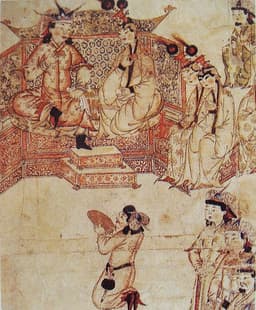
Ghazan Khan
Emperor · Medieval
63.2Total
Basic Information
Born
1230
1271
Died
1261
1304
Era
Medieval
Medieval
Nationality
Abbasid Caliphate
Ilkhanate
Occupation
Emperor
Emperor
Civilization
Middle Eastern
Middle Eastern
Score Comparison
Military (10%)
20.0
50.0
Political (20%)
25.0
70.0
Influence (20%)
49.4
72.0
Legacy (20%)
40.8
58.0
Leadership (15%)
41.5
68.0
Strategy (15%)
45.0
50.0
TOTAL
39.0
63.2
Al-Mustansir II of Cairo — Complete Timeline
1261 AD
Failed Expedition to BaghdadWar◆ Major
Al-Mustansir II led a small military expedition to reclaim Baghdad from the Mongols. The force was ambushed and defeated near Hit by Mongol troops. Al-Mustansir II was killed in the battle, ending his brief caliphate.
Mongol WarsFailed Reconquest
Impact: regionaltragic
Installation as Caliph in CairoPolitical Action◆ Major
Al-Mustansir II was recognized as caliph by the Mamluk Sultan Baybars in Cairo after the Mongol sack of Baghdad in 1258. This re-established the Abbasid caliphate in exile under Mamluk protection, though the caliph held no temporal power.
Abbasid RestorationMamluk Patronage
Impact: regionalconstructive
Ghazan Khan — Complete Timeline
1295 AD
Reforms of the Ilkhanate (Ghazan's Reforms)Reform◆ Major
Ghazan implemented a comprehensive reform program including tax reform, standardization of weights and measures, land redistribution, and the establishment of a new legal code. He also reformed the military and postal system, stabilizing the Ilkhanate after decades of instability.
ReformIlkhanateAdministration
Impact: regionalconstructive
Conversion to IslamCultural
Ghazan converted to Islam upon ascending the throne, becoming the first Ilkhan to adopt the faith. He publicly declared Islam the state religion, ordered the destruction of Buddhist temples and churches, and adopted the name Mahmud. This transformed the Ilkhanate's identity.
ReligionIlkhanateIslam
Impact: regionalconstructive
1297 AD
Patronage of Science and CultureCultural
Ghazan patronized scholars, historians, and scientists, including the vizier Rashid al-Din, who wrote the Jami' al-tawarikh, a world history. Ghazan also built observatories, hospitals, and mosques, contributing to the cultural flowering of the Ilkhanate.
CulturePatronageIlkhanate
Impact: regionalconstructive
1299 AD
Campaigns against the MamluksWar◆ Major
Ghazan led three major invasions of Mamluk Syria, capturing Damascus and Aleppo in 1299
Mongol InvasionSyriaMamluk Sultanate
Impact: regional
Battle of Wadi al-KhaznadarWar
Ghazan's Mongol army defeated the Mamluks under Sultan Al-Nasir Muhammad at Wadi al-Khaznadar near Homs. The victory allowed the Mongols to occupy Damascus and Aleppo, but they withdrew after a few months due to logistical problems and the need to return to Persia.
BattleMongol VictorySyria
Impact: regional
Expert Analysis
Origins
**Al-Mustansir II of Cairo** was born around 1210 as Abu al-Qasim Ahmad, a grandson of Caliph al-Zahir. After the Mongol siege of Baghdad in 1258, he fled to the Arabian desert and eventually reached Cairo in 1261. He had no independent power base, relying entirely on Mamluk patronage.
**Ghazan Khan** was born in 1271 in the Ilkhanate, the son of Arghun Khan. He was raised as a Buddhist but later educated in Islamic culture. He became governor of Khorasan and gained military experience fighting against the Chagatai Khanate.
Rise to Power
Al-Mustansir II's rise came when Mamluk Sultan Baybars sought to legitimize his rule by installing an Abbasid caliph in Cairo. In June 1261, Baybars recognized Al-Mustansir as caliph, a purely symbolic title. The caliph had no army or treasury, serving only as a figurehead.
Ghazan Khan overthrew his uncle Baidu in 1295 after a civil war. To gain support from the Muslim majority, he converted to Islam upon taking the throne, becoming the first Ilkhan to do so. This political move solidified his rule and shifted the Ilkhanate's identity.
Leadership & Governance
Al-Mustansir II's leadership was negligible. He attempted an expedition to reclaim Baghdad in 1261 with a small Mamluk force, but was ambushed and killed near Hit. His governance score of 25.0 reflects his lack of actual authority.
Ghazan Khan implemented sweeping reforms. He standardized weights and measures, reformed taxation to reduce corruption, and redistributed land to peasants. He also established a state-run postal system and patronized the historian Rashid al-Din to compile the Jami' al-tawarikh. His political score of 70.0 shows his effective administration.
Triumph & Tragedy
Al-Mustansir II's only triumph was being recognized as caliph, reviving the Abbasid line in Cairo. His tragedy was his failed expedition, which ended in his death and demonstrated the impotence of his title.
Ghazan Khan's greatest success was his conversion and reforms, which integrated the Mongol Ilkhanate into the Islamic world. He also captured Damascus and Aleppo in 1299-1300 after the Battle of Wadi al-Khaznadar (scored 50.0 military). However, his failure to hold Syria due to supply issues and Mamluk counterattacks limited his gains.
Character & Destiny
Al-Mustansir II was a figurehead, lacking the resources or personality to exert real influence. His destiny was to be a pawn in Mamluk politics.
Ghazan Khan was pragmatic and reform-minded. His conversion was politically motivated, but he genuinely patronized Islamic culture. His character shaped his legacy as a reformer, but his military ambitions were checked by logistical realities.
Legacy
Al-Mustansir II's legacy is symbolic: he established the Cairo Abbasid caliphate that continued until the Ottoman conquest in 1517. His influence score of 49.4 reflects this symbolic importance.
Ghazan Khan's legacy is more concrete: his reforms modernized the Ilkhanate, and his patronage of Rashid al-Din produced a seminal historical work. His influence score of 72.0 and legacy of 58.0 show his lasting impact on Persian and Islamic history.
Conclusion
Ghazan Khan had greater impact than Al-Mustansir II. His total score of 63.2 far exceeds Al-Mustansir's 39.0. While Al-Mustansir revived a symbolic institution, Ghazan transformed a Mongol state into an Islamic kingdom through real reforms and cultural patronage. The gap of 24.2 points reflects the difference between a puppet and a ruler who shaped his era.
Rankings
🥇
Ghazan KhanLeader
Mil: 50.0Pol: 70.0Inf: 72.0
63.2
🥈
Al-Mustansir II of Cairo
Mil: 20.0Pol: 25.0Inf: 49.4
39.0
+24.2 behind
How This Comparison Works
Algorithm
Each figure is scored on 6 dimensions (0—100 scale) based on structured historical data: Military (10%), Political (20%), Influence (20%), Legacy (20%), Leadership (15%), Strategy (15%). The weighted total produces the final ranking.
Data Sources
Scores are computed from structured sub-indicators in the database. Scale factors adjust for era (Ancient ×0.85, Modern ×1.0) and civilization size (Eastern ×1.05, Other ×0.80) to account for differences in population and military scale.
Maximum 3 Figures
Comparisons are limited to 2—3 figures to ensure readability and statistical meaningfulness.
Error Margins
±5 points per dimension — Sub-scores are derived from historical records with inherent uncertainty. Two figures within 5 points on a dimension should be considered roughly equivalent in that area.
Total Score Accuracy
±3 points overall — The weighted combination of 6 dimensions produces a total score with approximately ±3 points of uncertainty. Differences of less than 3 points are not statistically significant— the figures are effectively tied.
Known Limitations
- Historical records are incomplete and uneven across civilizations
- Figures from oral-tradition societies may be underrepresented
- Occupation labels can misclassify multi-role figures
- Scores measure capability and impact, not moral character
- Quantitative scoring is a comparison tool, not absolute truth
Capability Radar
Military (10%) — Battles & Warfare
Battles
5
55
Win Rate
5
60
Expansion
5
45
Political (20%) — Governance & Reform
Reform
15
85
Diplomacy
25
70
Economy
15
75
Influence (20%) — Cultural & Global Reach
Cultural
20
70
Global
15
55
Legacy (20%) — Historical Impact
Historical
25
65
Longevity
20
60
Leadership (15%) — Power & Stability
Tenure
30
60
Stability
20
65
Strategy (15%) — Tactics & Innovation
Strategy
5
55
Tactics
5
50
Reform
5
65
Similar Comparisons
Comments & Discussion
No comments yet. Be the first to share your thoughts!