Loading...
This comparison has not been analyzed yet.
One-time AI generation (~1 minute). Scores and timeline are already available below.
Aguda vs Jayavarman VII
Jayavarman VII leads by 10.4 pts · 2 figures compared
…

Aguda
Emperor · Medieval
61.0Total
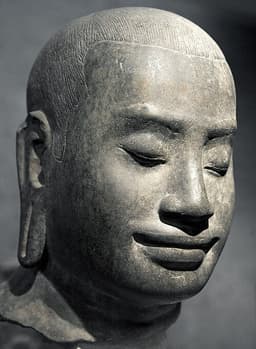
Jayavarman VII
Emperor · Medieval
71.4Total
Basic Information
Born
1068
1122
Died
1123
1218
Era
Medieval
Medieval
Nationality
Jin dynasty
Cambodia
Occupation
Emperor
Emperor
Civilization
Eastern
Eastern
Score Comparison
Military (10%)
82.0
80.0
Political (20%)
59.3
72.0
Influence (20%)
56.7
65.0
Legacy (20%)
52.0
72.0
Leadership (15%)
66.0
78.0
Strategy (15%)
68.0
66.3
TOTAL
61.0
71.4
Aguda — Complete Timeline
1114 AD
Unified the Jurchen tribesPolitical Action◆ Major
Aguda united the disparate Jurchen tribes under his leadership, creating a confederation that rebelled against Liao domination. He established a centralized military command and declared the Jin dynasty in 1115.
UnificationJurchenRebellion
Impact: regionalconstructive
1115 AD
Battle of HubudagangWar◆ Major
Aguda's Jin army decisively defeated a larger Liao force at Hubudagang. This victory broke Liao military power in the region and allowed the Jin to capture the Liao upper capital (Shangjing) shortly after.
BattleLiao defeatJin victory
Impact: regional
1122 AD
Captured the Liao central capitalWar◆ Major
Aguda led the Jin capture of the Liao central capital (Zhongjing). This conquest effectively ended Liao resistance in the south and forced the Liao emperor Yelu Yanxi to flee westward.
ConquestLiao capitalJin expansion
Impact: national
Jayavarman VII — Complete Timeline
1181 AD
Defeated the ChamsWar◆ Major
Jayavarman VII led a naval and land campaign to defeat the Champa kingdom, which had previously sacked Angkor. He conquered Champa and incorporated it into the Khmer Empire, ending the Cham threat.
ChampaWarConquest
Impact: regional
Construction of Angkor ThomCultural
Jayavarman VII built the fortified city of Angkor Thom as his new capital, featuring the Bayon temple with its iconic stone faces. The city was a massive urban and religious complex, reflecting his Mahayana Buddhist faith.
Angkor ThomCapitalBayon
Impact: globalconstructive
Conversion to Mahayana BuddhismCultural◆ Major
Jayavarman VII adopted Mahayana Buddhism as the state religion, shifting from the Hindu traditions of his predecessors. He built Buddhist temples like the Bayon and promoted the cult of the bodhisattva Lokeshvara.
BuddhismReligionConversion
Impact: regionalconstructive
1190 AD
Built Extensive Public WorksReform◆ Major
Jayavarman VII oversaw the construction of a vast network of roads, rest houses, and hospitals (102 hospitals) across the Khmer Empire. These public works improved infrastructure and welfare, demonstrating his focus on public welfare.
Public WorksInfrastructureHospitals
Impact: regionalconstructive
This comparison has not been analyzed yet.
One-time AI generation (~1 minute). Scores and timeline are already available below.
Rankings
🥇
Jayavarman VIILeader
Mil: 80.0Pol: 72.0Inf: 65.0
71.4
🥈
Aguda
Mil: 82.0Pol: 59.3Inf: 56.7
61.0
+10.4 behind
How This Comparison Works
Algorithm
Each figure is scored on 6 dimensions (0—100 scale) based on structured historical data: Military (10%), Political (20%), Influence (20%), Legacy (20%), Leadership (15%), Strategy (15%). The weighted total produces the final ranking.
Data Sources
Scores are computed from structured sub-indicators in the database. Scale factors adjust for era (Ancient ×0.85, Modern ×1.0) and civilization size (Eastern ×1.05, Other ×0.80) to account for differences in population and military scale.
Maximum 3 Figures
Comparisons are limited to 2—3 figures to ensure readability and statistical meaningfulness.
Error Margins
±5 points per dimension — Sub-scores are derived from historical records with inherent uncertainty. Two figures within 5 points on a dimension should be considered roughly equivalent in that area.
Total Score Accuracy
±3 points overall — The weighted combination of 6 dimensions produces a total score with approximately ±3 points of uncertainty. Differences of less than 3 points are not statistically significant— the figures are effectively tied.
Known Limitations
- Historical records are incomplete and uneven across civilizations
- Figures from oral-tradition societies may be underrepresented
- Occupation labels can misclassify multi-role figures
- Scores measure capability and impact, not moral character
- Quantitative scoring is a comparison tool, not absolute truth
Capability Radar
Military (10%) — Battles & Warfare
Battles
85
75
Win Rate
90
80
Expansion
85
75
Political (20%) — Governance & Reform
Reform
80
90
Diplomacy
75
70
Economy
70
80
Influence (20%) — Cultural & Global Reach
Cultural
60
85
Global
55
65
Legacy (20%) — Historical Impact
Historical
70
80
Longevity
60
70
Leadership (15%) — Power & Stability
Tenure
70
85
Stability
65
75
Strategy (15%) — Tactics & Innovation
Strategy
85
85
Tactics
80
70
Reform
75
60
Similar Comparisons
Comments & Discussion
No comments yet. Be the first to share your thoughts!