Loading...
Jayavarman VII vs Julius Caesar
Julius Caesar leads by 11.4 pts · 2 figures compared
…
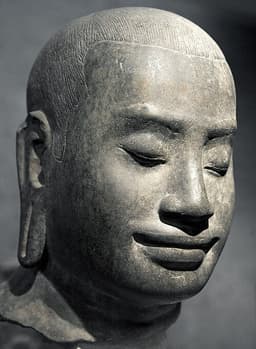
Jayavarman VII
Emperor · Medieval
71.4Total

Julius Caesar
General · Ancient
82.8Total
Basic Information
Born
1122
-100
Died
1218
-44
Era
Medieval
Ancient
Nationality
Cambodia
Roman Republic
Occupation
Emperor
General
Civilization
Eastern
Western
Score Comparison
Military (10%)
80.0
88.0
Political (20%)
72.0
78.0
Influence (20%)
65.0
85.0
Legacy (20%)
72.0
82.0
Leadership (15%)
78.0
80.0
Strategy (15%)
66.3
85.0
TOTAL
71.4
82.8
Jayavarman VII — Complete Timeline
1181 AD
Defeated the ChamsWar◆ Major
Jayavarman VII led a naval and land campaign to defeat the Champa kingdom, which had previously sacked Angkor. He conquered Champa and incorporated it into the Khmer Empire, ending the Cham threat.
ChampaWarConquest
Impact: regional
Construction of Angkor ThomCultural
Jayavarman VII built the fortified city of Angkor Thom as his new capital, featuring the Bayon temple with its iconic stone faces. The city was a massive urban and religious complex, reflecting his Mahayana Buddhist faith.
Angkor ThomCapitalBayon
Impact: globalconstructive
Conversion to Mahayana BuddhismCultural◆ Major
Jayavarman VII adopted Mahayana Buddhism as the state religion, shifting from the Hindu traditions of his predecessors. He built Buddhist temples like the Bayon and promoted the cult of the bodhisattva Lokeshvara.
BuddhismReligionConversion
Impact: regionalconstructive
1190 AD
Built Extensive Public WorksReform◆ Major
Jayavarman VII oversaw the construction of a vast network of roads, rest houses, and hospitals (102 hospitals) across the Khmer Empire. These public works improved infrastructure and welfare, demonstrating his focus on public welfare.
Public WorksInfrastructureHospitals
Impact: regionalconstructive
Julius Caesar — Complete Timeline
58 BC
Gallic WarsWar◆ Major
Caesar, as proconsul of Gaul, launched a series of campaigns that conquered all of Gaul (modern France, Belgium, and parts of Switzerland). He fought numerous battles, including against the Helvetii, the Belgae, and the Gallic chieftain Vercingetorix. The wars brought immense wealth and a loyal army to Caesar.
Gallic WarsConquestRoman Expansion
Impact: regional
49 BC
Crossing the RubiconPolitical Action◆ Major
Caesar led Legio XIII across the Rubicon River into Italy, defying the Roman Senate's order to disband his army. This act triggered a civil war against Pompey and the Optimates, ultimately leading to Caesar's dictatorship and the end of the Roman Republic.
Roman Civil WarEnd of RepublicPower Struggle
Impact: global
48 BC
Battle of PharsalusWar◆ Major
Caesar's outnumbered army defeated the larger forces of Pompey the Great at Pharsalus in Greece. Caesar's tactical use of a reserve line to counter Pompey's cavalry charge proved decisive. Pompey fled to Egypt, where he was assassinated, leaving Caesar as the undisputed master of the Roman world.
Roman Civil WarBattleDecisive Victory
Impact: regional
44 BC
Appointment as Dictator for LifePolitical Action◆ Major
The Roman Senate appointed Caesar dictator perpetuo (dictator for life), granting him unprecedented personal power. This move concentrated military, legislative, and judicial authority in one person, effectively ending the Roman Republic's traditional system of checks and balances and alarming many senators.
DictatorshipEnd of RepublicPower Consolidation
Impact: regionaldestructive
Assassination on the Ides of MarchPolitical Action◆ Major
A group of Roman senators, led by Marcus Junius Brutus and Gaius Cassius Longinus, stabbed Caesar to death at a meeting of the Senate in the Theatre of Pompey. The assassination was intended to restore the Republic, but instead triggered another civil war that led to the rise of the Roman Empire.
AssassinationRoman PoliticsEnd of Republic
Impact: globaldestructive
Expert Analysis
jayavarman-vii-vs-julius-caesar
# The Conqueror and the Builder
On the Ides of March in 44 BCE, Julius Caesar fell beneath twenty-three dagger blows in the Senate chamber of Rome, his blood pooling on the marble floor where he had once stood as master of the known world. Nearly thirteen centuries later and six thousand miles away, Jayavarman VII died in his bed in Angkor Thom, surrounded by the serene stone faces of Avalokiteshvara that still gaze out from the Bayon temple today. One man’s end was a political earthquake that shattered a republic; the other’s was a quiet transition that left an empire intact. What drove these two rulers—both brilliant, both ambitious, both builders of worlds—to such different fates?
Origins
Julius Caesar was born into the chaos of a dying republic. Rome in 100 BCE was a city of civil wars, street violence, and senatorial corruption. His family, the Julii, claimed descent from Venus herself, but they were politically marginal—patricians in name only, struggling for relevance. Caesar’s father died when he was sixteen, leaving him to navigate a treacherous world of Marius and Sulla, of proscriptions and exile. He learned early that survival meant audacity.
Jayavarman VII came from a very different world. Born around 1122, he was a prince of the Khmer Empire at its zenith—a civilization of rice paddies, monsoon rains, and Hindu gods carved into sandstone. His father was King Dharanindravarman II, but Jayavarman was not the designated heir. For much of his early life, he seems to have been a scholar and a Buddhist layman, studying philosophy while others fought for the throne. When the Chams sacked Angkor in 1177, he was already in his fifties—an old man by medieval standards, yet one who had spent decades watching and waiting.
Rise to Power
Caesar’s path was a masterclass in calculated risk. He borrowed fortunes to throw games for the Roman mob, won military commands in Spain, and forged the First Triumvirate with Pompey and Crassus—a backroom deal that made him consul at forty-two. His conquest of Gaul from 58 to 50 BCE was not just a war; it was a political machine, generating wealth, loyalty, and a veteran army that answered to him alone. When the Senate ordered him to disband, he crossed the Rubicon—a river that was both a geographical boundary and a point of no return. “The die is cast,” he said, and with that, he chose civil war over submission.
Jayavarman VII’s rise was more reluctant, more reactive. After the Cham invasion of 1177, the Khmer king fled, and the empire collapsed into chaos. Jayavarman, then in his late fifties, gathered what forces he could and fought back. In 1181, he defeated the Chams in a decisive naval and land campaign, driving them from Angkor and then pursuing them into their own territory. He did not seize power; it was thrust upon him by necessity. Where Caesar marched on Rome, Jayavarman rebuilt it.
Leadership & Governance
Caesar ruled like a storm. As dictator, he reformed the calendar, granted citizenship to provincials, initiated public works, and centralized power in his own hands—all in just five years. His military genius was unmatched: at Alesia, he besieged a Gallic army while simultaneously building defenses against a relief force, winning a battle that should have been unwinnable. But he governed with the same ruthlessness that won wars. He packed the Senate with his supporters, struck coins with his own image, and accepted the title “dictator for life.” He was a reformer, yes, but also a man who believed that history belonged to those who seized it.
Jayavarman VII governed like a father. He built Angkor Thom, a fortified city whose walls stretched eight miles, and at its center the Bayon temple, where 216 stone faces—said to be his own likeness as the bodhisattva Avalokiteshvara—watch over every direction. But he also built 102 hospitals, rest houses along every major road, and a network of reservoirs that irrigated the Khmer heartland. He converted the state from Hinduism to Mahayana Buddhism, not as a political weapon, but as a genuine act of faith. His inscriptions speak not of glory but of compassion: “The suffering of his subjects is the suffering of the king.” He was a builder, not a conqueror—and he built for his people, not for himself.
Triumph & Tragedy
Caesar’s greatest triumph was his greatest tragedy. He conquered Gaul, defeated Pompey, and became master of Rome—only to be murdered by men he had pardoned, led by Brutus, whom he had loved like a son. “Et tu, Brute?” may be Shakespeare’s invention, but it captures the terrible intimacy of his fall. He died because he could not stop winning; his success made him a tyrant in the eyes of those who still believed in the Republic.
Jayavarman VII’s tragedy was subtler. He built an empire of stone and water, but his massive construction projects drained the Khmer treasury and overstrained the labor force. After his death, the empire began a slow decline, its canals silting up, its temples abandoned to the jungle. He built too much, too fast, and his successors could not sustain it. The Bayon’s faces still smile, but they smile over a ghost city.
Character & Destiny
Caesar was a gambler. He wrote his own commentaries, controlled his own narrative, and believed that fortune favored the bold. His personality—arrogant, charismatic, and utterly convinced of his own destiny—drove him to take risks that no sane man would take. That same personality made him impossible to trust. The conspirators killed him not because they hated him, but because they feared him.
Jayavarman VII was a philosopher-king. He had spent decades in contemplation before he ever took the throne, and his rule reflected that patience. He was not driven by ego but by duty. His personality—serene, devout, and deeply humane—allowed him to build an empire that lasted, even after his death. The Khmer Empire did not collapse overnight; it faded, like a stone wearing away under rain.
Legacy
Caesar’s legacy is the Roman Empire. His name became a title: Kaiser, Tsar. He changed the course of Western history, and his assassination did not restore the Republic—it merely cleared the way for Augustus. He is remembered as a genius and a tyrant, a man who destroyed one world to create another.
Jayavarman VII’s legacy is Angkor. The Bayon, Angkor Thom, the hospitals, the roads—they are still there, carved into the Cambodian landscape. He is remembered as a builder and a bodhisattva, a king who saw himself as a servant of his people. In Cambodia, he is not a distant historical figure; he is a presence, a face that watches over the land.
Conclusion
Two men, two empires, two ways of ruling. Caesar conquered the world and died for it; Jayavarman VII built a world and lived to see it flourish. One sought glory, the other sought peace. One left a legacy of power, the other a legacy of compassion. Perhaps the difference is not in their abilities—both were brilliant—but in their definitions of success. Caesar wanted to be remembered. Jayavarman VII wanted to be forgotten, in the way that a father is forgotten when his children thrive. In the end, both got what they wanted. And we are still telling their stories.
Rankings
🥇
Julius CaesarLeader
Mil: 88.0Pol: 78.0Inf: 85.0
82.8
🥈
Jayavarman VII
Mil: 80.0Pol: 72.0Inf: 65.0
71.4
+11.4 behind
How This Comparison Works
Algorithm
Each figure is scored on 6 dimensions (0—100 scale) based on structured historical data: Military (10%), Political (20%), Influence (20%), Legacy (20%), Leadership (15%), Strategy (15%). The weighted total produces the final ranking.
Data Sources
Scores are computed from structured sub-indicators in the database. Scale factors adjust for era (Ancient ×0.85, Modern ×1.0) and civilization size (Eastern ×1.05, Other ×0.80) to account for differences in population and military scale.
Maximum 3 Figures
Comparisons are limited to 2—3 figures to ensure readability and statistical meaningfulness.
Error Margins
±5 points per dimension — Sub-scores are derived from historical records with inherent uncertainty. Two figures within 5 points on a dimension should be considered roughly equivalent in that area.
Total Score Accuracy
±3 points overall — The weighted combination of 6 dimensions produces a total score with approximately ±3 points of uncertainty. Differences of less than 3 points are not statistically significant— the figures are effectively tied.
Known Limitations
- Historical records are incomplete and uneven across civilizations
- Figures from oral-tradition societies may be underrepresented
- Occupation labels can misclassify multi-role figures
- Scores measure capability and impact, not moral character
- Quantitative scoring is a comparison tool, not absolute truth
Capability Radar
Military (10%) — Battles & Warfare
Battles
75
95
Win Rate
80
92
Expansion
75
97
Political (20%) — Governance & Reform
Reform
90
90
Diplomacy
70
85
Economy
80
82
Influence (20%) — Cultural & Global Reach
Cultural
85
88
Global
65
94
Legacy (20%) — Historical Impact
Historical
80
95
Longevity
70
96
Leadership (15%) — Power & Stability
Tenure
85
75
Stability
75
60
Strategy (15%) — Tactics & Innovation
Strategy
85
94
Tactics
70
96
Reform
60
88
Similar Comparisons
Comments & Discussion
No comments yet. Be the first to share your thoughts!