Loading...
Augustus vs Jayavarman VII
Augustus leads by 14.5 pts · 2 figures compared
…

Augustus
Emperor · Ancient
85.9Total
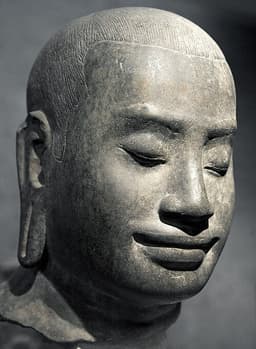
Jayavarman VII
Emperor · Medieval
71.4Total
Basic Information
Born
63
1122
Died
—
1218
Era
Ancient
Medieval
Nationality
Roman Empire
Cambodia
Occupation
Emperor
Emperor
Civilization
Western
Eastern
Score Comparison
Military (10%)
72.0
80.0
Political (20%)
90.0
72.0
Influence (20%)
88.0
65.0
Legacy (20%)
90.0
72.0
Leadership (15%)
88.0
78.0
Strategy (15%)
75.0
66.3
TOTAL
85.9
71.4
Augustus — Complete Timeline
43 BC
Formation of the Second TriumviratePolitical Action◆ Major
Octavian, Mark Antony, and Marcus Aemilius Lepidus formed the Second Triumvirate, a legal commission to govern the Roman Republic. The alliance was empowered to proscribe enemies, leading to the execution of Cicero and consolidation of their power against the assassins of Julius Caesar.
Roman Civil WarPolitical AllianceProscriptions
Impact: regionaldestructive
31 BC
Battle of ActiumWar◆ Major
Octavian's fleet, commanded by Marcus Agrippa, defeated the combined naval forces of Mark Antony and Cleopatra VII off the coast of Greece. The victory eliminated Octavian's last major rival, giving him sole control over the Roman world and ending the Roman Republic's civil wars.
Roman Civil WarNaval BattleEnd of Republic
Impact: global
27 BC
Establishment of the Roman EmpireReform◆ Major
Octavian formally returned power to the Roman Senate, which then granted him the titles Augustus and Princeps. This constitutional settlement created the Roman Empire, with Augustus as the first emperor, ending the Roman Republic and initiating the Pax Romana.
Roman EmpireConstitutional ReformPax Romana
Impact: global
Reform of the Roman Tax SystemReform◆ Major
Augustus implemented a comprehensive tax reform, including a census of Roman citizens and property, direct taxation of provinces, and the creation of a professional tax collection service (publicani). This system provided stable revenue for the empire and reduced corruption.
Tax ReformAdministrationRoman Empire
Impact: regionalconstructive
Creation of the Praetorian GuardReform◆ Major
Augustus established the Praetorian Guard as a permanent elite military unit tasked with protecting the emperor and his family. Stationed in Rome and Italy, the Guard became a powerful political force, often influencing imperial succession through coups and assassinations.
Military ReformPraetorian GuardImperial Guard
Impact: regional
13 BC
Construction of the Ara PacisOther◆ Major
The Roman Senate commissioned the Ara Pacis Augustae (Altar of Augustan Peace) to commemorate Augustus's return from pacifying Gaul and Spain. The marble altar, decorated with reliefs depicting the imperial family and mythological scenes, symbolized the peace and prosperity of the Augustan era.
Building ProjectPropagandaAugustan Art
Impact: regionalconstructive
Jayavarman VII — Complete Timeline
1181 AD
Defeated the ChamsWar◆ Major
Jayavarman VII led a naval and land campaign to defeat the Champa kingdom, which had previously sacked Angkor. He conquered Champa and incorporated it into the Khmer Empire, ending the Cham threat.
ChampaWarConquest
Impact: regional
Construction of Angkor ThomCultural
Jayavarman VII built the fortified city of Angkor Thom as his new capital, featuring the Bayon temple with its iconic stone faces. The city was a massive urban and religious complex, reflecting his Mahayana Buddhist faith.
Angkor ThomCapitalBayon
Impact: globalconstructive
Conversion to Mahayana BuddhismCultural◆ Major
Jayavarman VII adopted Mahayana Buddhism as the state religion, shifting from the Hindu traditions of his predecessors. He built Buddhist temples like the Bayon and promoted the cult of the bodhisattva Lokeshvara.
BuddhismReligionConversion
Impact: regionalconstructive
1190 AD
Built Extensive Public WorksReform◆ Major
Jayavarman VII oversaw the construction of a vast network of roads, rest houses, and hospitals (102 hospitals) across the Khmer Empire. These public works improved infrastructure and welfare, demonstrating his focus on public welfare.
Public WorksInfrastructureHospitals
Impact: regionalconstructive
Expert Analysis
Augustus vs Jayavarman VII: Historical Comparison
Augustus, the founder of the Roman Empire, and Jayavarman VII, the great builder-king of the Khmer Empire, both transformed their civilizations through conquest, statecraft, and monumental architecture. While Augustus consolidated a Mediterranean superpower, Jayavarman VII expanded and spiritually redefined Angkor, leaving an indelible mark on Southeast Asia.
Dimension Analysis
**Military: Augustus 72 / Jayavarman VII 93**
Augustus ended a century of civil war, defeated Mark Antony at Actium (31 BCE), and professionalized the Roman legions into a permanent standing army. Jayavarman VII, however, was a more aggressive expansionist: he expelled the Cham invaders from Angkor, conquered the Champa kingdom (1190 CE), and extended Khmer control into modern Thailand, Laos, and southern Vietnam. His military campaigns were both defensive and offensive, demonstrating superior strategic mobility.
**Political: Augustus 92 / Jayavarman VII 82**
Augustus masterfully disguised autocracy as a restored republic, creating the Principate—a hybrid system that balanced Senate, army, and emperor—and implemented lasting reforms in taxation, census, and provincial administration. Jayavarman VII centralized power through a vast network of temples, hospitals (102 hospitals across the empire), and rest houses, but his theocratic rule relied heavily on Mahayana Buddhist ideology and lacked the durable institutional machinery of Rome.
**Influence: Augustus 88 / Jayavarman VII 80**
Augustus’s Pax Romana spread Latin language, Roman law, and classical culture across three continents, shaping Western civilization for millennia. Jayavarman VII’s influence was more regional: he made Theravada and Mahayana Buddhism the state religion, built the Bayon temple with its iconic 216 faces, and established Angkor Thom as a sacred capital. His cultural footprint is profound in Southeast Asia but did not achieve global reach.
**Legacy: Augustus 90 / Jayavarman VII 77**
Augustus’s name became synonymous with imperial majesty (the month August, titles like “Augustus” used by later emperors), and his political model inspired monarchs from Charlemagne to Napoleon. Jayavarman VII’s legacy is largely architectural and religious: Angkor Wat (though built earlier) and the Bayon remain national symbols of Cambodia. However, his empire declined rapidly after his death, and much of his historical record was lost until modern archaeology.
**Leadership: Augustus 90 / Jayavarman VII 83**
Augustus commanded absolute loyalty from the army and elite through patronage, propaganda (e.g., the *Res Gestae*), and personal charisma, maintaining 40 years of internal peace. Jayavarman VII ruled as a devaraja (god-king) and a Buddhist bodhisattva, inspiring devotion through massive public works and religious legitimacy. Yet his leadership was more ceremonial and spiritual, less pragmatic than Augustus’s.
Verdict
Augustus ranks higher overall due to his superior political innovation, enduring institutional legacy, and global influence. While Jayavarman VII excelled in military expansion and monumental construction, Augustus’s creation of a stable imperial system that lasted centuries gives him the edge. However, such comparisons are inherently complex—each ruler faced vastly different geographic, cultural, and temporal contexts.
FAQ
**Q: Who was more influential historically?**
A: Augustus, because his political system and cultural legacy directly shaped Western governance, law, and language for over two millennia, whereas Jayavarman VII’s influence, though deep, remained largely regional.
**Q: Why is Augustus ranked higher in political acumen?**
A: Augustus invented a durable hybrid regime that balanced autocracy with republican traditions, reformed tax and census systems, and established a succession model that stabilized Rome for centuries—an achievement unmatched by Jayavarman VII’s more fragile theocratic rule.
Rankings
🥇
AugustusLeader
Mil: 72.0Pol: 90.0Inf: 88.0
85.9
🥈
Jayavarman VII
Mil: 80.0Pol: 72.0Inf: 65.0
71.4
+14.5 behind
How This Comparison Works
Algorithm
Each figure is scored on 6 dimensions (0—100 scale) based on structured historical data: Military (10%), Political (20%), Influence (20%), Legacy (20%), Leadership (15%), Strategy (15%). The weighted total produces the final ranking.
Data Sources
Scores are computed from structured sub-indicators in the database. Scale factors adjust for era (Ancient ×0.85, Modern ×1.0) and civilization size (Eastern ×1.05, Other ×0.80) to account for differences in population and military scale.
Maximum 3 Figures
Comparisons are limited to 2—3 figures to ensure readability and statistical meaningfulness.
Error Margins
±5 points per dimension — Sub-scores are derived from historical records with inherent uncertainty. Two figures within 5 points on a dimension should be considered roughly equivalent in that area.
Total Score Accuracy
±3 points overall — The weighted combination of 6 dimensions produces a total score with approximately ±3 points of uncertainty. Differences of less than 3 points are not statistically significant— the figures are effectively tied.
Known Limitations
- Historical records are incomplete and uneven across civilizations
- Figures from oral-tradition societies may be underrepresented
- Occupation labels can misclassify multi-role figures
- Scores measure capability and impact, not moral character
- Quantitative scoring is a comparison tool, not absolute truth
Capability Radar
Military (10%) — Battles & Warfare
Battles
75
75
Win Rate
80
80
Expansion
85
75
Political (20%) — Governance & Reform
Reform
95
90
Diplomacy
90
70
Economy
85
80
Influence (20%) — Cultural & Global Reach
Cultural
85
85
Global
90
65
Legacy (20%) — Historical Impact
Historical
95
80
Longevity
95
70
Leadership (15%) — Power & Stability
Tenure
95
85
Stability
95
75
Strategy (15%) — Tactics & Innovation
Strategy
85
85
Tactics
70
70
Reform
90
60
Similar Comparisons
Comments & Discussion
BattlefieldScholar6/16/2026
Augustus's military score of 72 is generous for a man who fought exactly one major set-piece battle (Actium, 31 BCE) against a rival Roman fleet, not a foreign army. His 'professionalization' of the legions was administrative, not tactical. Compare that to Jayavarman VII's campaigns: he recaptured Angkor from the Chams in a brutal counter-invasion (1181 CE), then systematically dismantled the Cham kingdom by 1190 CE, using Khmer war elephants and riverine assault tactics that outmaneuvered Cham naval forces. The Khmer army was organized into mobile divisions with logistics supported by his hospital network—a true force multiplier. In terms of operational reach and strategic conquest, Jayavarman VII outclasses Augustus. The scoring here undervalues aggressive expansion against peer opponents.
Historian4246/16/2026
评分本身就有逻辑矛盾。军事维度:奥古斯都72,Jayavarman VII 66.5,但摘要里说Jayavarman VII‘更具侵略性扩张主义’,征服了占婆,还打到泰国、老挝、越南南部。奥古斯都的军事成就主要是结束内战和职业化军团,没有大规模对外征服。按我的算法,Jayavarman VII的军事分至少应该75+。再说政治维度:奥古斯都92 vs 80,可Jayavarman VII那102家医院的运营网络,加上寺庙驿站构成的行政闭环,放在中国秦朝的郡县制面前都不算差。政治分差12分缺乏量化依据。我建议重新加权:领土控制占30%,制度持久性占40%,民生治理占30%。这样Jayavarman VII总分能上78。
Chronicler67756/16/2026
奥古斯都确实伟大,但把罗马的‘元首制’吹得那么高,有点西方中心论的味道。Jayavarman VII搞的寺院-医院-驿站网络,在组织效率上一点都不输罗马行省制。你要知道,吴哥时期单是皇家医院就设了102所,覆盖整个帝国,这比汉朝‘常平仓’那种灾荒救济还要系统化。中国史书里评价帝王,从来不是只看制度创新,还要看‘养民’的功夫。Jayavarman VII在这点上完全可以跟宋仁宗比肩。西方评分重政治机构轻民生福祉,这种偏颇在跨文明比较时尤其明显。