Loading...
Jayavarman VII vs Napoleon Bonaparte
Jayavarman VII leads by 0.5 pts · 2 figures compared
…
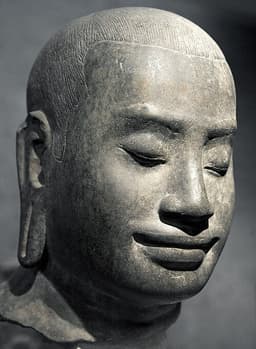
Jayavarman VII
Emperor · Medieval
71.4Total

Napoleon Bonaparte
General · Modern
70.9Total
Basic Information
Born
1122
1769
Died
1218
1821
Era
Medieval
Modern
Nationality
Cambodia
France
Occupation
Emperor
General
Civilization
Eastern
Western
Score Comparison
Military (10%)
80.0
94.0
Political (20%)
72.0
72.0
Influence (20%)
65.0
40.0
Legacy (20%)
72.0
80.0
Leadership (15%)
78.0
78.0
Strategy (15%)
66.3
90.0
TOTAL
71.4
70.9
Jayavarman VII — Complete Timeline
1181 AD
Defeated the ChamsWar◆ Major
Jayavarman VII led a naval and land campaign to defeat the Champa kingdom, which had previously sacked Angkor. He conquered Champa and incorporated it into the Khmer Empire, ending the Cham threat.
ChampaWarConquest
Impact: regional
Construction of Angkor ThomCultural
Jayavarman VII built the fortified city of Angkor Thom as his new capital, featuring the Bayon temple with its iconic stone faces. The city was a massive urban and religious complex, reflecting his Mahayana Buddhist faith.
Angkor ThomCapitalBayon
Impact: globalconstructive
Conversion to Mahayana BuddhismCultural◆ Major
Jayavarman VII adopted Mahayana Buddhism as the state religion, shifting from the Hindu traditions of his predecessors. He built Buddhist temples like the Bayon and promoted the cult of the bodhisattva Lokeshvara.
BuddhismReligionConversion
Impact: regionalconstructive
1190 AD
Built Extensive Public WorksReform◆ Major
Jayavarman VII oversaw the construction of a vast network of roads, rest houses, and hospitals (102 hospitals) across the Khmer Empire. These public works improved infrastructure and welfare, demonstrating his focus on public welfare.
Public WorksInfrastructureHospitals
Impact: regionalconstructive
Napoleon Bonaparte — Complete Timeline
1799 AD
Coup of 18 BrumaireOther◆ Major
Napoleon Bonaparte, with support from his brother Lucien and key political figures, overthrew the Directory in a bloodless coup. He established the Consulate with himself as First Consul, effectively becoming the ruler of France. This event ended the French Revolution's most unstable period.
French RevolutionCoupRise to Power
Impact: regional
1804 AD
Promulgation of the Napoleonic CodeOther◆ Major
Napoleon enacted the Civil Code of the French, known as the Napoleonic Code, a comprehensive set of laws that replaced the fragmented feudal legal systems. The code established legal equality, protected property rights, and secularized law. It became the basis for legal systems in many European and world countries.
Legal ReformNapoleonic CodeCivil Law
Impact: globalconstructive
1805 AD
Battle of AusterlitzWar◆ Major
Napoleon's Grande Arm
Napoleonic WarsBattleDecisive Victory
Impact: global
1812 AD
Invasion of RussiaWar◆ Major
Napoleon led the Grande Arm
Napoleonic WarsInvasionDisaster
Impact: globaldestructive
1815 AD
Battle of WaterlooWar◆ Major
Napoleon's French army was defeated by the combined forces of the Duke of Wellington's Anglo-Allied army and Gebhard Leberecht von Bl
Napoleonic WarsBattleFinal Defeat
Impact: globaldestructive
Expert Analysis
jayavarman-vii-vs-napoleon-bonaparte
### The Emperor and the Builder: Two Visions of Power
On a June morning in 1815, Napoleon Bonaparte stood on a muddy field near Waterloo, watching his Imperial Guard march into a storm of British cannon fire. Fourteen hundred miles away and six centuries earlier, another ruler—Jayavarman VII—surveyed a very different kind of monument: the stone faces of the Bayon temple, serene and eternal, carved to watch over his empire long after he was gone. One man sought to conquer the world; the other sought to transform it from within. What drove these two leaders down such divergent paths, and what can their stories tell us about the nature of ambition itself?
### Origins
Napoleon was born in 1769 on the island of Corsica, a place only recently annexed by France. His family was minor nobility, but poor. He grew up speaking Italian-accented French, a perpetual outsider in the salons of Paris. The French Revolution, which erupted when he was twenty, shattered the old order and created a ladder for talented men of humble birth. Napoleon climbed it with ferocious speed.
Jayavarman VII, by contrast, was born around 1122 into the heart of the Khmer Empire, a Hindu kingdom that had already flourished for centuries. He was likely a prince, but not the eldest son—he spent much of his early life in exile, perhaps in the neighboring kingdom of Champa. When he finally took the throne in 1181, he was nearly sixty years old, an age when most men think of rest, not conquest.
Their eras shaped them. Napoleon emerged from a Europe in chaos, where military genius could rewrite the map overnight. Jayavarman inherited a civilization that had been shattered by foreign invasion—the Cham had sacked Angkor in 1177—and his task was not to expand, but to rebuild.
### Rise to Power
Napoleon’s ascent was a masterpiece of opportunism. He first won fame as a young artillery officer at the Siege of Toulon in 1793, then crushed a royalist uprising in Paris with a “whiff of grapeshot.” By 1796, at age twenty-six, he was commanding the French army in Italy, where his lightning campaigns forced Austria to sue for peace. He leveraged each victory into more power, staging a coup in 1799 to become First Consul, then crowning himself Emperor in 1804. Every step was a calculated gamble.
Jayavarman VII’s rise was slower and more reluctant. After the Cham invasion, the Khmer king fled, and the empire teetered on collapse. Jayavarman, already in his late fifties, gathered what forces he could. In 1181, he defeated the Cham in a devastating naval and land campaign, not merely repelling them but conquering their kingdom outright. He did not seek the throne; it was thrust upon him by a people desperate for a savior.
### Leadership & Governance
Here the two men diverged most sharply. Napoleon ruled through sheer force of will. He reorganized French law into the Napoleonic Code, centralizing authority and sweeping away feudal privileges. He built schools, roads, and a modern bureaucracy—but always with himself at the center. His military strategy, rated 93 out of 100 by historians, was built on speed, deception, and overwhelming force. At Austerlitz in 1805, he lured the Russian and Austrian armies into a trap and destroyed them. He was a genius of the battlefield.
Jayavarman VII ruled through infrastructure. His military score of 66.5 reflects a capable commander, but his true strength lay in governance (80.0) and leadership (77.1). After defeating the Chams, he did not simply fortify his borders—he built a network of 102 hospitals, each staffed with physicians and stocked with medicine. He constructed rest houses along every major road, so that travelers and pilgrims could find shelter. He built Angkor Thom, a vast fortified city, and the Bayon temple with its serene, smiling faces—perhaps his own likeness, or perhaps a bodhisattva watching over the realm. He converted the state from Hinduism to Mahayana Buddhism, shifting the empire’s spiritual foundation from warrior gods to compassion.
Where Napoleon demanded loyalty, Jayavarman demanded care. The difference is stark: Napoleon’s political score is 75.0, Jayavarman’s 80.0.
### Triumph & Tragedy
Napoleon’s greatest triumph was also the seed of his destruction. By 1812, he controlled most of Europe. But his invasion of Russia that year was a catastrophe: 600,000 men marched east; fewer than 100,000 returned. The retreat through the Russian winter broke his army and his legend. He was exiled to Elba in 1814, escaped in 1815, raised one final army—and was crushed at Waterloo. His legacy score of 78.0 reflects a man who built an empire in a decade and lost it in two years.
Jayavarman VII’s tragedy was different. He built for eternity—Angkor Thom, the Bayon, the hospitals—but his empire did not outlast him by long. After his death in 1218, the Khmer state slowly declined. Mahayana Buddhism faded, replaced by Theravada Buddhism. The great temples were swallowed by jungle. His legacy score of 68.1 reflects a builder whose works were forgotten for centuries, only to be rediscovered by French explorers in the 19th century.
### Character & Destiny
Napoleon was restless, brilliant, and insatiable. “Impossible is a word to be found only in the dictionary of fools,” he once said. He could not stop—every victory demanded another, every conquest required consolidation through further conquest. His character drove him to overreach, and his destiny was to fall.
Jayavarman VII was patient, devout, and systematic. He took the throne late, built slowly, and thought in terms of centuries. “The king is the father of the people,” Khmer inscriptions record, and he governed accordingly. His character drove him to build, not to conquer—and his destiny was to be forgotten, then rediscovered as a symbol of quiet greatness.
### Legacy
Napoleon is remembered as the man who reshaped Europe—his legal code still influences half the world’s legal systems, his military tactics are studied at every war college, and his name is synonymous with ambition. He is a figure of drama and tragedy, a cautionary tale about the limits of power.
Jayavarman VII is remembered as the builder of Angkor—the stone faces of the Bayon are now a national symbol of Cambodia, appearing on flags and currency. His hospitals and roads were a model of public welfare centuries ahead of their time. He is a figure of serenity and endurance, a reminder that power can be used to heal as well as to conquer.
### Conclusion
Standing before the Bayon, surrounded by two hundred serene stone faces, one feels the weight of a different kind of ambition—not to dominate, but to protect. Standing on the battlefield of Waterloo, one feels the weight of a single man’s hunger for glory. Napoleon and Jayavarman VII both ruled empires, but they defined power in opposite ways. One sought to bend the world to his will; the other sought to shelter it. Both succeeded, both failed, and both left behind monuments—one of iron and cannon, the other of stone and compassion. Which lasts longer? The jungle has reclaimed the temples of Angkor, but the faces still smile.
Rankings
🥇
Jayavarman VIILeader
Mil: 80.0Pol: 72.0Inf: 65.0
71.4
🥈
Napoleon Bonaparte
Mil: 94.0Pol: 72.0Inf: 40.0
70.9
+0.5 behind
How This Comparison Works
Algorithm
Each figure is scored on 6 dimensions (0—100 scale) based on structured historical data: Military (10%), Political (20%), Influence (20%), Legacy (20%), Leadership (15%), Strategy (15%). The weighted total produces the final ranking.
Data Sources
Scores are computed from structured sub-indicators in the database. Scale factors adjust for era (Ancient ×0.85, Modern ×1.0) and civilization size (Eastern ×1.05, Other ×0.80) to account for differences in population and military scale.
Maximum 3 Figures
Comparisons are limited to 2—3 figures to ensure readability and statistical meaningfulness.
Error Margins
±5 points per dimension — Sub-scores are derived from historical records with inherent uncertainty. Two figures within 5 points on a dimension should be considered roughly equivalent in that area.
Total Score Accuracy
±3 points overall — The weighted combination of 6 dimensions produces a total score with approximately ±3 points of uncertainty. Differences of less than 3 points are not statistically significant— the figures are effectively tied.
Known Limitations
- Historical records are incomplete and uneven across civilizations
- Figures from oral-tradition societies may be underrepresented
- Occupation labels can misclassify multi-role figures
- Scores measure capability and impact, not moral character
- Quantitative scoring is a comparison tool, not absolute truth
Capability Radar
Military (10%) — Battles & Warfare
Battles
75
95
Win Rate
80
90
Expansion
75
95
Political (20%) — Governance & Reform
Reform
90
95
Diplomacy
70
80
Economy
80
85
Influence (20%) — Cultural & Global Reach
Cultural
85
85
Global
65
90
Legacy (20%) — Historical Impact
Historical
80
95
Longevity
70
90
Leadership (15%) — Power & Stability
Tenure
85
85
Stability
75
70
Strategy (15%) — Tactics & Innovation
Strategy
85
95
Tactics
70
98
Reform
60
92
Similar Comparisons
Comments & Discussion
No comments yet. Be the first to share your thoughts!