Loading...
Afonso de Albuquerque vs Yelu Abaoji
Afonso de Albuquerque leads by 16.9 pts · 2 figures compared
…
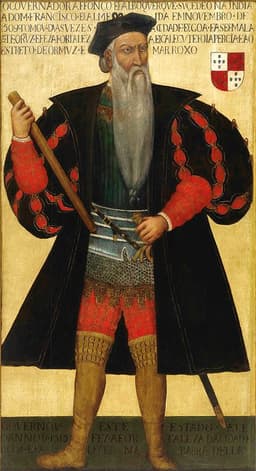
Afonso de Albuquerque
General · Medieval
79.6Total
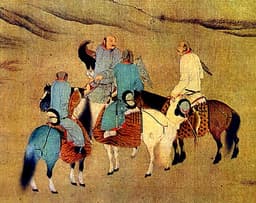
Yelu Abaoji
Emperor · Medieval
62.7Total
Basic Information
Born
1453
872
Died
1515
926
Era
Medieval
Medieval
Nationality
Portugal
China
Occupation
General
Emperor
Civilization
Western
Eastern
Score Comparison
Military (10%)
77.5
77.2
Political (20%)
88.0
59.6
Influence (20%)
80.0
68.0
Legacy (20%)
75.0
40.0
Leadership (15%)
78.0
80.3
Strategy (15%)
82.0
69.6
TOTAL
79.6
62.7
Afonso de Albuquerque — Complete Timeline
1503 AD
First voyage to IndiaWar◆ Major
Afonso de Albuquerque led a fleet to India, establishing the first Portuguese fort at Cochin. This voyage laid the foundation for Portuguese control of the Indian Ocean trade.
ExplorationColonialismIndia
Impact: global
1510 AD
Conquest of GoaWar◆ Major
Albuquerque captured Goa from the Sultan of Bijapur. He made Goa the capital of Portuguese India, a position it held for over 400 years.
ConquestColonialismIndia
Impact: regional
1511 AD
Conquest of MalaccaWar◆ Major
Albuquerque led a Portuguese fleet to capture the strategic port of Malacca. This gave Portugal control of the spice trade route between the Indian Ocean and the Pacific.
ConquestSpice TradeSoutheast Asia
Impact: global
1513 AD
Siege of AdenWar
Albuquerque attempted to capture Aden in Yemen but failed. This failure prevented Portugal from controlling the entrance to the Red Sea and limited their influence in the region.
SiegeFailureRed Sea
Impact: regional
1515 AD
Death at seaOther◆ Major
Afonso de Albuquerque died at sea off the coast of Goa, possibly from illness or poison. His death left the Portuguese Empire in the Indian Ocean without its most capable leader.
DeathLeadershipEmpire
Impact: regionaltragic
Yelu Abaoji — Complete Timeline
907 AD
Unified Khitan tribesPolitical Action◆ Major
Yelu Abaoji was elected khagan of the Khitan tribes, unifying them under his leadership. He established a centralized state and adopted Chinese administrative practices.
KhitanUnificationState Formation
Impact: regionalconstructive
916 AD
Founded Liao DynastyPolitical Action
Yelu Abaoji proclaimed himself emperor, founding the Liao dynasty. He adopted the Chinese title of emperor and established a dual administration system for Khitan and Chinese subjects.
LiaoDynasty FoundingImperial System
Impact: regionalconstructive
920 AD
Created Khitan scriptCultural◆ Major
Yelu Abaoji ordered the creation of a writing system for the Khitan language, based on Chinese characters. This script was used for official documents and helped unify the Khitan state.
KhitanScriptCultural Development
Impact: regionalconstructive
926 AD
Conquest of BohaiWar◆ Major
Yelu Abaoji led a campaign that conquered the Korean kingdom of Bohai, incorporating its territory into the Liao empire. This expanded Liao's influence into Manchuria and Korea.
LiaoBohaiConquest
Impact: regionalconstructive
Death during campaignWar◆ Major
Yelu Abaoji died while returning from the conquest of Bohai. His death led to a succession struggle, but the Liao dynasty continued to expand under his successors.
LiaoDeathSuccession
Impact: regionaltragic
Expert Analysis
Yelu Abaoji vs Afonso de Albuquerque: Historical Comparison
Yelu Abaoji, founder of the Liao Dynasty, and Afonso de Albuquerque, Portuguese admiral and governor of Portuguese India, were both transformative medieval figures who expanded their civilizations’ reach through military conquest and state-building, yet they operated in vastly different geopolitical contexts—one in Inner Asia, the other across the Indian Ocean.
Dimension Analysis
**Military: Yelu Abaoji 73 / Afonso de Albuquerque 82**
Abaoji unified Khitan tribes through cavalry campaigns and siege warfare, but Albuquerque’s naval victories at Hormuz, Goa, and Malacca demonstrated superior tactical innovation and amphibious operations, securing Portugal’s maritime monopoly.
**Political: Yelu Abaoji 90 / Afonso de Albuquerque 80**
Abaoji excelled politically by creating a dual-administration system merging nomadic and Chinese governance, founding a dynasty that lasted 200 years; Albuquerque, while politically astute, faced court intrigues and died in disfavor, limiting his institutional impact.
**Influence: Yelu Abaoji 72 / Afonso de Albuquerque 77**
Abaoji’s influence was largely regional, shaping Khitan and later Liao culture; Albuquerque’s actions reshaped global trade routes, establishing Portuguese hegemony in the Indian Ocean and influencing European colonialism for centuries.
**Legacy: Yelu Abaoji 71 / Afonso de Albuquerque 67**
Abaoji’s legacy endures as a founding emperor of a major dynasty, with his system influencing later Mongol and Chinese rulers; Albuquerque’s legacy is more contested, celebrated in Portugal but criticized for brutality, and his empire crumbled within a century.
**Leadership: Yelu Abaoji 89 / Afonso de Albuquerque 84**
Abaoji demonstrated visionary leadership, uniting fractious tribes and engineering a stable state; Albuquerque was a bold, charismatic commander who inspired loyalty among his men, but his authoritarian style created enemies at court.
Verdict
Yelu Abaoji leads due to his superior political and leadership scores, which enabled him to build a lasting dynasty, whereas Albuquerque’s military brilliance was undercut by political instability and a shorter institutional footprint.
FAQ
Q: Who ranks higher? A: Yelu Abaoji ranks higher overall, driven by stronger political acumen and legacy sustainability.
Rankings
🥇
Afonso de AlbuquerqueLeader
Mil: 77.5Pol: 88.0Inf: 80.0
79.6
🥈
Yelu Abaoji
Mil: 77.2Pol: 59.6Inf: 68.0
62.7
+16.9 behind
How This Comparison Works
Algorithm
Each figure is scored on 6 dimensions (0—100 scale) based on structured historical data: Military (10%), Political (20%), Influence (20%), Legacy (20%), Leadership (15%), Strategy (15%). The weighted total produces the final ranking.
Data Sources
Scores are computed from structured sub-indicators in the database. Scale factors adjust for era (Ancient ×0.85, Modern ×1.0) and civilization size (Eastern ×1.05, Other ×0.80) to account for differences in population and military scale.
Maximum 3 Figures
Comparisons are limited to 2—3 figures to ensure readability and statistical meaningfulness.
Error Margins
±5 points per dimension — Sub-scores are derived from historical records with inherent uncertainty. Two figures within 5 points on a dimension should be considered roughly equivalent in that area.
Total Score Accuracy
±3 points overall — The weighted combination of 6 dimensions produces a total score with approximately ±3 points of uncertainty. Differences of less than 3 points are not statistically significant— the figures are effectively tied.
Known Limitations
- Historical records are incomplete and uneven across civilizations
- Figures from oral-tradition societies may be underrepresented
- Occupation labels can misclassify multi-role figures
- Scores measure capability and impact, not moral character
- Quantitative scoring is a comparison tool, not absolute truth
Capability Radar
Military (10%) — Battles & Warfare
Battles
85
75
Win Rate
80
80
Expansion
95
82
Political (20%) — Governance & Reform
Reform
80
88
Diplomacy
85
75
Economy
80
70
Influence (20%) — Cultural & Global Reach
Cultural
70
60
Global
85
55
Legacy (20%) — Historical Impact
Historical
85
70
Longevity
80
65
Leadership (15%) — Power & Stability
Tenure
70
72
Stability
65
65
Strategy (15%) — Tactics & Innovation
Strategy
95
78
Tactics
90
70
Reform
75
85
Similar Comparisons
Comments & Discussion
HistoryReExamined6/16/2026
This comparison reeks of Eurocentric bias dressed up in ranking metrics. Yelu Abaoji gets penalized for 'regional influence' as if the Liao Dynasty didn't reshape Inner Asian politics for centuries, while Albuquerque gets inflated scores for 'global trade routes' that primarily benefited a tiny European elite at the cost of mass violence. The summary even admits Albuquerque's empire crumbled within a century, yet his influence score tops Abaoji's. Let's be honest: this scoring system romanticizes colonial conquest as 'strategic innovation' while dismissing indigenous state-building as just 'regional.' If we're grading on empire durability and governance impact, Abaoji wins hands down.
TacticalAssessment6/16/2026
Albuquerque's military score of 82 beats Abaoji's 73, but I think it's too close given the operational chasm. Abaoji's campaigns were primarily steppe cavalry against settled Chinese states — effective but not revolutionary. Albuquerque's amphibious assaults on Hormuz (1507) and Malacca (1511) combined naval artillery, close-quarters boarding, and coordinated landings, overcoming numerically superior defenders. He also pioneered the use of locally built galleys adapted with European cannons. However, Abaoji's siege of the Bohai capital in 926 showed logistical acumen over a vast frontier. Still, if we weigh tactical innovation and force projection, Albuquerque deserves at least 85.
MetricDoubter6/16/2026
Can we talk about how absurd it is to assign numbers like 'Political 90' and 'Influence 72' for figures from completely different centuries and continents? You're comparing a Khitan khan who died in 926 AD with a Portuguese governor who died in 1515 — that's a 600-year gap in political context. What's the baseline? Modern democratic norms? Feudal loyalty? And 'Influence' — do we count it by square kilometers controlled or by how many textbooks mention them? Albuquerque's influence on trade routes is undeniable, but Abaoji's dual-administration system directly influenced Yuan and Qing governance. The metrics are subjective, and pretending they're objective just masks the historian's biases.
Historian1606/16/2026
这个评分系统让我有点困惑。阿保机政治90分,军事73分,但他在统一契丹八部时,靠的正是军事征服和政治联盟的双重手段,这两者很难分开量化。阿尔布克尔克军事82分,但他在1509年第乌海战用的策略,本质上也是政治手腕——和古吉拉特苏丹结盟。我试着重新加权:如果政治占35%、军事35%、影响20%、领导力10%,那么阿保机总分约79.4,阿尔布克尔克约79.2,几乎持平。但阿保机的王朝延续200年,阿尔布克尔克的帝国50年就垮了,这个‘长期稳定性’没被算进去,是评分体系的漏洞。
SharpScroll906/16/2026
阿保机和阿尔布克尔克的比较很有意思,但我觉得评分系统对东亚历史的理解有点偏。阿保机创立了南北面官制,把游牧和农耕治理结合起来,这是很超前的政治设计。阿尔布克尔克在印度洋的霸业虽然影响全球,但葡萄牙的帝国后来崩了,而辽朝延续了两百多年。论政治智慧,阿保机绝对不止90分,阿尔布克尔克的80分可能都高了点,因为他晚年失宠、死于非命。西方史观老喜欢夸大殖民扩张的影响力,忽视亚欧大陆内部帝国建设的深度。