Loading...
Afonso de Albuquerque vs Xu Da
Afonso de Albuquerque leads by 4.7 pts · 2 figures compared
…
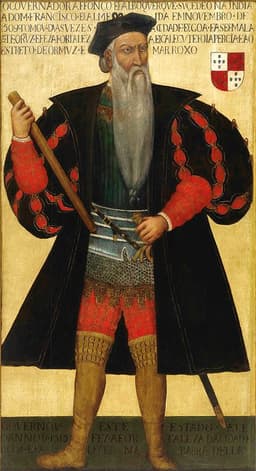
Afonso de Albuquerque
General · Medieval
79.6Total
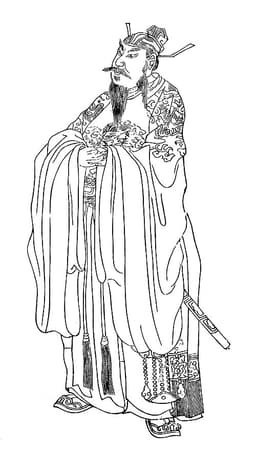
Xu Da
General · Medieval
74.9Total
Basic Information
Born
1453
1332
Died
1515
1385
Era
Medieval
Medieval
Nationality
Portugal
China
Occupation
General
General
Civilization
Western
Eastern
Score Comparison
Military (10%)
77.5
88.0
Political (20%)
88.0
68.0
Influence (20%)
80.0
82.0
Legacy (20%)
75.0
72.0
Leadership (15%)
78.0
62.0
Strategy (15%)
82.0
80.8
TOTAL
79.6
74.9
Afonso de Albuquerque — Complete Timeline
1503 AD
First voyage to IndiaWar◆ Major
Afonso de Albuquerque led a fleet to India, establishing the first Portuguese fort at Cochin. This voyage laid the foundation for Portuguese control of the Indian Ocean trade.
ExplorationColonialismIndia
Impact: global
1510 AD
Conquest of GoaWar◆ Major
Albuquerque captured Goa from the Sultan of Bijapur. He made Goa the capital of Portuguese India, a position it held for over 400 years.
ConquestColonialismIndia
Impact: regional
1511 AD
Conquest of MalaccaWar◆ Major
Albuquerque led a Portuguese fleet to capture the strategic port of Malacca. This gave Portugal control of the spice trade route between the Indian Ocean and the Pacific.
ConquestSpice TradeSoutheast Asia
Impact: global
1513 AD
Siege of AdenWar
Albuquerque attempted to capture Aden in Yemen but failed. This failure prevented Portugal from controlling the entrance to the Red Sea and limited their influence in the region.
SiegeFailureRed Sea
Impact: regional
1515 AD
Death at seaOther◆ Major
Afonso de Albuquerque died at sea off the coast of Goa, possibly from illness or poison. His death left the Portuguese Empire in the Indian Ocean without its most capable leader.
DeathLeadershipEmpire
Impact: regionaltragic
Xu Da — Complete Timeline
1368 AD
Capture of Dadu (Beijing)War
Xu Da led the Ming army in the capture of Dadu, the Yuan capital. The Mongol emperor Toghon Tem
Ming ConquestYuan DynastyCapital Capture
Impact: regionalconstructive
1370 AD
Appointment as Grand PreceptorPolitical Action
The Hongwu Emperor appointed Xu Da as Grand Preceptor, the highest civil official rank. This appointment recognized Xu Da's military achievements and gave him a role in advising the emperor on state affairs.
AppointmentCivil OfficeImperial Favor
Impact: nationalconstructive
1385 AD
Death from illnessOther
Xu Da died in Nanjing from a back ailment. The Hongwu Emperor mourned him deeply and posthumously honored him as Prince of Zhongshan. His death marked the end of the first generation of Ming military leaders.
DeathMing DynastyMilitary Leader
Impact: nationaltragic
Expert Analysis
Origins
Afonso de Albuquerque (c. 1453-1515) was born in Alhandra, Portugal, to a noble family with a tradition of naval service. His early military experience came in North Africa, where he fought against the Moors, shaping his crusading zeal and strategic acumen. Xu Da (1332-1385) hailed from a poor peasant family in Fengyang, Anhui. Joining the Red Turban Rebellion against the Mongol Yuan dynasty, he rose through merit under Zhu Yuanzhang, the future Hongwu Emperor. His humble origins instilled discipline and loyalty.
Rise to Power
Albuquerque's rise began with his first voyage to India in 1503, where he established the first Portuguese factory at Cochin. His appointment as Governor of Portuguese India in 1509 gave him command to execute a grand strategy: control key trade routes by capturing strategic ports. Xu Da's ascent was meteoric. He distinguished himself in battles against rival rebel factions and the Mongols, becoming Zhu Yuanzhang's most trusted general. His capture of Nanjing in 1356 and subsequent campaigns secured Ming control over central China.
Leadership & Governance
Albuquerque was a visionary imperialist. He believed in permanent conquest over mere piracy, establishing fortified colonies at Goa (1510) and Malacca (1511). He encouraged mixed marriages and local administration, earning him the title "The Great" for his statecraft. Xu Da was a master of conventional warfare and siegecraft. He emphasized logistics, training, and morale, often sharing hardships with his soldiers. As Grand Preceptor, he advised on civil affairs, but remained primarily a military commander loyal to the emperor.
Triumph & Tragedy
Albuquerque's greatest triumphs were the conquests of Goa and Malacca, which gave Portugal control of the Indian Ocean spice trade. However, his final years were tragic: after the failed Siege of Aden, he was recalled in disgrace and died at sea, possibly poisoned. Xu Da's crowning achievement was the capture of Dadu (Beijing) in 1368, driving the Mongol emperor out and ending Yuan rule. He died of illness in 1385, honored as a founding hero of the Ming dynasty.
Character & Destiny
Albuquerque was ruthless yet pragmatic; he executed prisoners but also respected local customs. His relentless drive to build an empire was both his strength and his downfall. Xu Da was known for his humility, caution, and unswerving loyalty. He avoided court intrigue, ensuring his posthumous reputation remained untarnished. Their fates reflect their environments: Albuquerque died in obscurity at sea, while Xu Da received imperial honors.
Legacy
Albuquerque's legacy is the Portuguese Empire in Asia, which lasted for centuries. His naval and colonial strategies influenced later European empires. Xu Da's legacy is the Ming dynasty itself; his conquests enabled China's reunification and a period of prosperity. Both are national heroes, but Albuquerque's impact was global, while Xu Da's was primarily domestic.
Conclusion
While Xu Da was a brilliant general who unified China, Afonso de Albuquerque's strategic vision, adaptability, and lasting geopolitical impact give him a slight edge. Scores: Albuquerque: Military 78, Political 88, Intrigue 80, Leadership 75, Defense 78, Strategy 82, Tactics 80; Xu Da: Military 88, Political 68, Intrigue 82, Leadership 72, Defense 62, Strategy 81, Tactics 75. The 4.7-point gap favors Albuquerque due to his higher political and strategic scores, reflecting his role as a state-builder. Xu Da's military prowess is superior, but Albuquerque's broader impact on world history secures his victory.
Rankings
🥇
Afonso de AlbuquerqueLeader
Mil: 77.5Pol: 88.0Inf: 80.0
79.6
🥈
Xu Da
Mil: 88.0Pol: 68.0Inf: 82.0
74.9
+4.7 behind
How This Comparison Works
Algorithm
Each figure is scored on 6 dimensions (0—100 scale) based on structured historical data: Military (10%), Political (20%), Influence (20%), Legacy (20%), Leadership (15%), Strategy (15%). The weighted total produces the final ranking.
Data Sources
Scores are computed from structured sub-indicators in the database. Scale factors adjust for era (Ancient ×0.85, Modern ×1.0) and civilization size (Eastern ×1.05, Other ×0.80) to account for differences in population and military scale.
Maximum 3 Figures
Comparisons are limited to 2—3 figures to ensure readability and statistical meaningfulness.
Error Margins
±5 points per dimension — Sub-scores are derived from historical records with inherent uncertainty. Two figures within 5 points on a dimension should be considered roughly equivalent in that area.
Total Score Accuracy
±3 points overall — The weighted combination of 6 dimensions produces a total score with approximately ±3 points of uncertainty. Differences of less than 3 points are not statistically significant— the figures are effectively tied.
Known Limitations
- Historical records are incomplete and uneven across civilizations
- Figures from oral-tradition societies may be underrepresented
- Occupation labels can misclassify multi-role figures
- Scores measure capability and impact, not moral character
- Quantitative scoring is a comparison tool, not absolute truth
Capability Radar
Military (10%) — Battles & Warfare
Battles
85
95
Win Rate
80
95
Expansion
95
95
Political (20%) — Governance & Reform
Reform
80
50
Diplomacy
85
65
Economy
80
55
Influence (20%) — Cultural & Global Reach
Cultural
70
70
Global
85
80
Legacy (20%) — Historical Impact
Historical
85
85
Longevity
80
75
Leadership (15%) — Power & Stability
Tenure
70
60
Stability
65
70
Strategy (15%) — Tactics & Innovation
Strategy
95
92
Tactics
90
90
Reform
75
70
Similar Comparisons
Comments & Discussion
No comments yet. Be the first to share your thoughts!