Loading...
Afonso de Albuquerque vs Wanyan Zongbi
Afonso de Albuquerque leads by 23.9 pts · 2 figures compared
…
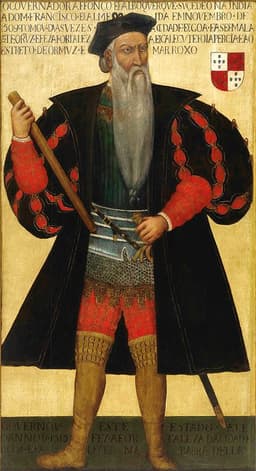
Afonso de Albuquerque
General · Medieval
79.6Total

Wanyan Zongbi
General · Medieval
55.7Total
Basic Information
Born
1453
1095
Died
1515
1148
Era
Medieval
Medieval
Nationality
Portugal
China
Occupation
General
General
Civilization
Western
Eastern
Score Comparison
Military (10%)
77.5
74.0
Political (20%)
88.0
40.8
Influence (20%)
80.0
53.3
Legacy (20%)
75.0
45.8
Leadership (15%)
78.0
71.0
Strategy (15%)
82.0
67.2
TOTAL
79.6
55.7
Afonso de Albuquerque — Complete Timeline
1503 AD
First voyage to IndiaWar◆ Major
Afonso de Albuquerque led a fleet to India, establishing the first Portuguese fort at Cochin. This voyage laid the foundation for Portuguese control of the Indian Ocean trade.
ExplorationColonialismIndia
Impact: global
1510 AD
Conquest of GoaWar◆ Major
Albuquerque captured Goa from the Sultan of Bijapur. He made Goa the capital of Portuguese India, a position it held for over 400 years.
ConquestColonialismIndia
Impact: regional
1511 AD
Conquest of MalaccaWar◆ Major
Albuquerque led a Portuguese fleet to capture the strategic port of Malacca. This gave Portugal control of the spice trade route between the Indian Ocean and the Pacific.
ConquestSpice TradeSoutheast Asia
Impact: global
1513 AD
Siege of AdenWar
Albuquerque attempted to capture Aden in Yemen but failed. This failure prevented Portugal from controlling the entrance to the Red Sea and limited their influence in the region.
SiegeFailureRed Sea
Impact: regional
1515 AD
Death at seaOther◆ Major
Afonso de Albuquerque died at sea off the coast of Goa, possibly from illness or poison. His death left the Portuguese Empire in the Indian Ocean without its most capable leader.
DeathLeadershipEmpire
Impact: regionaltragic
Wanyan Zongbi — Complete Timeline
1129 AD
Campaign against Song in 1129-1130War◆ Major
Wanyan Zongbi led a major Jin invasion of Southern Song territory, advancing deep into the south. He captured the Song capital of Hangzhou temporarily but was eventually repelled by Song forces.
JinSongInvasion
Impact: regionaldestructive
1140 AD
Battle of YanchengWar◆ Major
Wanyan Zongbi's Jin army was defeated by Yue Fei's Song forces at Yancheng. This battle was a major setback for Jin and demonstrated the effectiveness of Yue Fei's military tactics.
JinSongBattle
Impact: regionaltragic
1141 AD
Negotiated Treaty of ShaoxingPolitical Action
Wanyan Zongbi played a key role in negotiating the Treaty of Shaoxing with the Southern Song. The treaty established the Huai River as the border and required Song to pay tribute to Jin, ending major hostilities.
JinSongTreaty
Impact: regional
1142 AD
Suppression of Yue FeiPolitical Action◆ Major
Wanyan Zongbi demanded the execution of Yue Fei as part of the peace settlement. The Song court complied, executing Yue Fei, which removed a major obstacle to Jin's security.
JinSongExecution
Impact: regionaldestructive
1148 AD
Death and legacyOther
Wanyan Zongbi died, having been one of the most influential Jin generals. His campaigns and diplomacy shaped Jin-Song relations for decades.
JinDeathLegacy
Impact: regional
Expert Analysis
Origins
Afonso de Albuquerque was born in 1453 in Alhandra, Portugal, to a noble family with royal connections. His father, Gonçalo de Albuquerque, was Lord of Vila Verde, and his mother, Dona Leonor de Menezes, came from a prominent family. He received an education in mathematics and military arts at the court of King Afonso V. In contrast, Wanyan Zongbi (also known as Wuzhu) was born around 1100 as a prince of the Jin dynasty, a Jurchen-led empire that had conquered northern China. He was the son of Emperor Taizu of Jin, the founder of the dynasty. His upbringing was steeped in Jurchen martial traditions, with little formal education compared to his Portuguese counterpart.
Rise to Power
Albuquerque rose through Portuguese naval expeditions. In 1503, he made his first voyage to India, establishing a fort at Cochin. His strategic acumen caught the attention of King Manuel I, who appointed him Governor of Portuguese India in 1509. His rise was marked by decisive actions: he captured Goa in 1510 from the Sultan of Bijapur, making it the capital of Portuguese India. Wanyan Zongbi rose as a military commander during the Jin-Song wars. In 1129-1130, he led a major invasion of the Southern Song dynasty, capturing their capital Hangzhou temporarily. His success made him a leading general, but his political influence was limited by his status as a prince serving under emperors.
Leadership & Governance
Albuquerque was a visionary imperial administrator. He established a network of fortified ports (Goa, Malacca, Hormuz) to control trade routes, implemented a policy of encouraging intermarriage with local women, and introduced a system of naval patrols. His political score of 88.0 reflects his ability to govern diverse populations. Wanyan Zongbi's leadership was primarily military; his political score of 40.8 indicates limited governance role. He focused on campaigns and later negotiated the Treaty of Shaoxing in 1142, which established the Huai River as the border. His approach was more reactive, responding to Song offensives.
Triumph & Tragedy
Albuquerque's greatest triumph was capturing Malacca in 1511, securing the spice trade for Portugal. His failure at Aden in 1513 prevented control of the Red Sea, limiting Portuguese influence. He died at sea in 1515, possibly poisoned, leaving his empire incomplete. Wanyan Zongbi's triumph was the successful invasion of 1129-1130, but his tragedy was the defeat at Yancheng in 1140 by Yue Fei. Though he later secured Yue Fei's execution, his military reputation suffered. His legacy is mixed: he expanded Jin territory but failed to conquer the Song.
Character & Destiny
Albuquerque was determined and ruthless, executing prisoners to instill fear. His character drove him to build a lasting empire, but his harshness created enemies. Wanyan Zongbi was pragmatic, willing to negotiate peace after military setbacks. His fate was tied to the Jin court's politics; he remained a loyal general but never seized supreme power. Historians note his strategic adaptability but also his inability to overcome decisive defeats.
Legacy
Albuquerque's legacy endures: Goa remained Portuguese until 1961, and his naval strategies influenced later empires. His total score of 79.6 reflects enduring impact. Wanyan Zongbi is remembered mainly for his role in the Jin-Song wars, but his political influence faded; his score of 55.7 indicates a more limited legacy. The Treaty of Shaoxing lasted until the Mongol conquest, but his personal contributions are overshadowed by Yue Fei's martyrdom.
Conclusion
Afonso de Albuquerque had a greater impact than Wanyan Zongbi. His military score of 77.5 vs 74.0 shows comparable martial skill, but his political score of 88.0 vs 40.8 and influence score of 80.0 vs 53.3 demonstrate superior state-building. Albuquerque created a colonial empire that reshaped global trade, while Zongbi's campaigns only maintained the status quo. The data supports Albuquerque as the more consequential figure.
Rankings
🥇
Afonso de AlbuquerqueLeader
Mil: 77.5Pol: 88.0Inf: 80.0
79.6
🥈
Wanyan Zongbi
Mil: 74.0Pol: 40.8Inf: 53.3
55.7
+23.9 behind
How This Comparison Works
Algorithm
Each figure is scored on 6 dimensions (0—100 scale) based on structured historical data: Military (10%), Political (20%), Influence (20%), Legacy (20%), Leadership (15%), Strategy (15%). The weighted total produces the final ranking.
Data Sources
Scores are computed from structured sub-indicators in the database. Scale factors adjust for era (Ancient ×0.85, Modern ×1.0) and civilization size (Eastern ×1.05, Other ×0.80) to account for differences in population and military scale.
Maximum 3 Figures
Comparisons are limited to 2—3 figures to ensure readability and statistical meaningfulness.
Error Margins
±5 points per dimension — Sub-scores are derived from historical records with inherent uncertainty. Two figures within 5 points on a dimension should be considered roughly equivalent in that area.
Total Score Accuracy
±3 points overall — The weighted combination of 6 dimensions produces a total score with approximately ±3 points of uncertainty. Differences of less than 3 points are not statistically significant— the figures are effectively tied.
Known Limitations
- Historical records are incomplete and uneven across civilizations
- Figures from oral-tradition societies may be underrepresented
- Occupation labels can misclassify multi-role figures
- Scores measure capability and impact, not moral character
- Quantitative scoring is a comparison tool, not absolute truth
Capability Radar
Military (10%) — Battles & Warfare
Battles
85
75
Win Rate
80
65
Expansion
95
75
Political (20%) — Governance & Reform
Reform
80
30
Diplomacy
85
55
Economy
80
40
Influence (20%) — Cultural & Global Reach
Cultural
70
45
Global
85
35
Legacy (20%) — Historical Impact
Historical
85
55
Longevity
80
40
Leadership (15%) — Power & Stability
Tenure
70
60
Stability
65
50
Strategy (15%) — Tactics & Innovation
Strategy
95
70
Tactics
90
80
Reform
75
40
Similar Comparisons
Comments & Discussion
No comments yet. Be the first to share your thoughts!