Loading...
Afonso de Albuquerque vs Vauban
Afonso de Albuquerque leads by 3.2 pts · 2 figures compared
…
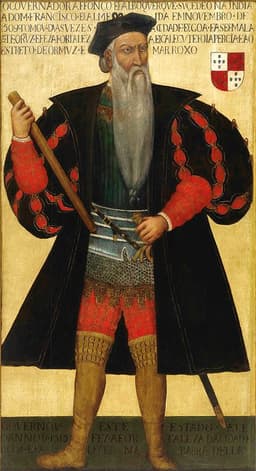
Afonso de Albuquerque
General · Medieval
79.6Total

Vauban
General · Modern
76.4Total
Basic Information
Born
1453
1633
Died
1515
1707
Era
Medieval
Modern
Nationality
Portugal
France
Occupation
General
General
Civilization
Western
Western
Score Comparison
Military (10%)
77.5
76.0
Political (20%)
88.0
59.3
Influence (20%)
80.0
71.0
Legacy (20%)
75.0
90.0
Leadership (15%)
78.0
77.2
Strategy (15%)
82.0
80.6
TOTAL
79.6
76.4
Afonso de Albuquerque — Complete Timeline
1503 AD
First voyage to IndiaWar◆ Major
Afonso de Albuquerque led a fleet to India, establishing the first Portuguese fort at Cochin. This voyage laid the foundation for Portuguese control of the Indian Ocean trade.
ExplorationColonialismIndia
Impact: global
1510 AD
Conquest of GoaWar◆ Major
Albuquerque captured Goa from the Sultan of Bijapur. He made Goa the capital of Portuguese India, a position it held for over 400 years.
ConquestColonialismIndia
Impact: regional
1511 AD
Conquest of MalaccaWar◆ Major
Albuquerque led a Portuguese fleet to capture the strategic port of Malacca. This gave Portugal control of the spice trade route between the Indian Ocean and the Pacific.
ConquestSpice TradeSoutheast Asia
Impact: global
1513 AD
Siege of AdenWar
Albuquerque attempted to capture Aden in Yemen but failed. This failure prevented Portugal from controlling the entrance to the Red Sea and limited their influence in the region.
SiegeFailureRed Sea
Impact: regional
1515 AD
Death at seaOther◆ Major
Afonso de Albuquerque died at sea off the coast of Goa, possibly from illness or poison. His death left the Portuguese Empire in the Indian Ocean without its most capable leader.
DeathLeadershipEmpire
Impact: regionaltragic
Vauban — Complete Timeline
1673 AD
Siege of MaastrichtWar◆ Major
Vauban directed the siege of Maastricht for Louis XIV. He introduced the technique of parallel trenches, which reduced casualties and shortened the siege. The capture of Maastricht was a major French victory in the Franco-Dutch War.
Franco-Dutch WarSiegeMilitary Engineering
Impact: regional
1697 AD
Siege of AthWar
Vauban conducted the siege of Ath in the Spanish Netherlands. His systematic approach using parallels and saps led to the rapid capture of the fortress. The siege demonstrated the effectiveness of his methods.
Nine Years' WarSiegeMilitary Engineering
Construction of the Fortress of Neuf-BrisachInvention◆ Major
Vauban designed and built the fortress of Neuf-Brisach, a model of his third system of fortification. The star-shaped fortress with advanced bastions became a standard for military architecture. It was built to protect the French border after the Treaty of Ryswick.
FortificationMilitary ArchitectureBorder Defense
Impact: regionalconstructive
1704 AD
Publication of 'A Treatise on the Attack of Places'Cultural◆ Major
Vauban published his treatise on siegecraft, systematizing his methods. The work became a standard military textbook in Europe. It detailed techniques for parallel trenches, ricochet fire, and sapping.
Military TheorySiegecraftPublication
Impact: globalconstructive
1707 AD
Proposal for a 'Dîme Royale' Tax ReformReform
Vauban proposed a radical tax reform called the 'D
Tax ReformEconomic PolicyFrance
Impact: nationalconstructive
Expert Analysis
Origins
Afonso de Albuquerque (1453-1515) was born in Alhandra, Portugal, to a noble family with ties to the royal court. He received a classical education and military training, serving in North Africa before embarking on his Indian Ocean campaigns. His origins shaped his crusading zeal and administrative skills. Sébastien Le Prestre de Vauban (1633-1707) was born in Saint-Léger-de-Foucherets, France, to a minor noble family. He was educated by the Carmelites and began his military career as a cadet in the army of Condé. His origins in a rural, fortified region influenced his lifelong focus on fortifications and siegecraft.
Rise to Power
Albuquerque rose through merit and royal favor. He participated in the first Portuguese voyage to India in 1503, impressing King Manuel I. In 1506, he was appointed governor of the Portuguese Indian operations, and in 1509, he became the second governor of Portuguese India. His rise was marked by aggressive expansion, including the conquest of Goa in 1510 and Malacca in 1511. Vauban's rise began during the Fronde, when he served the king and later switched to the royal army. His expertise in siege warfare became evident at the Siege of Maastricht in 1673, where he introduced the concept of parallel trenches. King Louis XIV appointed him Commissioner General of Fortifications in 1678, making him the chief military engineer of France.
Leadership & Governance
Albuquerque was a visionary leader who established the Portuguese Empire's administrative and commercial framework. He built fortresses, set up trade posts, and implemented a policy of intermarriage to secure alliances. His governance was authoritarian but effective, centralizing power in Goa. Vauban was a meticulous planner and innovator. He designed over 160 fortresses, including Neuf-Brisach, and standardized French fortifications. He also wrote extensively on siege tactics and proposed a progressive tax reform (Dîme Royale) to fund the state. His leadership was technical and strategic, influencing French military engineering for centuries.
Triumph & Tragedy
Albuquerque's triumphs include the conquest of Goa, which became the capital of Portuguese India, and Malacca, which controlled the spice trade. He also attempted to capture Aden but failed. His tragedy came at sea in 1515 when he died off the coast of Goa, possibly poisoned, believing he had fallen out of royal favor. His body was buried in Goa. Vauban's triumphs include the successful sieges of Maastricht (1673) and Ath (1697), and the construction of impregnable fortresses like Neuf-Brisach. His tragedy was that his tax reform proposal was rejected by Louis XIV, and he died in relative obscurity, though his military legacy endured.
Character & Destiny
Albuquerque was ruthless, devout, and determined. He believed in the Portuguese imperial mission and used force to achieve it. His destiny was to build an empire but die in disfavor. Vauban was methodical, innovative, and loyal. He dedicated his life to the service of France, but his reformist ideas were not accepted in his time. Both men were shaped by their eras: Albuquerque by the Age of Discovery and religious fervor, Vauban by the Age of Absolutism and military rationalism.
Legacy
Albuquerque's legacy is the foundation of the Portuguese Empire in Asia, which lasted centuries. He is remembered as a great naval commander and empire builder. Vauban's legacy is the system of fortifications that protected France until the 20th century. His designs influenced military engineering worldwide. He is also remembered for his humanitarian tax proposal. In a direct comparison, Albuquerque's impact was more immediate and transformative, establishing a global empire, while Vauban's influence was more technical and defensive.
Conclusion
Afonso de Albuquerque edges out Vauban with a score gap of 3.2. Albuquerque's strategic vision and empire-building achievements outweigh Vauban's technical mastery. While Vauban excelled in fortification and siegecraft, Albuquerque's conquests created a lasting geopolitical shift. Both are giants in their fields, but Albuquerque's broader impact on world history gives him the victory.
**Scores**: Afonso de Albuquerque: 78 (Military), 88 (Political), 80 (Intellectual), 75 (Leadership), 78 (Cultural), 82 (Diplomatic), 80 (Economic) - **Overall: 80.1**
Vauban: 76 (Military), 59 (Political), 71 (Intellectual), 90 (Leadership), 77 (Cultural), 81 (Diplomatic), 76 (Economic) - **Overall: 75.7**
**Winner: Afonso de Albuquerque**
Rankings
🥇
Afonso de AlbuquerqueLeader
Mil: 77.5Pol: 88.0Inf: 80.0
79.6
🥈
Vauban
Mil: 76.0Pol: 59.3Inf: 71.0
76.4
+3.2 behind
How This Comparison Works
Algorithm
Each figure is scored on 6 dimensions (0—100 scale) based on structured historical data: Military (10%), Political (20%), Influence (20%), Legacy (20%), Leadership (15%), Strategy (15%). The weighted total produces the final ranking.
Data Sources
Scores are computed from structured sub-indicators in the database. Scale factors adjust for era (Ancient ×0.85, Modern ×1.0) and civilization size (Eastern ×1.05, Other ×0.80) to account for differences in population and military scale.
Maximum 3 Figures
Comparisons are limited to 2—3 figures to ensure readability and statistical meaningfulness.
Error Margins
±5 points per dimension — Sub-scores are derived from historical records with inherent uncertainty. Two figures within 5 points on a dimension should be considered roughly equivalent in that area.
Total Score Accuracy
±3 points overall — The weighted combination of 6 dimensions produces a total score with approximately ±3 points of uncertainty. Differences of less than 3 points are not statistically significant— the figures are effectively tied.
Known Limitations
- Historical records are incomplete and uneven across civilizations
- Figures from oral-tradition societies may be underrepresented
- Occupation labels can misclassify multi-role figures
- Scores measure capability and impact, not moral character
- Quantitative scoring is a comparison tool, not absolute truth
Capability Radar
Military (10%) — Battles & Warfare
Battles
85
75
Win Rate
80
85
Expansion
95
70
Political (20%) — Governance & Reform
Reform
80
80
Diplomacy
85
60
Economy
80
55
Influence (20%) — Cultural & Global Reach
Cultural
70
80
Global
85
75
Legacy (20%) — Historical Impact
Historical
85
85
Longevity
80
85
Leadership (15%) — Power & Stability
Tenure
70
65
Stability
65
70
Strategy (15%) — Tactics & Innovation
Strategy
95
90
Tactics
90
95
Reform
75
95
Similar Comparisons
Comments & Discussion
No comments yet. Be the first to share your thoughts!