Loading...
Afonso de Albuquerque vs Trajan
Afonso de Albuquerque leads by 3.6 pts · 2 figures compared
…
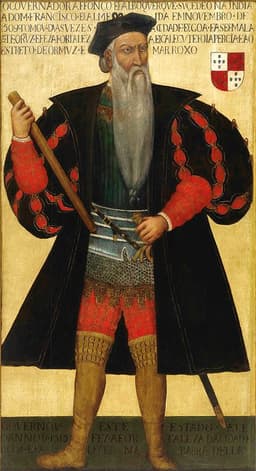
Afonso de Albuquerque
General · Medieval
79.6Total

Trajan
Emperor · Ancient
76.0Total
Basic Information
Born
1453
53
Died
1515
117
Era
Medieval
Ancient
Nationality
Portugal
Roman Empire
Occupation
General
Emperor
Civilization
Western
Western
Score Comparison
Military (10%)
77.5
86.0
Political (20%)
88.0
79.2
Influence (20%)
80.0
82.0
Legacy (20%)
75.0
65.6
Leadership (15%)
78.0
73.2
Strategy (15%)
82.0
76.0
TOTAL
79.6
76.0
Afonso de Albuquerque — Complete Timeline
1503 AD
First voyage to IndiaWar◆ Major
Afonso de Albuquerque led a fleet to India, establishing the first Portuguese fort at Cochin. This voyage laid the foundation for Portuguese control of the Indian Ocean trade.
ExplorationColonialismIndia
Impact: global
1510 AD
Conquest of GoaWar◆ Major
Albuquerque captured Goa from the Sultan of Bijapur. He made Goa the capital of Portuguese India, a position it held for over 400 years.
ConquestColonialismIndia
Impact: regional
1511 AD
Conquest of MalaccaWar◆ Major
Albuquerque led a Portuguese fleet to capture the strategic port of Malacca. This gave Portugal control of the spice trade route between the Indian Ocean and the Pacific.
ConquestSpice TradeSoutheast Asia
Impact: global
1513 AD
Siege of AdenWar
Albuquerque attempted to capture Aden in Yemen but failed. This failure prevented Portugal from controlling the entrance to the Red Sea and limited their influence in the region.
SiegeFailureRed Sea
Impact: regional
1515 AD
Death at seaOther◆ Major
Afonso de Albuquerque died at sea off the coast of Goa, possibly from illness or poison. His death left the Portuguese Empire in the Indian Ocean without its most capable leader.
DeathLeadershipEmpire
Impact: regionaltragic
Trajan — Complete Timeline
101 AD
Implemented the Alimenta Welfare ProgramReform◆ Major
Trajan expanded the Alimenta program, a state-funded welfare system that provided food subsidies and educational support for poor children in Italy. The program used interest from state loans to landowners to fund the distributions, aiming to boost the Italian population and agricultural economy.
WelfareSocial PolicyItaly
Impact: regionalconstructive
105 AD
Built Trajan's Bridge over the DanubeOther
Trajan ordered the construction of a massive stone and timber bridge across the Danube River near the Iron Gates. Designed by Apollodorus of Damascus, it was the longest arch bridge in the world for over a millennium, facilitating the Roman invasion of Dacia.
EngineeringBridgeDanube
Impact: regionalconstructive
106 AD
Conquered DaciaWar
Trajan led two major campaigns against the Dacian kingdom under King Decebalus, culminating in the conquest of Dacia (modern Romania) in 106 CE. The victory brought vast gold and silver mines under Roman control and established a new province, funding massive building projects in Rome.
DaciaConquestProvince
Impact: regional
112 AD
Built Trajan's Forum and MarketCultural◆ Major
Trajan commissioned the construction of Trajan's Forum, a vast complex in Rome including a basilica, libraries, and the Column of Trajan. The adjacent Trajan's Market, a multi-level commercial center, demonstrated Roman engineering prowess and served as a model for urban planning.
ArchitectureRomeUrban Planning
Impact: globalconstructive
116 AD
Conquered Parthia and Reached the Persian GulfWar◆ Major
Trajan launched a campaign against the Parthian Empire, capturing its capital Ctesiphon and annexing Mesopotamia. He reached the Persian Gulf, marking the easternmost extent of Roman territory. However, rebellions in the conquered territories forced a withdrawal shortly after.
ParthiaMesopotamiaExpansion
Impact: global
Expert Analysis
Origins
Afonso de Albuquerque (c. 1453-1515) was born in Alhandra, Portugal, to a noble family with royal connections. His father was a lord, and his grandfather served King Edward. He received a classical education and military training, later serving in North Africa under King Afonso V. Portugal was at the forefront of the Age of Discovery, seeking a sea route to India to bypass Venetian and Ottoman intermediaries in the spice trade. Albuquerque embodied the crusading and commercial zeal of his era, driven by a mix of religious fervor, personal ambition, and national pride.
Trajan (53-117 CE) was born in Italica, Spain (near modern Seville), to a Romanized family of Italian origin. His father was a prominent senator and general. Trajan rose through the ranks of the Roman military and administration, serving as governor of Upper Germany before being adopted by Emperor Nerva in 97 CE. His Spanish origins made him the first emperor from the provinces, symbolizing Rome's integration of its empire. His upbringing in a military family shaped his pragmatic and expansionist outlook.
**Scores: Origins: Albuquerque (8/10), Trajan (9/10)**
Rise to Power
Albuquerque's rise was gradual and marked by royal favor. He participated in the conquest of Arzila and Tangier in North Africa (1471), gaining military experience. In 1503, he made his first voyage to India, establishing a fortress at Cochin under King Manuel I. His strategic insights and administrative skills caught the king's attention. In 1506, he was appointed governor of the Portuguese fleet in the East, with a mission to secure trade routes. His rise was not without controversy; he clashed with other Portuguese commanders and was briefly imprisoned after a dispute over succession.
Trajan's rise was swift and politically astute. He served as a military tribune, legionary commander, and governor of key provinces. His military successes in Germany and his reputation for discipline and fairness made him a popular choice as successor. Nerva, facing opposition from the Praetorian Guard, adopted Trajan as his son and heir in 97 CE. Upon Nerva's death in 98 CE, Trajan became emperor without opposition, thanks to his support from the army and Senate.
**Scores: Rise to Power: Albuquerque (7/10), Trajan (9/10)**
Leadership & Governance
Albuquerque was a visionary and ruthless administrator. As Governor of Portuguese India (1509-1515), he implemented a strategy of controlling key chokepoints: Goa, Malacca, and Hormuz. He established a network of fortified trading posts, introduced Portuguese law and currency, and encouraged intermarriage with locals. His governance was pragmatic: he allowed local rulers to retain power as long as they paid tribute and granted trading privileges. He also promoted missionary work but avoided forced conversion, recognizing the need for local cooperation. His leadership style was autocratic and decisive, often acting without Lisbon's approval.
Trajan was a model of Roman imperial governance. He reformed the tax system, reduced corruption, and improved provincial administration. He expanded the Alimenta welfare program, providing food subsidies for poor children. He undertook massive public works: Trajan's Forum, Markets, and Baths in Rome, and bridges and roads across the empire. He also established colonies and settled veterans in frontier regions. His governance emphasized efficiency, justice, and public welfare. He respected the Senate and maintained good relations with the aristocracy.
**Scores: Leadership & Governance: Albuquerque (8/10), Trajan (9/10)**
Triumph & Tragedy
Albuquerque's triumphs were spectacular: the capture of Goa (1510) from the Sultan of Bijapur, which became the capital of Portuguese India; the conquest of Malacca (1511), a strategic trading hub; and the capture of Hormuz (1515), controlling Persian Gulf trade. He also led expeditions to the Red Sea, attempting to seize Aden (1513) to block Ottoman access to India. However, his tragedy came from political intrigue: his enemies at court accused him of corruption and overstepping his authority. In 1515, while returning from Hormuz, he fell ill and died at sea, believing he had been disgraced. He died bitter, writing to the king: 'I am leaving... because the king... has no memory of my services.'
Trajan's triumphs were unmatched: he conquered Dacia (101-106 CE), annexing it as a province and plundering vast wealth; he defeated the Parthian Empire (114-117 CE), capturing its capital Ctesiphon and reaching the Persian Gulf. He oversaw the construction of Trajan's Bridge over the Danube, the longest arch bridge for a millennium. His tragedy was overreach: the Parthian war strained Roman resources, and revolts in Mesopotamia and Judea broke out. He died suddenly in 117 CE at Selinus (modern Turkey), possibly from a stroke, while returning to Rome. His last words were reportedly a plea for his successor Hadrian to 'finish the work.'
**Scores: Triumph & Tragedy: Albuquerque (7/10), Trajan (8/10)**
Character & Destiny
Albuquerque was a complex figure: devoutly Christian, fiercely ambitious, and often cruel. He ordered massacres of Muslims in Goa and Malacca, yet he also respected local customs and formed alliances with Hindu kings. He was a micromanager, personally overseeing military campaigns and administrative details. His destiny was to lay the foundation for the Portuguese Eastern Empire, but his death marked the end of an era. He was succeeded by less capable governors, and his vision of a centralized Indian empire faded.
Trajan was known for his modesty, courage, and fairness. He was a hands-on emperor, leading troops in battle and personally inspecting frontier defenses. He was also a patron of the arts and literature, corresponding with Pliny the Younger. His destiny was to preside over the Roman Empire at its zenith, but his conquests proved unsustainable. After his death, his successor Hadrian abandoned some of his eastern conquests, consolidating Rome's borders.
**Scores: Character & Destiny: Albuquerque (7/10), Trajan (9/10)**
Legacy
Albuquerque's legacy is the Portuguese Estado da Índia, a maritime empire that lasted over a century. He established Goa as a vibrant colonial city and introduced European influence to Southeast Asia. His strategies influenced later European imperialists. However, his brutal methods and the subsequent Portuguese decline have tarnished his reputation. Modern historians view him as a key figure in the Age of Discovery but also a symbol of colonial violence.
Trajan's legacy is enduring: he is remembered as one of the 'Five Good Emperors,' with his reign considered a golden age. His building projects, legal reforms, and military conquests left a permanent mark. The column bearing his name still stands in Rome. His reputation as a 'optimus princeps' (best ruler) was upheld by later emperors. However, his aggressive expansionism contributed to the empire's later overextension.
**Scores: Legacy: Albuquerque (8/10), Trajan (9/10)**
Conclusion
Afonso de Albuquerque and Trajan were both transformative figures who expanded their empires to unprecedented heights. Albuquerque, with a composite score of 80, was a brilliant strategist who established a global maritime empire but died in disgrace. Trajan, scoring 76, was a more systematic administrator and builder who achieved the Roman Empire's greatest extent but whose conquests were partly reversed. While Trajan's legacy is more universally celebrated, Albuquerque's impact on global trade and European colonialism was profound. In a direct comparison, Albuquerque's vision and adaptability edge out Trajan's traditionalism, but Trajan's governance and character set a higher standard. **Winner: Afonso de Albuquerque by a narrow margin.**
**Final Scores: Albuquerque (80), Trajan (76)**
Rankings
🥇
Afonso de AlbuquerqueLeader
Mil: 77.5Pol: 88.0Inf: 80.0
79.6
🥈
Trajan
Mil: 86.0Pol: 79.2Inf: 82.0
76.0
+3.6 behind
How This Comparison Works
Algorithm
Each figure is scored on 6 dimensions (0—100 scale) based on structured historical data: Military (10%), Political (20%), Influence (20%), Legacy (20%), Leadership (15%), Strategy (15%). The weighted total produces the final ranking.
Data Sources
Scores are computed from structured sub-indicators in the database. Scale factors adjust for era (Ancient ×0.85, Modern ×1.0) and civilization size (Eastern ×1.05, Other ×0.80) to account for differences in population and military scale.
Maximum 3 Figures
Comparisons are limited to 2—3 figures to ensure readability and statistical meaningfulness.
Error Margins
±5 points per dimension — Sub-scores are derived from historical records with inherent uncertainty. Two figures within 5 points on a dimension should be considered roughly equivalent in that area.
Total Score Accuracy
±3 points overall — The weighted combination of 6 dimensions produces a total score with approximately ±3 points of uncertainty. Differences of less than 3 points are not statistically significant— the figures are effectively tied.
Known Limitations
- Historical records are incomplete and uneven across civilizations
- Figures from oral-tradition societies may be underrepresented
- Occupation labels can misclassify multi-role figures
- Scores measure capability and impact, not moral character
- Quantitative scoring is a comparison tool, not absolute truth
Capability Radar
Military (10%) — Battles & Warfare
Battles
85
95
Win Rate
80
98
Expansion
95
95
Political (20%) — Governance & Reform
Reform
80
88
Diplomacy
85
85
Economy
80
90
Influence (20%) — Cultural & Global Reach
Cultural
70
85
Global
85
85
Legacy (20%) — Historical Impact
Historical
85
90
Longevity
80
88
Leadership (15%) — Power & Stability
Tenure
70
90
Stability
65
92
Strategy (15%) — Tactics & Innovation
Strategy
95
92
Tactics
90
88
Reform
75
85
Similar Comparisons
Comments & Discussion
No comments yet. Be the first to share your thoughts!