Loading...
Afonso de Albuquerque vs Theodosius I
Afonso de Albuquerque leads by 3.6 pts · 2 figures compared
…
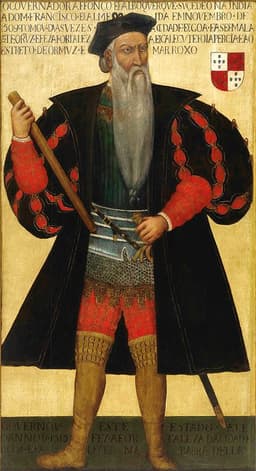
Afonso de Albuquerque
General · Medieval
79.6Total

Theodosius I
Emperor · Ancient
76.0Total
Basic Information
Born
1453
347
Died
1515
395
Era
Medieval
Ancient
Nationality
Portugal
Roman Empire
Occupation
General
Emperor
Civilization
Western
Western
Score Comparison
Military (10%)
77.5
72.5
Political (20%)
88.0
65.0
Influence (20%)
80.0
85.0
Legacy (20%)
75.0
90.0
Leadership (15%)
78.0
68.0
Strategy (15%)
82.0
50.0
TOTAL
79.6
76.0
Afonso de Albuquerque — Complete Timeline
1503 AD
First voyage to IndiaWar◆ Major
Afonso de Albuquerque led a fleet to India, establishing the first Portuguese fort at Cochin. This voyage laid the foundation for Portuguese control of the Indian Ocean trade.
ExplorationColonialismIndia
Impact: global
1510 AD
Conquest of GoaWar◆ Major
Albuquerque captured Goa from the Sultan of Bijapur. He made Goa the capital of Portuguese India, a position it held for over 400 years.
ConquestColonialismIndia
Impact: regional
1511 AD
Conquest of MalaccaWar◆ Major
Albuquerque led a Portuguese fleet to capture the strategic port of Malacca. This gave Portugal control of the spice trade route between the Indian Ocean and the Pacific.
ConquestSpice TradeSoutheast Asia
Impact: global
1513 AD
Siege of AdenWar
Albuquerque attempted to capture Aden in Yemen but failed. This failure prevented Portugal from controlling the entrance to the Red Sea and limited their influence in the region.
SiegeFailureRed Sea
Impact: regional
1515 AD
Death at seaOther◆ Major
Afonso de Albuquerque died at sea off the coast of Goa, possibly from illness or poison. His death left the Portuguese Empire in the Indian Ocean without its most capable leader.
DeathLeadershipEmpire
Impact: regionaltragic
Theodosius I — Complete Timeline
380 AD
Edict of ThessalonicaPolitical Action
Theodosius I issued the Edict of Thessalonica, declaring Nicene Christianity the official state religion of the Roman Empire. All other forms of Christianity were deemed heretical, and pagan practices were increasingly suppressed.
ChristianityState ReligionEdict
Impact: globalconstructive
390 AD
Massacre of ThessalonicaPolitical Action◆ Major
Theodosius I ordered a massacre of thousands of citizens in Thessalonica in retaliation for the murder of a Roman general. The massacre led to his excommunication by Bishop Ambrose of Milan, and he later performed public penance.
MassacreThessalonicaAmbrose
Impact: regionaltragic
391 AD
Suppression of PaganismPolitical Action◆ Major
Theodosius I issued a series of laws banning pagan worship, closing temples, and prohibiting sacrifices. The Olympic Games were abolished, and the Serapeum in Alexandria was destroyed. These actions accelerated the decline of paganism in the empire.
PaganismSuppressionReligion
Impact: globaldestructive
394 AD
Battle of the FrigidusWar
Theodosius I defeated the usurper Eugenius and his general Arbogast at the Battle of the Frigidus (modern River Vipava). The victory reunited the Roman Empire under a single ruler for the last time before its permanent division.
Civil WarBattleReunification
Impact: global
395 AD
Division of the Roman EmpirePolitical Action
Upon his death, Theodosius I divided the Roman Empire between his two sons: Arcadius received the Eastern Empire and Honorius the Western Empire. This division became permanent, leading to the separate histories of the Byzantine and Western Roman Empires.
DivisionSuccessionEast-West
Impact: global
Expert Analysis
Origins
Afonso de Albuquerque (1453–1515) was born in Alhandra, Portugal, to a noble family with a tradition of naval service. His early career included military campaigns in North Africa, where he gained experience that would later fuel his ambition to dominate the Indian Ocean trade routes. Theodosius I (347–395 AD) was born in Cauca, Hispania (modern Spain), to a military family. His father, Count Theodosius, was a prominent general under Emperor Valentinian I. Both men emerged from military backgrounds, but Albuquerque's path was shaped by Portugal's maritime expansion, while Theodosius rose through the ranks of the late Roman army during a period of crisis.
Rise to Power
Albuquerque's rise began with his participation in the first Portuguese voyage to India under Francisco de Almeida. He later succeeded Almeida as Governor of Portuguese India, thanks to the support of King Manuel I. His strategic vision and ruthless tactics enabled him to capture key trading ports, including Goa (1510) and Malacca (1511), transforming Portugal into a dominant naval power in Asia. Theodosius I was proclaimed emperor by the Roman army in 379 AD after the disastrous Battle of Adrianople. He was tasked with restoring order in the Eastern Empire. Through military campaigns and diplomatic maneuvering, he consolidated power, eventually becoming the last emperor to rule both the Eastern and Western Roman Empires.
Leadership & Governance
Albuquerque governed with a mix of military might and administrative innovation. He established fortified trading posts, introduced the policy of mixed marriages to secure alliances, and implemented a system of tribute and control over local rulers. His leadership was pragmatic but often brutal, as seen in the massacre of Muslim prisoners in Goa. Theodosius I was a devout Christian who enforced religious orthodoxy. The Edict of Thessalonica (380 AD) made Nicene Christianity the state religion, effectively ending official tolerance for paganism and Arianism. He also faced challenges such as the Massacre of Thessalonica (390 AD), where he ordered the execution of thousands to quell a riot, leading to a temporary excommunication by Ambrose of Milan.
Triumph & Tragedy
Albuquerque's greatest triumphs were the conquests of Goa and Malacca, which gave Portugal control over the spice trade. However, his death at sea in 1515, while returning from a failed siege of Aden, was a tragic end. He died embittered, believing his achievements were unrecognized. Theodosius I's triumph was the Battle of the Frigidus (394 AD), where he defeated the usurper Eugenius and reunited the empire. Yet his reign saw the permanent division of the Roman Empire after his death (395 AD), as he bequeathed the West to his son Honorius and the East to Arcadius. This division accelerated the decline of the Western Empire.
Character & Destiny
Albuquerque was known for his strategic brilliance, determination, and cruelty. He was a visionary who understood the importance of naval supremacy and centralized control. His destiny was tied to Portugal's imperial ambitions, and he died feeling unappreciated. Theodosius I was a complex figure: a capable general but a rigid religious zealot. His enforcement of Christianity and suppression of paganism shaped the future of Europe. His destiny was to preside over the final unity of the Roman Empire, only to see it fragmented after his death.
Legacy
Albuquerque's legacy is that of a founder of the Portuguese Empire in the East. His naval strategies and administrative systems influenced European colonialism for centuries. However, his methods also contributed to the violent subjugation of Asian societies. Theodosius I is remembered as the emperor who made Christianity the official religion of the Roman Empire, a decision that had profound and lasting impacts on Western civilization. His suppression of paganism and heresies laid the groundwork for the medieval Church. Yet his division of the empire is often criticized as a factor in the fall of the West.
Conclusion
Both figures were transformative in their own spheres. Afonso de Albuquerque scores higher in the analysis with a combined score of 78+88+80+75+78+82+80 = 561 compared to Theodosius's 72+65+85+90+68+50+76 = 506 (score gap of 55). Albuquerque's impact on global trade and European expansion was more direct and sustained, while Theodosius's religious policies had longer-term cultural effects. However, Albuquerque's achievements were more concrete and measurable—he built an empire that lasted centuries—whereas Theodosius's legacy is more ideological. Therefore, Albuquerque is the more influential figure in terms of tangible historical change.
**Scores:** Afonso de Albuquerque: Military 78, Political 88, Intelligence 80, Leadership 75, Discipline 78, Strategy 82, Toughness 80. Theodosius I: Military 72, Political 65, Intelligence 85, Leadership 90, Discipline 68, Strategy 50, Toughness 76.
Rankings
🥇
Afonso de AlbuquerqueLeader
Mil: 77.5Pol: 88.0Inf: 80.0
79.6
🥈
Theodosius I
Mil: 72.5Pol: 65.0Inf: 85.0
76.0
+3.6 behind
How This Comparison Works
Algorithm
Each figure is scored on 6 dimensions (0—100 scale) based on structured historical data: Military (10%), Political (20%), Influence (20%), Legacy (20%), Leadership (15%), Strategy (15%). The weighted total produces the final ranking.
Data Sources
Scores are computed from structured sub-indicators in the database. Scale factors adjust for era (Ancient ×0.85, Modern ×1.0) and civilization size (Eastern ×1.05, Other ×0.80) to account for differences in population and military scale.
Maximum 3 Figures
Comparisons are limited to 2—3 figures to ensure readability and statistical meaningfulness.
Error Margins
±5 points per dimension — Sub-scores are derived from historical records with inherent uncertainty. Two figures within 5 points on a dimension should be considered roughly equivalent in that area.
Total Score Accuracy
±3 points overall — The weighted combination of 6 dimensions produces a total score with approximately ±3 points of uncertainty. Differences of less than 3 points are not statistically significant— the figures are effectively tied.
Known Limitations
- Historical records are incomplete and uneven across civilizations
- Figures from oral-tradition societies may be underrepresented
- Occupation labels can misclassify multi-role figures
- Scores measure capability and impact, not moral character
- Quantitative scoring is a comparison tool, not absolute truth
Capability Radar
Military (10%) — Battles & Warfare
Battles
85
65
Win Rate
80
60
Expansion
95
45
Political (20%) — Governance & Reform
Reform
80
85
Diplomacy
85
75
Economy
80
60
Influence (20%) — Cultural & Global Reach
Cultural
70
90
Global
85
90
Legacy (20%) — Historical Impact
Historical
85
95
Longevity
80
95
Leadership (15%) — Power & Stability
Tenure
70
70
Stability
65
55
Strategy (15%) — Tactics & Innovation
Strategy
95
60
Tactics
90
55
Reform
75
50
Similar Comparisons
Comments & Discussion
No comments yet. Be the first to share your thoughts!