Loading...
Afonso de Albuquerque vs Tan Lun
Afonso de Albuquerque leads by 30.2 pts · 2 figures compared
…
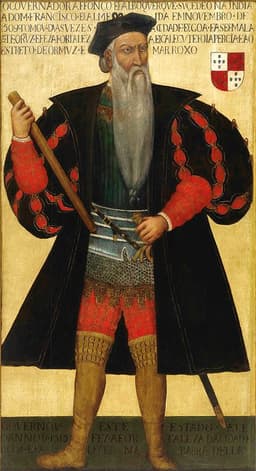
Afonso de Albuquerque
General · Medieval
79.6Total

Tan Lun
General · Medieval
49.4Total
Basic Information
Born
1453
1520
Died
1515
1577
Era
Medieval
Medieval
Nationality
Portugal
China
Occupation
General
General
Civilization
Western
Eastern
Score Comparison
Military (10%)
77.5
70.0
Political (20%)
88.0
36.5
Influence (20%)
80.0
48.6
Legacy (20%)
75.0
40.0
Leadership (15%)
78.0
57.6
Strategy (15%)
82.0
61.3
TOTAL
79.6
49.4
Afonso de Albuquerque — Complete Timeline
1503 AD
First voyage to IndiaWar◆ Major
Afonso de Albuquerque led a fleet to India, establishing the first Portuguese fort at Cochin. This voyage laid the foundation for Portuguese control of the Indian Ocean trade.
ExplorationColonialismIndia
Impact: global
1510 AD
Conquest of GoaWar◆ Major
Albuquerque captured Goa from the Sultan of Bijapur. He made Goa the capital of Portuguese India, a position it held for over 400 years.
ConquestColonialismIndia
Impact: regional
1511 AD
Conquest of MalaccaWar◆ Major
Albuquerque led a Portuguese fleet to capture the strategic port of Malacca. This gave Portugal control of the spice trade route between the Indian Ocean and the Pacific.
ConquestSpice TradeSoutheast Asia
Impact: global
1513 AD
Siege of AdenWar
Albuquerque attempted to capture Aden in Yemen but failed. This failure prevented Portugal from controlling the entrance to the Red Sea and limited their influence in the region.
SiegeFailureRed Sea
Impact: regional
1515 AD
Death at seaOther◆ Major
Afonso de Albuquerque died at sea off the coast of Goa, possibly from illness or poison. His death left the Portuguese Empire in the Indian Ocean without its most capable leader.
DeathLeadershipEmpire
Impact: regionaltragic
Tan Lun — Complete Timeline
1555 AD
Commanded Coastal Defense Against Wokou PiratesWar◆ Major
Tan Lun was appointed to command coastal defenses in Zhejiang and Fujian provinces against Japanese pirates (Wokou). He organized local militias and coordinated with General Qi Jiguang, implementing new tactics to counter pirate raids.
Ming DynastyPiracyCoastal Defense
Impact: regionalconstructive
1561 AD
Collaborated with Qi Jiguang in Anti-Pirate CampaignsWar◆ Major
Tan Lun worked closely with General Qi Jiguang in a series of campaigns against the Wokou pirates. Their combined forces achieved several decisive victories, significantly reducing pirate activity along China's southeastern coast.
Ming DynastyPiracyMilitary Cooperation
Impact: regionalconstructive
1571 AD
Appointed Minister of WarPolitical Action◆ Major
Tan Lun was appointed Minister of War in the Ming central government. In this capacity, he oversaw military reforms and border defense policies, including the strengthening of the Great Wall defenses against Mongol incursions.
Ming DynastyAppointmentMilitary Reform
Impact: nationalconstructive
1572 AD
Oversaw Construction of Great Wall FortificationsOther
As Minister of War, Tan Lun oversaw the construction and reinforcement of Great Wall fortifications in the northern border regions. These defensive works included watchtowers, garrison stations, and improved walls, aimed at deterring Mongol raids.
Ming DynastyGreat WallDefense
Impact: nationalconstructive
Expert Analysis
Origins
Afonso de Albuquerque was born in 1453 in Alhandra, Portugal, to a noble family with ties to the royal court. He received a classical education and military training, later serving in North Africa under King Afonso V. His early experiences in the Moroccan campaigns shaped his strategic thinking about naval power and overseas expansion.
Tan Lun was born in 1520 in Huanggang, Hubei province, China, during the Ming dynasty. He came from a scholarly family and passed the imperial civil service examinations, entering the bureaucracy as a magistrate. His early career involved local administration, where he gained experience in organizing militias to deal with banditry and coastal raids.
Rise to Power
Albuquerque rose through the Portuguese nobility, participating in the conquest of Arzila in 1471. In 1503, he made his first voyage to India under the command of his cousin, Francisco de Almeida. His big break came in 1506 when King Manuel I appointed him as the second governor of Portuguese India, with orders to expand Portuguese control. He captured Goa in 1510 from the Sultan of Bijapur, establishing it as the capital of Portuguese India. In 1511, he conquered Malacca, a strategic port controlling the spice trade between the Indian Ocean and China.
Tan Lun's rise began when he was appointed as a magistrate in coastal Zhejiang, where he faced the Wokou (Japanese pirates). He organized local defense forces, using innovative tactics and fortifications. His success caught the attention of the central government, and he was promoted to command coastal defenses in Fujian. Collaborating with General Qi Jiguang, he participated in several campaigns that crushed pirate strongholds. In 1573, he was appointed Minister of War, overseeing military reforms and border defense.
Leadership & Governance
Albuquerque governed with a centralized, autocratic style. He established a network of fortified ports (Goa, Malacca, Hormuz) to control trade routes. He promoted mixed marriages and used local auxiliaries to maintain control. However, his harsh treatment of Muslim rulers and populations created long-term resentment. He scored 82.0 in Strategy for his ability to seize key choke points.
Tan Lun's leadership was more bureaucratic and collaborative. He worked closely with Qi Jiguang, combining his administrative skills with Qi's tactical brilliance. As Minister of War, he standardized military drills, improved supply systems, and reinforced the Great Wall with stone and brick. His political score of 36.5 reflects his limited influence in the faction-ridden Ming court.
Triumph & Tragedy
Albuquerque's triumphs include the conquest of Goa (1510), which became the commercial and administrative center of Portuguese India for four centuries, and the capture of Malacca (1511), which gave Portugal control over the spice trade. His score of 77.5 in Military reflects these achievements. His tragedies include the failed siege of Aden (1513), which prevented control of the Red Sea, and his death at sea in 1515, possibly poisoned, leaving his empire incomplete.
Tan Lun's triumphs include successful campaigns against the Wokou pirates in the 1560s, restoring security to China's southeastern coast. He also oversaw the construction of over 1,200 li (600 km) of Great Wall fortifications. His tragedy lies in his low influence; his political score of 36.5 indicates he was often sidelined by court factions. His military score of 70.0 is solid but not exceptional.
Character & Destiny
Albuquerque was determined, ruthless, and visionary. He wrote extensively about his plans for a Portuguese thalassocracy. His death at sea, possibly by poison, cut short his ambitions. He scored 78.0 in Leadership for his ability to inspire loyalty among his captains and soldiers.
Tan Lun was conscientious, methodical, but less charismatic. He operated within the constraints of the Ming bureaucracy, which limited his scope. His leadership score of 57.6 reflects his competence but lack of dramatic impact.
Legacy
Albuquerque's legacy is immense: he founded the Portuguese Empire in the East, establishing a network of ports that lasted until the 20th century. His policies shaped colonialism in Asia. His legacy score of 75.0 reflects this enduring impact.
Tan Lun's legacy is more modest. He is remembered as an effective administrator and defender, but his contributions are overshadowed by Qi Jiguang. His legacy score of 40.0 indicates limited recognition outside China.
Conclusion
Afonso de Albuquerque had a far greater impact than Tan Lun. With a total score of 79.6 against 49.4, the 30.2-point gap is decisive. Albuquerque created a global empire that reshaped trade and politics, while Tan Lun was a competent local defender. The data supports Albuquerque as the more consequential figure.
Rankings
🥇
Afonso de AlbuquerqueLeader
Mil: 77.5Pol: 88.0Inf: 80.0
79.6
🥈
Tan Lun
Mil: 70.0Pol: 36.5Inf: 48.6
49.4
+30.2 behind
How This Comparison Works
Algorithm
Each figure is scored on 6 dimensions (0—100 scale) based on structured historical data: Military (10%), Political (20%), Influence (20%), Legacy (20%), Leadership (15%), Strategy (15%). The weighted total produces the final ranking.
Data Sources
Scores are computed from structured sub-indicators in the database. Scale factors adjust for era (Ancient ×0.85, Modern ×1.0) and civilization size (Eastern ×1.05, Other ×0.80) to account for differences in population and military scale.
Maximum 3 Figures
Comparisons are limited to 2—3 figures to ensure readability and statistical meaningfulness.
Error Margins
±5 points per dimension — Sub-scores are derived from historical records with inherent uncertainty. Two figures within 5 points on a dimension should be considered roughly equivalent in that area.
Total Score Accuracy
±3 points overall — The weighted combination of 6 dimensions produces a total score with approximately ±3 points of uncertainty. Differences of less than 3 points are not statistically significant— the figures are effectively tied.
Known Limitations
- Historical records are incomplete and uneven across civilizations
- Figures from oral-tradition societies may be underrepresented
- Occupation labels can misclassify multi-role figures
- Scores measure capability and impact, not moral character
- Quantitative scoring is a comparison tool, not absolute truth
Capability Radar
Military (10%) — Battles & Warfare
Battles
85
55
Win Rate
80
60
Expansion
95
30
Political (20%) — Governance & Reform
Reform
80
45
Diplomacy
85
35
Economy
80
30
Influence (20%) — Cultural & Global Reach
Cultural
70
30
Global
85
20
Legacy (20%) — Historical Impact
Historical
85
35
Longevity
80
25
Leadership (15%) — Power & Stability
Tenure
70
40
Stability
65
40
Strategy (15%) — Tactics & Innovation
Strategy
95
60
Tactics
90
65
Reform
75
50
Similar Comparisons
Comments & Discussion
No comments yet. Be the first to share your thoughts!