Loading...
Afonso de Albuquerque vs Sengge Rinchen
Afonso de Albuquerque leads by 22.7 pts · 2 figures compared
…
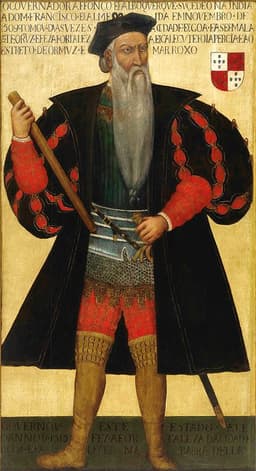
Afonso de Albuquerque
General · Medieval
79.6Total
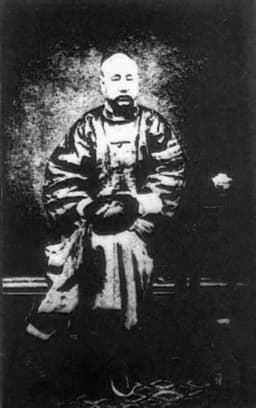
Sengge Rinchen
General · Modern
56.9Total
Basic Information
Born
1453
1811
Died
1515
1865
Era
Medieval
Modern
Nationality
Portugal
China
Occupation
General
General
Civilization
Western
Eastern
Score Comparison
Military (10%)
77.5
70.0
Political (20%)
88.0
43.7
Influence (20%)
80.0
55.0
Legacy (20%)
75.0
54.0
Leadership (15%)
78.0
67.0
Strategy (15%)
82.0
60.7
TOTAL
79.6
56.9
Afonso de Albuquerque — Complete Timeline
1503 AD
First voyage to IndiaWar◆ Major
Afonso de Albuquerque led a fleet to India, establishing the first Portuguese fort at Cochin. This voyage laid the foundation for Portuguese control of the Indian Ocean trade.
ExplorationColonialismIndia
Impact: global
1510 AD
Conquest of GoaWar◆ Major
Albuquerque captured Goa from the Sultan of Bijapur. He made Goa the capital of Portuguese India, a position it held for over 400 years.
ConquestColonialismIndia
Impact: regional
1511 AD
Conquest of MalaccaWar◆ Major
Albuquerque led a Portuguese fleet to capture the strategic port of Malacca. This gave Portugal control of the spice trade route between the Indian Ocean and the Pacific.
ConquestSpice TradeSoutheast Asia
Impact: global
1513 AD
Siege of AdenWar
Albuquerque attempted to capture Aden in Yemen but failed. This failure prevented Portugal from controlling the entrance to the Red Sea and limited their influence in the region.
SiegeFailureRed Sea
Impact: regional
1515 AD
Death at seaOther◆ Major
Afonso de Albuquerque died at sea off the coast of Goa, possibly from illness or poison. His death left the Portuguese Empire in the Indian Ocean without its most capable leader.
DeathLeadershipEmpire
Impact: regionaltragic
Sengge Rinchen — Complete Timeline
1859 AD
Battle of Dagu FortsWar◆ Major
Sengge Rinchen commanded Qing forces defending the Dagu Forts against a British and French naval attack. His forces repelled the assault, sinking several enemy ships and inflicting heavy casualties, a rare Qing victory in the Second Opium War.
Second Opium WarBattleVictory
Impact: regional
1860 AD
Battle of PalikaoWar◆ Major
Sengge Rinchen commanded Qing cavalry at the Battle of Palikao against Anglo-French forces. His forces were decisively defeated by superior firepower, leading to the fall of Beijing and the burning of the Old Summer Palace.
Second Opium WarBattleDefeat
Impact: regionaltragic
1863 AD
Suppression of the Nian RebellionWar◆ Major
Sengge Rinchen led Qing forces against the Nian rebels in northern China. He achieved several victories but was ultimately killed in battle against the Nian in 1865, marking a turning point in the rebellion.
Nian RebellionCampaignDeath
Impact: regionaltragic
Expert Analysis
Afonso de Albuquerque vs Sengge Rinchen
# The Admiral and the Prince
In the spring of 1511, a Portuguese fleet of eighteen ships slipped through the Strait of Malacca, its commander a man of fifty-eight with a graying beard and eyes that had seen too many sunsets at sea. Three centuries later, in the summer of 1860, a Mongol prince in Qing armor watched from the walls of the Dagu Forts as British and French gunboats churned the waters of the Hai River. Both men stood at the edge of empires—one building, one defending. Their fates would be decided by the same element: the sea. Yet one would die hailed as a founder, the other as a failure. Why?
Origins
Afonso de Albuquerque was born in 1453, the year Constantinople fell to the Ottomans—a coincidence that would define his world. Portugal, a small kingdom on the edge of Europe, had spent decades pushing south along Africa’s coast, seeking a sea route to the spice riches of the East. Albuquerque grew up in the court of King Afonso V, learning navigation, war, and the art of empire. The age of exploration was his classroom; the Indian Ocean, his destiny.
Sengge Rinchen was born in 1811, a Mongol prince of the Khorchin banner, his people long integrated into the Qing Empire. China in the nineteenth century was a civilization under siege—from within by the Taiping Rebellion, from without by European gunboats. Sengge Rinchen learned to ride before he could walk, mastering the cavalry tactics that had once made the Mongols masters of Asia. But by his time, the world had changed: gunpowder, steamships, and treaties written in English had rewritten the rules of war.
Rise to Power
Albuquerque’s rise was slow and methodical. He first sailed to India in 1503 at age fifty, commanding a fleet that established a Portuguese fort at Cochin. This was not glory but groundwork—a toehold on a continent that would soon be his. In 1506, he was appointed governor of Portuguese India, a title that gave him authority but little patience from Lisbon. He was a man who believed in action, not correspondence.
Sengge Rinchen rose through the Qing military bureaucracy, a system that valued loyalty over innovation. His first major command came in 1859, when he was ordered to defend the Dagu Forts at the mouth of the Hai River, guarding the approach to Beijing. He was not a revolutionary; he was a guardian. His task was to hold the line against forces he barely understood.
Leadership & Governance
Albuquerque ruled the Indian Ocean with a blend of terror and pragmatism. After capturing Goa in 1510 from the Sultan of Bijapur, he did not simply loot and leave. He made Goa the capital of Portuguese India, encouraging intermarriage, building churches, and establishing a mint. He understood that empire required not just soldiers but settlers. His conquest of Malacca in 1511—a city that controlled the spice trade—was a masterstroke of naval strategy and political timing. He wrote to his king: “If you want to hold the East, hold Malacca.”
Yet his wisdom had limits. In 1513, he attempted to capture Aden in Yemen, seeking to block the Red Sea and choke off Ottoman trade. The siege failed. The walls held. The tide turned. That failure would haunt him, for it left the door to the Indian Ocean half-open.
Sengge Rinchen’s leadership was defined by courage and tragedy. At the Battle of Dagu Forts in 1859, he commanded the defense against a British and French naval attack. His forces used cannons and fire rafts to repel the invaders, inflicting heavy casualties—a rare Qing victory against Western arms. It was his finest hour. But it was also his last.
The following year, at the Battle of Palikao (1860), Sengge Rinchen led his Mongol cavalry in a charge against Anglo-French infantry. It was a scene from another century: horsemen with sabers against rifles and artillery. The result was slaughter. His forces were decisively defeated, and the road to Beijing lay open. The Qing Emperor fled. The Summer Palace was burned.
Triumph & Tragedy
Albuquerque’s triumph was the creation of a maritime empire that would last four centuries. His tragedy was that he never saw it flourish. In 1515, while sailing off the coast of Goa, he fell ill—possibly poisoned, possibly struck by fever. He died at sea, alone, his body committed to the waters he had conquered. His last words, according to legend, were: “I leave nothing to my son but the example of my life.”
Sengge Rinchen’s triumph was a single battle, a moment of resistance that delayed the inevitable. His tragedy was everything that followed. After Palikao, he was stripped of command but later restored to fight the Nian Rebellion. In 1863, he achieved several victories against the rebels, but he was ultimately surrounded and killed in battle. He died fighting, as a Mongol prince should—but his death changed nothing.
Character & Destiny
Albuquerque was a builder. He saw the Indian Ocean not as a place to plunder but as a space to control. He was ruthless—he ordered the massacre of Muslim prisoners in Goa—but he was also visionary. He understood that empire required infrastructure, not just courage. His personality was that of a man who believed the world could be remade.
Sengge Rinchen was a defender. He saw his world crumbling and fought to hold it together. He was loyal to a dynasty that was already dying. His personality was that of a man who believed the past could be preserved. It could not.
Legacy
Albuquerque is remembered as the founder of the Portuguese Empire in Asia. His name adorns streets in Goa, Lisbon, and Malacca. His strategy—control the choke points, build the forts, marry the locals—became the blueprint for European colonialism. His legacy is a mixed one: he brought trade and Christianity, but also violence and disruption.
Sengge Rinchen is remembered, if at all, as a footnote in the story of China’s humiliation. His victory at Dagu is a point of pride; his defeat at Palikao, a lesson in futility. In modern China, he is sometimes invoked as a symbol of resistance against foreign aggression, but his name lacks the resonance of a national hero.
Conclusion
One built an empire; the other tried to save one. Their differences are not merely personal but epochal. Albuquerque lived in an age when the world was opening, when a small kingdom could project power across oceans. Sengge Rinchen lived in an age when the world was closing, when an ancient empire could not adapt fast enough. Their fates were written not by their courage or intelligence, but by the currents of history—currents as indifferent as the sea that swallowed Albuquerque and the dust that covered Sengge Rinchen’s last charge.
Rankings
🥇
Afonso de AlbuquerqueLeader
Mil: 77.5Pol: 88.0Inf: 80.0
79.6
🥈
Sengge Rinchen
Mil: 70.0Pol: 43.7Inf: 55.0
56.9
+22.7 behind
How This Comparison Works
Algorithm
Each figure is scored on 6 dimensions (0—100 scale) based on structured historical data: Military (10%), Political (20%), Influence (20%), Legacy (20%), Leadership (15%), Strategy (15%). The weighted total produces the final ranking.
Data Sources
Scores are computed from structured sub-indicators in the database. Scale factors adjust for era (Ancient ×0.85, Modern ×1.0) and civilization size (Eastern ×1.05, Other ×0.80) to account for differences in population and military scale.
Maximum 3 Figures
Comparisons are limited to 2—3 figures to ensure readability and statistical meaningfulness.
Error Margins
±5 points per dimension — Sub-scores are derived from historical records with inherent uncertainty. Two figures within 5 points on a dimension should be considered roughly equivalent in that area.
Total Score Accuracy
±3 points overall — The weighted combination of 6 dimensions produces a total score with approximately ±3 points of uncertainty. Differences of less than 3 points are not statistically significant— the figures are effectively tied.
Known Limitations
- Historical records are incomplete and uneven across civilizations
- Figures from oral-tradition societies may be underrepresented
- Occupation labels can misclassify multi-role figures
- Scores measure capability and impact, not moral character
- Quantitative scoring is a comparison tool, not absolute truth
Capability Radar
Military (10%) — Battles & Warfare
Battles
85
75
Win Rate
80
60
Expansion
95
20
Political (20%) — Governance & Reform
Reform
80
20
Diplomacy
85
50
Economy
80
20
Influence (20%) — Cultural & Global Reach
Cultural
70
40
Global
85
35
Legacy (20%) — Historical Impact
Historical
85
55
Longevity
80
30
Leadership (15%) — Power & Stability
Tenure
70
40
Stability
65
30
Strategy (15%) — Tactics & Innovation
Strategy
95
70
Tactics
90
80
Reform
75
30
Similar Comparisons
Comments & Discussion
SteppeSavage6/16/2026
Albuquerque was building an empire with ships and blood; Sengge Rinchen was just a Mongol general clinging to medieval tactics against rifles. The Dagu Forts fell because he couldn't adapt—cavalry charges mean nothing against ironclads. Albuquerque pioneered total oceanic dominance, locking down trade routes from Hormuz to Malacca. One was a revolutionary, the other a dinosaur frozen in time. Sengge Rinchen's legacy is a cautionary tale for anyone who thinks bravery beats technology. The sea doe
海洋铁锤6/16/2026
阿尔布克尔克是帝国设计师,不是莽夫。你们吹他“征服”印度洋?笑死,他不过是替葡萄牙皇室当了个武装商人,靠烧杀抢掠逼贸易站投降。塞恩格林钦虽败,但他在蒙古骑兵对抗英法铁甲舰时还敢冲锋,这才是真血性。阿尔布克尔克死后葡萄牙在亚洲撑了四十年就烂了;塞恩格林钦死了,清朝还苟了几十年。谁更有韧性?别被教科书洗脑,胜败不在纸面上。
ClassicistTide6/16/2026
The real difference isn't tactics—it's context. Albuquerque fought in an era when European naval power was a novelty, facing fragmented sultanates. Sengge Rinchen faced industrialized warfare: the Second Opium War's Anglo-French fleet had explosive shells and steam power. Calling Albuquerque a "founder" ignores that his empire relied on terror and a tiny garrison. Rinchen's failure was structural—Qing China refused to modernize. Both were products of their systems, not lone geniuses or fools. Ju
骑兵挽歌6/16/2026
阿尔布克尔克是个赌徒,靠火器和海上机动偷袭印度洋。塞恩格林钦呢?他明知大沽炮台守不住,还带蒙古骑兵冲滩,这不是傻,是忠诚的悲剧。西方史书给前者镀金,给后者泼脏水,就因为赢家写历史。阿尔布克尔克的“帝国”几年后就被奥斯曼和当地势力反扑,塞恩格林钦的失败却暴露了清朝体制的腐朽。别拿个人成败定英雄,塞恩格林钦的血比阿尔布克尔克的勋章更沉。
DataDrifter6/16/2026
Stats don't lie. Albuquerque captured Malacca with 18 ships and maybe 1,200 men. Sengge Rinchen lost Dagu Forts with over 10,000 troops defending against a smaller Anglo-French force. One multiplied resources, the other mismanaged them. Rinchen had the advantage of fortifications and interior lines; Albuquerque had none. Numbers say Albuquerque optimized his assets; Rinchen squandered his. Call him a patriot, but he was a bad strategist. Tough truth