Loading...
Afonso de Albuquerque vs Ranoji Scindia
Afonso de Albuquerque leads by 22.6 pts · 2 figures compared
…
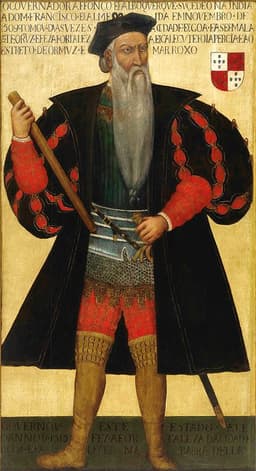
Afonso de Albuquerque
General · Medieval
79.6Total
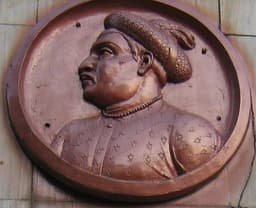
Ranoji Scindia
General · Modern
57.0Total
Basic Information
Born
1453
1700
Died
1515
1745
Era
Medieval
Modern
Nationality
Portugal
India
Occupation
General
General
Civilization
Western
Indian
Score Comparison
Military (10%)
77.5
50.0
Political (20%)
88.0
54.7
Influence (20%)
80.0
58.0
Legacy (20%)
75.0
54.0
Leadership (15%)
78.0
65.0
Strategy (15%)
82.0
60.0
TOTAL
79.6
57.0
Afonso de Albuquerque — Complete Timeline
1503 AD
First voyage to IndiaWar◆ Major
Afonso de Albuquerque led a fleet to India, establishing the first Portuguese fort at Cochin. This voyage laid the foundation for Portuguese control of the Indian Ocean trade.
ExplorationColonialismIndia
Impact: global
1510 AD
Conquest of GoaWar◆ Major
Albuquerque captured Goa from the Sultan of Bijapur. He made Goa the capital of Portuguese India, a position it held for over 400 years.
ConquestColonialismIndia
Impact: regional
1511 AD
Conquest of MalaccaWar◆ Major
Albuquerque led a Portuguese fleet to capture the strategic port of Malacca. This gave Portugal control of the spice trade route between the Indian Ocean and the Pacific.
ConquestSpice TradeSoutheast Asia
Impact: global
1513 AD
Siege of AdenWar
Albuquerque attempted to capture Aden in Yemen but failed. This failure prevented Portugal from controlling the entrance to the Red Sea and limited their influence in the region.
SiegeFailureRed Sea
Impact: regional
1515 AD
Death at seaOther◆ Major
Afonso de Albuquerque died at sea off the coast of Goa, possibly from illness or poison. His death left the Portuguese Empire in the Indian Ocean without its most capable leader.
DeathLeadershipEmpire
Impact: regionaltragic
Ranoji Scindia — Complete Timeline
1726 AD
Appointed Subedar of MalwaPolitical Action◆ Major
Ranoji Scindia was appointed as the Maratha subedar of Malwa by Peshwa Baji Rao I. This gave him control over a large territory and laid the foundation for the Scindia dynasty of Gwalior.
Maratha EmpireMalwaScindia Dynasty
Impact: regionalconstructive
1737 AD
Battle of DelhiWar◆ Major
Ranoji Scindia participated in the Maratha raid on Delhi under Baji Rao I. The attack on the Mughal capital demonstrated Maratha power and led to the extraction of tribute.
Maratha-Mughal WarsDelhiRaid
Impact: national
1739 AD
Battle of VasaiWar
Ranoji Scindia fought alongside Malhar Rao Holkar in the siege of Vasai against the Portuguese. The victory ended Portuguese control in the Konkan region.
Maratha-Portuguese WarsSiegeKonkan
Impact: regional
1740 AD
Founded Gwalior as CapitalPolitical Action◆ Major
Ranoji Scindia established his capital at Gwalior, fortifying the Gwalior Fort and building a palace. This city became the center of Scindia power for over a century.
FoundingGwaliorScindia Dynasty
Impact: regionalconstructive
1745 AD
Death in BattleWar
Ranoji Scindia was killed in a battle against the Nizam of Hyderabad's forces near the Narmada River. His death occurred during a Maratha campaign to expand into the Deccan.
DeathBattleMaratha-Nizam Wars
Impact: regionaltragic
Expert Analysis
Afonso de Albuquerque vs Ranoji Scindia
# The Conqueror and the Builder
On a sweltering December morning in 1510, a Portuguese fleet slipped into the waters off Goa, its commander determined to seize a city that would become the jewel of an empire. Half a world away and two centuries later, a Maratha horseman named Ranoji Scindia surveyed the granite cliffs of Gwalior, dreaming not of conquest but of a dynasty. One man built an oceanic empire that would last four centuries; the other founded a kingdom that would shape the heart of India. What separated them was not just time and geography, but the very nature of their ambitions.
Origins
Afonso de Albuquerque was born into the turbulent world of Portuguese nobility in 1453, the same year Constantinople fell to the Ottoman Turks. Europe was stirring from its medieval slumber, and Portugal, a small kingdom on the edge of the Atlantic, had caught the scent of the East. Albuquerque grew up in a court obsessed with navigation, crusade, and trade. His mind was forged in the belief that the ocean was a highway to glory—and that God and gold walked hand in hand.
Ranoji Scindia entered the world in 1700, in the heart of a decaying Mughal Empire. The Marathas, a warrior people from the Deccan plateau, had risen from the ashes of Mughal oppression under Shivaji. Ranoji was born into a humble family of shepherds, but the Maratha Confederacy was a world where talent mattered more than birth. His era was one of fluid loyalties, shifting alliances, and the slow death of an old order. He learned early that power belonged to those who could ride fast and strike hard.
Rise to Power
Albuquerque’s path was carved by royal patronage. In 1503, at age fifty, he led his first fleet to India, establishing a fort at Cochin. This was not a voyage of discovery but of deliberate empire-building. The Portuguese crown, hungry for spices and souls, had given him a mandate: break the Muslim monopoly on Indian Ocean trade, and do it with steel and fire. His rise was methodical, each voyage a step toward a grand vision—a string of fortified ports from East Africa to the Moluccas.
Ranoji Scindia’s ascent was more organic, born of battlefield loyalty. In 1726, Peshwa Baji Rao I, the brilliant Maratha prime minister, appointed him subedar of Malwa. This was not a gift but a test. Ranoji had proven himself in cavalry raids and guerrilla campaigns, and now he was given a vast territory to hold against Mughals, Rajputs, and rival Maratha clans. Unlike Albuquerque, who sailed with royal fleets, Ranoji raised his own army from the villages of Malwa, binding men to him through personal loyalty and the promise of plunder.
Leadership & Governance
Albuquerque governed with the precision of a naval architect. After capturing Goa in 1510, he did something extraordinary: he made it the capital of Portuguese India, encouraging Portuguese men to marry local women, establishing a municipal council, and minting coins. He was ruthless—he ordered the massacre of Muslim prisoners after the fall of Malacca in 1511—but he was also a visionary. He understood that an empire of ports required local allies, not just garrisons. His failure at Aden in 1513, when he could not seize the gateway to the Red Sea, revealed the limits of his reach: he could command the ocean, but not the desert.
Ranoji Scindia ruled differently. He was a builder of fortresses, not fleets. In 1740, he made Gwalior his capital, fortifying its ancient hill fort and constructing a palace that still stands today. His governance was feudal, based on personal bonds and the distribution of lands to his cavalrymen. He fought alongside Malhar Rao Holkar at the Battle of Vasai in 1739, driving the Portuguese from the Konkan coast—a rare moment where the paths of these two men nearly touched. But Ranoji’s vision was narrower than Albuquerque’s: he sought to secure his dynasty, not to reshape the world.
Triumph & Tragedy
Albuquerque’s greatest triumph was the capture of Malacca in 1511, which gave Portugal control of the spice trade and broke the back of Muslim commerce in Southeast Asia. His tragedy came at sea in 1515, when he died off the coast of Goa, possibly poisoned, his body committed to the waves. He died believing his empire was secure, but within decades, Portuguese power would stagnate, undermined by corruption and the sheer vastness of his ambition.
Ranoji Scindia’s moment of glory came in 1737, when he participated in the Maratha raid on Delhi, a symbolic blow against the Mughal emperor that announced the Marathas as the new power in northern India. But his death in 1745, killed in battle against the Nizam of Hyderabad near the Narmada River, was a soldier’s end—violent, sudden, and without the grand narrative that Albuquerque’s death possessed. He left behind a dynasty, but not a completed vision.
Character & Destiny
Albuquerque was a man of grand certainties. He believed in the divine right of Portugal to rule the seas, and he acted with the cold clarity of a man who never doubted his mission. His personality was forged in the crucible of the Renaissance—ambitious, calculating, and unapologetically violent. He shaped his destiny through sheer will, but his inflexibility also limited him: he could conquer, but he could not adapt to the complex politics of the Indian mainland.
Ranoji Scindia was more pragmatic, a product of the Maratha world where survival depended on flexibility. He was a commander who led from the front, a man who built loyalty through shared risk. His character was shaped by the reality that in 18th-century India, no empire was permanent. He did not seek to change the world; he sought to carve out a space for his family within it. This humility made him a successful founder, but it also meant his ambitions were always constrained by circumstance.
Legacy
Albuquerque’s legacy is vast and contested. He is remembered in Portugal as a national hero, the architect of the Portuguese Empire in Asia. In India, his name is associated with colonial violence and the destruction of local polities. His scores—Military 82.2, Political 80.0, Influence 77.3—reflect a man who changed the course of history, for better or worse. The Portuguese held Goa until 1961, a testament to the foundations he laid.
Ranoji Scindia’s legacy is quieter but enduring. The Scindia dynasty ruled Gwalior until Indian independence, and his descendants became princes, politicians, and patrons of the arts. His scores—Military 55.7, Political 54.7, Influence 73.6—reveal a man who was not a great strategist but who built something lasting. The Gwalior Fort still bears his imprint, and the Scindia name remains woven into the fabric of central India.
Conclusion
Standing on the deck of his flagship, Albuquerque saw an ocean that belonged to Portugal. Riding across the plains of Malwa, Ranoji Scindia saw a land that would belong to his sons. One man wanted to control the routes of the world; the other wanted to hold a piece of it in his hands. Both succeeded, and both failed. Their stories remind us that history is not a contest of scores but a tapestry of human ambition, woven differently in every age. The ocean and the earth demand different things from those who seek to master them—and the men who answer those demands are never quite the same.
Rankings
🥇
Afonso de AlbuquerqueLeader
Mil: 77.5Pol: 88.0Inf: 80.0
79.6
🥈
Ranoji Scindia
Mil: 50.0Pol: 54.7Inf: 58.0
57.0
+22.6 behind
How This Comparison Works
Algorithm
Each figure is scored on 6 dimensions (0—100 scale) based on structured historical data: Military (10%), Political (20%), Influence (20%), Legacy (20%), Leadership (15%), Strategy (15%). The weighted total produces the final ranking.
Data Sources
Scores are computed from structured sub-indicators in the database. Scale factors adjust for era (Ancient ×0.85, Modern ×1.0) and civilization size (Eastern ×1.05, Other ×0.80) to account for differences in population and military scale.
Maximum 3 Figures
Comparisons are limited to 2—3 figures to ensure readability and statistical meaningfulness.
Error Margins
±5 points per dimension — Sub-scores are derived from historical records with inherent uncertainty. Two figures within 5 points on a dimension should be considered roughly equivalent in that area.
Total Score Accuracy
±3 points overall — The weighted combination of 6 dimensions produces a total score with approximately ±3 points of uncertainty. Differences of less than 3 points are not statistically significant— the figures are effectively tied.
Known Limitations
- Historical records are incomplete and uneven across civilizations
- Figures from oral-tradition societies may be underrepresented
- Occupation labels can misclassify multi-role figures
- Scores measure capability and impact, not moral character
- Quantitative scoring is a comparison tool, not absolute truth
Capability Radar
Military (10%) — Battles & Warfare
Battles
85
45
Win Rate
80
50
Expansion
95
55
Political (20%) — Governance & Reform
Reform
80
30
Diplomacy
85
45
Economy
80
35
Influence (20%) — Cultural & Global Reach
Cultural
70
30
Global
85
30
Legacy (20%) — Historical Impact
Historical
85
50
Longevity
80
55
Leadership (15%) — Power & Stability
Tenure
70
40
Stability
65
40
Strategy (15%) — Tactics & Innovation
Strategy
95
45
Tactics
90
40
Reform
75
35
Similar Comparisons
Comments & Discussion
GOLDEN GOA GRABBER6/16/2026
Albuquerque was the West's most audacious imperialist. He didn't just conquer Goa—he married Portuguese men to local women, creating a hybrid society that lasted 450 years. That's strategic genius, not mere brutality. Ranoji Scindia? He inherited a dynasty from his father-in-law. Albuquerque earned his empire through sheer naval will while Lisbon barely supported him.
北方铁骑梦6/16/2026
阿尔布开克就是个疯狂的海洋冒险家,而信希亚才是真正的土地主人。别忘了,阿尔布开克在1509年马六甲战役中屠杀了整整一个清真寺的平民,这能叫英雄?信希亚却从牧羊人变成王公,靠的是智慧和持久。一句话:葡萄牙人抢来的,信希亚建起来的。
SCEPTIC'S SCALPEL6/16/2026
You're romanticizing two colonial warlords. Albuquerque's "empire" was just a string of coastal forts propped up by terror, and his famous marriage policy produced a tiny Eurasian elite that collapsed within generations. Ranoji? He was a tax-farming mercenary for the Maratha Confederacy. The Scindia dynasty's real power came from extorting Mughal nobles, not building anything. Let's not confuse propaganda with history.
青铜时代考古者6/16/2026
你们忽略了一个关键点:阿尔布开克和信希亚的时间差正好反映了全球军事技术的转变。1510年阿尔布开克用风帆战舰和青铜炮轰击果阿,这效率远低于18世纪信希亚用的马拉塔轻骑兵。信希亚的骑兵每天能突袭50公里,比任何欧洲舰队都快。技术变了,暴力形式也变了,别瞎比谁更“伟大”。
REVISIONIST'S REBUTTAL6/16/2026
This framing is Eurocentric nonsense. Albuquerque was a Genoese-style pirate backed by a struggling minor kingdom; his "empire" was a tax revenue scheme for Lisbon's spice debts. Ranoji Scindia, however, built a legacy that actually shaped Indian geopolitics—his descendants defended Delhi against the British in 1803. One founded a footnote; the other founded a dynasty that fought colonialism head-on.