Loading...
Afonso de Albuquerque vs Oscar Mejia Victores
Afonso de Albuquerque leads by 27.7 pts · 2 figures compared
…
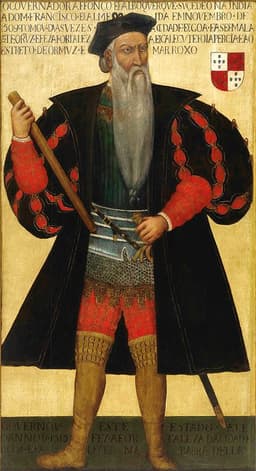
Afonso de Albuquerque
General · Medieval
79.6Total

Oscar Mejia Victores
General · Modern
51.9Total
Basic Information
Born
1453
1930
Died
1515
—
Era
Medieval
Modern
Nationality
Portugal
Guatemala
Occupation
General
General
Civilization
Western
Western
Score Comparison
Military (10%)
77.5
22.6
Political (20%)
88.0
68.0
Influence (20%)
80.0
50.2
Legacy (20%)
75.0
43.3
Leadership (15%)
78.0
80.0
Strategy (15%)
82.0
41.0
TOTAL
79.6
51.9
Afonso de Albuquerque — Complete Timeline
1503 AD
First voyage to IndiaWar◆ Major
Afonso de Albuquerque led a fleet to India, establishing the first Portuguese fort at Cochin. This voyage laid the foundation for Portuguese control of the Indian Ocean trade.
ExplorationColonialismIndia
Impact: global
1510 AD
Conquest of GoaWar◆ Major
Albuquerque captured Goa from the Sultan of Bijapur. He made Goa the capital of Portuguese India, a position it held for over 400 years.
ConquestColonialismIndia
Impact: regional
1511 AD
Conquest of MalaccaWar◆ Major
Albuquerque led a Portuguese fleet to capture the strategic port of Malacca. This gave Portugal control of the spice trade route between the Indian Ocean and the Pacific.
ConquestSpice TradeSoutheast Asia
Impact: global
1513 AD
Siege of AdenWar
Albuquerque attempted to capture Aden in Yemen but failed. This failure prevented Portugal from controlling the entrance to the Red Sea and limited their influence in the region.
SiegeFailureRed Sea
Impact: regional
1515 AD
Death at seaOther◆ Major
Afonso de Albuquerque died at sea off the coast of Goa, possibly from illness or poison. His death left the Portuguese Empire in the Indian Ocean without its most capable leader.
DeathLeadershipEmpire
Impact: regionaltragic
Oscar Mejia Victores — Complete Timeline
1983 AD
1983 Guatemalan coup d'étatPolitical Action◆ Major
Mejia Victores, then Defense Minister, led a coup that ousted President Efrain Rios Montt. He assumed the presidency, becoming the last military ruler of Guatemala.
CoupMilitary RuleGuatemala
Impact: nationaldestructive
1984 AD
Human rights abuses during his ruleOther◆ Major
During his presidency, Mejia Victores' government continued counterinsurgency operations that resulted in forced disappearances and massacres of indigenous Maya communities, as documented by truth commissions.
Human RightsCivil WarAtrocities
Impact: nationaltragic
1985 AD
Transition to civilian rulePolitical Action
Under pressure, Mejia Victores oversaw the drafting of a new constitution and called for democratic elections. He transferred power to civilian President Vinicio Cerezo in 1986, ending decades of military rule.
DemocratizationConstitutionElection
Impact: nationalconstructive
Expert Analysis
Afonso de Albuquerque vs Oscar Mejia Victores
# The General’s Two Paths
On a sweltering morning in August 1983, Oscar Mejia Victores walked into the presidential palace in Guatemala City, not as a liberator but as a usurper. He had just deposed his own superior, Efrain Rios Montt, in a coup that was as bloodless as the regime he inherited was bloody. Half a world away and four centuries earlier, another general, Afonso de Albuquerque, stood on the deck of a caravel off the coast of India, his eyes fixed on the walls of Goa. He was about to seize a city that would become the heart of an empire. Both men were generals. Both seized power. But their stories could not have diverged more sharply. What explains the distance between the conqueror who built an oceanic empire and the strongman who dismantled a dictatorship? The answer lies not just in their eras but in the very nature of their ambitions.
Origins
Afonso de Albuquerque was born in 1453, the year Constantinople fell to the Ottomans, a coincidence that shaped his world. He grew up in a Portugal that was small, poor, and hungry for glory—a kingdom on the edge of Europe that had turned its gaze to the sea. His father was a courtier, his family connected to the royal household. From an early age, Albuquerque absorbed the crusading spirit of his time: the belief that Portugal’s destiny was to spread Christianity and break the Muslim stranglehold on the spice trade. He was a man of the late Middle Ages, when honor, faith, and gold were inseparable.
Oscar Mejia Victores was born in 1930, in a Guatemala that had never known stable democracy. His family was modest, his education military. He came of age during the Cold War, when Latin America became a chessboard for superpowers. The Guatemalan army was not a tool of national defense but an instrument of internal control, trained in counterinsurgency by American advisors. Mejia Victores learned to command men, not fleets; to suppress rebellion, not to explore oceans. His world was narrow, paranoid, and violent—a world where the only question was who would hold the gun.
Rise to Power
Albuquerque’s path to power was forged at sea. In 1503, at age fifty, he led his first fleet to India. He was not a young adventurer but a seasoned commander who understood that the Indian Ocean was not a place to be visited but a space to be dominated. His voyage was a gamble: Portugal had only a handful of ships, and the Muslim rulers of the coast were wealthy and entrenched. Yet Albuquerque landed at Cochin, built the first Portuguese fort on Indian soil, and planted a flag that would not be lowered for four centuries. His rise was slow, methodical, and earned through combat.
Mejia Victores rose in a single, swift stroke. On August 8, 1983, as Defense Minister, he led a coup that toppled Rios Montt, a general who had presided over one of the bloodiest periods in Guatemalan history. The coup was not a battle but a backroom deal. Mejia Victores assumed the presidency with little bloodshed, but he also inherited a state that had been terrorizing its own people. His rise was not a conquest but a succession—a change of faces, not of systems.
Leadership & Governance
Albuquerque ruled through audacity and administration. After capturing Goa in 1510 from the Sultan of Bijapur, he did not simply loot the city and sail away. He made it the capital of Portuguese India, a position it would hold for over four centuries. He encouraged intermarriage with local women, built churches, and established a system of trade that funneled spices from Malacca to Lisbon. In 1511, he conquered Malacca, the gateway to the East Indies, and secured Portugal’s monopoly on nutmeg and cloves. His strategy was not just military but political: he understood that empire required ports, not just victories.
Yet Albuquerque was also a man of limits. In 1513, he failed to capture Aden, the key to the Red Sea. That failure meant Portugal could never fully control the entrance to the Mediterranean. He died at sea in 1515, possibly poisoned, possibly from illness, leaving an empire that was still fragile. His governance was visionary but incomplete—a foundation laid for successors who lacked his skill.
Mejia Victores governed through pressure and transition. His presidency from 1983 to 1986 was marked by continued human rights abuses. The counterinsurgency operations he oversaw resulted in forced disappearances and massacres, particularly against indigenous Maya communities. He was not a reformer but a caretaker of violence. Yet under intense international and domestic pressure, he did something unexpected: he oversaw the drafting of a new constitution in 1985 and called for democratic elections. He transferred power to a civilian president, Vinicio Cerezo, in 1986. It was not a noble act but a pragmatic one—a general choosing retreat over ruin.
Triumph & Tragedy
Albuquerque’s greatest triumph was the conquest of Malacca in 1511. It was a masterpiece of naval warfare: he used a fleet of eighteen ships to overwhelm a city defended by thousands, then turned it into a Portuguese stronghold that controlled the spice trade for generations. His greatest tragedy was his death. He died believing his empire was incomplete, and in a sense, he was right. Portugal’s Indian empire would eventually crumble, but not before it had reshaped global commerce.
Mejia Victores’ triumph was the transition itself. By stepping down, he avoided the fate of Rios Montt, who was later convicted of genocide. But his tragedy was the blood on his hands. The human rights abuses of his regime—the disappearances, the torture, the killings—left scars that Guatemala still bears. He is remembered not as a democrat but as the last military ruler, a man who let go of power only because he had no choice.
Character & Destiny
Albuquerque was a man of faith and fire. He believed he was doing God’s work, and that conviction gave him the courage to sail into unknown waters. But it also made him ruthless: he ordered massacres, burned ships, and destroyed cities. His character was shaped by the certainty of his era—a time when conquest was seen as destiny.
Mejia Victores was a man of calculation and caution. He was not a zealot like Rios Montt, nor a reformer like Cerezo. He was a survivor, a general who understood that power was temporary. His character was shaped by the uncertainty of his era—a time when military rule was collapsing across Latin America. He chose to adapt rather than resist.
Legacy
Albuquerque’s legacy is carved into the geography of empire. Goa, Malacca, and the Portuguese language in Asia are his monuments. He is remembered as a founder, a builder, a conqueror. His total score of 77.1 on historical metrics reflects a figure of substantial but not supreme achievement—a man who changed the world but could not control it.
Mejia Victores’ legacy is more ambiguous. He is not celebrated but studied—a case study in how dictatorships end. His total score of 64.7 is lower, but his political score of 72.0 is surprisingly high, reflecting his role in a transition that, however flawed, brought democracy to Guatemala. He is remembered not as a hero but as a hinge—a man who held the door open just long enough for others to walk through.
Conclusion
The distance between Albuquerque and Mejia Victores is not just one of centuries but of visions. One built an empire from nothing; the other dismantled a dictatorship from within. One died at sea, dreaming of glory; the other lived to see his country elect a civilian president. Both were generals, but they served different masters: one served a kingdom, the other a system. Their stories remind us that leadership is not a fixed quality but a response to circumstance. The same ambition that drove Albuquerque to conquer Goa might have driven Mejia Victores to cling to power. Instead, he let go. In that choice, however reluctant, lies a lesson as old as history itself: sometimes the greatest act of a general is not to win, but to walk away.
Rankings
🥇
Afonso de AlbuquerqueLeader
Mil: 77.5Pol: 88.0Inf: 80.0
79.6
🥈
Oscar Mejia Victores
Mil: 22.6Pol: 68.0Inf: 50.2
51.9
+27.7 behind
How This Comparison Works
Algorithm
Each figure is scored on 6 dimensions (0—100 scale) based on structured historical data: Military (10%), Political (20%), Influence (20%), Legacy (20%), Leadership (15%), Strategy (15%). The weighted total produces the final ranking.
Data Sources
Scores are computed from structured sub-indicators in the database. Scale factors adjust for era (Ancient ×0.85, Modern ×1.0) and civilization size (Eastern ×1.05, Other ×0.80) to account for differences in population and military scale.
Maximum 3 Figures
Comparisons are limited to 2—3 figures to ensure readability and statistical meaningfulness.
Error Margins
±5 points per dimension — Sub-scores are derived from historical records with inherent uncertainty. Two figures within 5 points on a dimension should be considered roughly equivalent in that area.
Total Score Accuracy
±3 points overall — The weighted combination of 6 dimensions produces a total score with approximately ±3 points of uncertainty. Differences of less than 3 points are not statistically significant— the figures are effectively tied.
Known Limitations
- Historical records are incomplete and uneven across civilizations
- Figures from oral-tradition societies may be underrepresented
- Occupation labels can misclassify multi-role figures
- Scores measure capability and impact, not moral character
- Quantitative scoring is a comparison tool, not absolute truth
Capability Radar
Military (10%) — Battles & Warfare
Battles
85
10
Win Rate
80
10
Expansion
95
5
Political (20%) — Governance & Reform
Reform
80
55
Diplomacy
85
50
Economy
80
30
Influence (20%) — Cultural & Global Reach
Cultural
70
15
Global
85
15
Legacy (20%) — Historical Impact
Historical
85
30
Longevity
80
20
Leadership (15%) — Power & Stability
Tenure
70
40
Stability
65
35
Strategy (15%) — Tactics & Innovation
Strategy
95
15
Tactics
90
15
Reform
75
20
Similar Comparisons
Comments & Discussion
No comments yet. Be the first to share your thoughts!