Loading...
Afonso de Albuquerque vs Nguyen Cao Ky
Afonso de Albuquerque leads by 30.6 pts · 2 figures compared
…
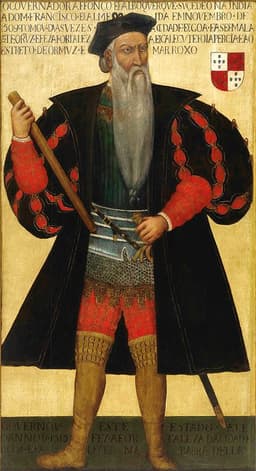
Afonso de Albuquerque
General · Medieval
79.6Total
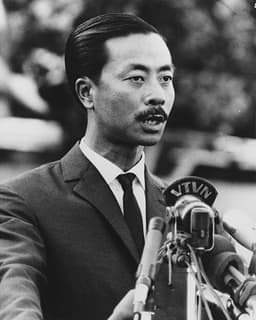
Nguyen Cao Ky
General · Modern
49.0Total
Basic Information
Born
1453
1930
Died
1515
—
Era
Medieval
Modern
Nationality
Portugal
Vietnam
Occupation
General
General
Civilization
Western
Eastern
Score Comparison
Military (10%)
77.5
45.0
Political (20%)
88.0
39.4
Influence (20%)
80.0
50.2
Legacy (20%)
75.0
40.0
Leadership (15%)
78.0
67.0
Strategy (15%)
82.0
60.0
TOTAL
79.6
49.0
Afonso de Albuquerque — Complete Timeline
1503 AD
First voyage to IndiaWar◆ Major
Afonso de Albuquerque led a fleet to India, establishing the first Portuguese fort at Cochin. This voyage laid the foundation for Portuguese control of the Indian Ocean trade.
ExplorationColonialismIndia
Impact: global
1510 AD
Conquest of GoaWar◆ Major
Albuquerque captured Goa from the Sultan of Bijapur. He made Goa the capital of Portuguese India, a position it held for over 400 years.
ConquestColonialismIndia
Impact: regional
1511 AD
Conquest of MalaccaWar◆ Major
Albuquerque led a Portuguese fleet to capture the strategic port of Malacca. This gave Portugal control of the spice trade route between the Indian Ocean and the Pacific.
ConquestSpice TradeSoutheast Asia
Impact: global
1513 AD
Siege of AdenWar
Albuquerque attempted to capture Aden in Yemen but failed. This failure prevented Portugal from controlling the entrance to the Red Sea and limited their influence in the region.
SiegeFailureRed Sea
Impact: regional
1515 AD
Death at seaOther◆ Major
Afonso de Albuquerque died at sea off the coast of Goa, possibly from illness or poison. His death left the Portuguese Empire in the Indian Ocean without its most capable leader.
DeathLeadershipEmpire
Impact: regionaltragic
Nguyen Cao Ky — Complete Timeline
1963 AD
Commander of South Vietnamese Air ForcePolitical Action◆ Major
Nguyen Cao Ky was appointed commander of the Republic of Vietnam Air Force. He led the air force during the Buddhist crisis and participated in the coup that overthrew President Ngo Dinh Diem.
Air ForceCoupDiem
Impact: national
1965 AD
Appointed Prime MinisterPolitical Action◆ Major
Nguyen Cao Ky became Prime Minister of South Vietnam, leading a military junta. His government intensified the war against the Viet Cong and North Vietnam, with strong US support.
Prime MinisterMilitary juntaVietnam War
Impact: national
1967 AD
Conflict with President ThieuPolitical Action
Nguyen Cao Ky ran for president but lost to Nguyen Van Thieu, becoming vice president. The two leaders had a tense relationship, with Ky later accusing Thieu of corruption and mismanagement of the war.
ElectionThieuRivalry
Impact: nationaldestructive
1975 AD
Exile after fall of SaigonPolitical Action◆ Major
Nguyen Cao Ky fled South Vietnam as Saigon fell to North Vietnamese forces. He settled in the United States, where he became a critic of the communist government and later returned to Vietnam for visits.
ExileFall of SaigonVietnam War
Impact: nationaltragic
Expert Analysis
Afonso de Albuquerque vs Nguyen Cao Ky
# The General and the Governor: Two Paths to Power in an Age of Empire
On a humid September morning in 1965, Nguyen Cao Ky stood before the world in a black flight jacket and lavender scarf, a pearl-handled revolver at his hip, declaring himself the new prime minister of South Vietnam. He was thirty-five years old, a pilot who had risen through the cockpit rather than the council chamber. Four centuries earlier, another man had stood on the deck of a caravel off the coast of India, his beard streaked with salt and his eyes fixed on a fortress he would soon capture. Afonso de Albuquerque was fifty-seven, a veteran of decades of naval warfare, and he carried not a pistol but a royal commission from King Manuel I of Portugal. Both men commanded armies; both sought to impose order on chaotic worlds. Yet one built an empire that lasted four centuries, while the other fled his country in defeat, never to return.
Origins
Nguyen Cao Ky was born in 1930 in Son Tay, a provincial town northwest of Hanoi. His father was a minor civil servant under French colonial rule, and young Ky grew up in a world where Vietnamese identity was both suppressed and fiercely protected. He attended French schools, learned to fly in the colonial air force, and by his early thirties had become a decorated pilot. His Vietnam was a nation tearing itself apart—divided by the Geneva Accords of 1954, haunted by the specter of communism in the north, and paralyzed by corruption in the south. Ky’s era was one of collapse, not construction.
Afonso de Albuquerque came into the world in 1453, the year Constantinople fell to the Ottomans. He was born near Lisbon to a noble family with royal connections; his great-grandfather had served King John I, and his father held minor court offices. Portugal was a small, ambitious kingdom on the edge of Europe, hungry for the spice trade that flowed through Muslim-controlled routes. Albuquerque’s world was one of expansion, not contraction. He learned mathematics, navigation, and the art of war in the service of a monarchy that saw the Indian Ocean as its destiny.
Rise to Power
Ky’s ascent came through the coup, not the court. In 1963, he was appointed commander of the South Vietnamese Air Force after a military junta overthrew and assassinated President Ngo Dinh Diem. Ky flew bombing missions against Viet Cong positions, and his pilots became the most effective arm of the Army of the Republic of Vietnam. Two years later, in the chaos of successive coups, he was made prime minister—not because he was a skilled politician, but because he was a strongman who could hold the fractious generals together. His path was the path of the warlord: seize the moment, or be seized by it.
Albuquerque’s rise was slower and more deliberate. He first sailed to India in 1503, commanding a fleet that established the Portuguese fort at Cochin. He spent years learning the politics of the Malabar Coast, negotiating with local rajas and fighting Muslim navies. In 1506, he was appointed governor of Portuguese India, but he had to fight for his position against rivals in Lisbon and Goa. His path was the path of the empire-builder: patient, strategic, and ruthless.
Leadership & Governance
As prime minister, Ky ruled with a pilot’s instinct for speed and a general’s tolerance for violence. He intensified the war against the Viet Cong, welcomed American escalation, and suppressed Buddhist protests with force. His government was a military junta, not a democracy; he once said, “People ask me who my heroes are. I have none.” He was charismatic but erratic, decisive but cruel. His leadership was a product of desperation: South Vietnam was a sinking ship, and Ky was trying to plug holes with gunfire.
Albuquerque governed differently. After capturing Goa in 1510, he made it the capital of Portuguese India and married his soldiers to local women, creating a mixed-race population loyal to Portugal. He issued laws protecting Hindus from forced conversion, established a mint, and built hospitals. His conquest of Malacca in 1511 gave Portugal control of the spice trade, but he also negotiated with Chinese and Persian merchants, understanding that empire required commerce as much as cannon. His leadership was a product of ambition: Portugal was building a world, and Albuquerque was its architect.
Triumph & Tragedy
Ky’s greatest moment came in 1965, when he stabilized South Vietnam after a year of chaos. His worst failure was his rivalry with Nguyen Van Thieu, who outmaneuvered him in the 1967 election. Ky became vice president, a hollow title, and watched helplessly as the war turned against them. In 1975, as Saigon fell, he fled to the United States, where he opened a liquor store in California. His triumph was temporary; his tragedy was total.
Albuquerque’s greatest moment was the capture of Malacca, a city so wealthy that its fall echoed across Asia. His worst failure was the siege of Aden in 1513, where he tried and failed to block the Red Sea to Muslim shipping. He died at sea in 1515, possibly poisoned, possibly of illness, while returning from a failed campaign. His triumph was lasting; his tragedy was personal.
Character & Destiny
Ky was a man of action, not reflection. He flew his own jet into combat, wore a purple scarf to symbolize his defiance, and spoke of victory as if it were a bombing run. But he could not build institutions, only alliances. His character was shaped by a war that offered no second acts.
Albuquerque was a man of vision, not vanity. He wrote detailed reports to his king, studied the cultures he conquered, and planned for a future he would not live to see. He once said, “I will leave no stone unturned to serve the king.” His character was shaped by an empire that rewarded patience.
Legacy
Today, Nguyen Cao Ky is remembered—if at all—as a footnote in the American War in Vietnam. His scores reflect a moderate influence and a legacy that barely registers: 70.9 and 56.0. He represents a failed state, a lost cause.
Afonso de Albuquerque is remembered as the founder of the Portuguese Empire in Asia. His scores are higher across the board: military 82.2, political 80.0, leadership 84.3. He represents a successful expansion, a lasting footprint. Goa remained Portuguese until 1961.
Conclusion
Why did one man build an empire and the other lose a country? The answer lies not in their characters alone, but in their eras. Albuquerque’s Portugal was rising; Ky’s Vietnam was falling. One sailed with the wind of history at his back; the other flew into a storm. Both were generals; both were leaders. But one governed a world he could shape, while the other governed a nation he could only postpone losing. Perhaps the difference between triumph and tragedy is not skill, but timing.
Rankings
🥇
Afonso de AlbuquerqueLeader
Mil: 77.5Pol: 88.0Inf: 80.0
79.6
🥈
Nguyen Cao Ky
Mil: 45.0Pol: 39.4Inf: 50.2
49.0
+30.6 behind
How This Comparison Works
Algorithm
Each figure is scored on 6 dimensions (0—100 scale) based on structured historical data: Military (10%), Political (20%), Influence (20%), Legacy (20%), Leadership (15%), Strategy (15%). The weighted total produces the final ranking.
Data Sources
Scores are computed from structured sub-indicators in the database. Scale factors adjust for era (Ancient ×0.85, Modern ×1.0) and civilization size (Eastern ×1.05, Other ×0.80) to account for differences in population and military scale.
Maximum 3 Figures
Comparisons are limited to 2—3 figures to ensure readability and statistical meaningfulness.
Error Margins
±5 points per dimension — Sub-scores are derived from historical records with inherent uncertainty. Two figures within 5 points on a dimension should be considered roughly equivalent in that area.
Total Score Accuracy
±3 points overall — The weighted combination of 6 dimensions produces a total score with approximately ±3 points of uncertainty. Differences of less than 3 points are not statistically significant— the figures are effectively tied.
Known Limitations
- Historical records are incomplete and uneven across civilizations
- Figures from oral-tradition societies may be underrepresented
- Occupation labels can misclassify multi-role figures
- Scores measure capability and impact, not moral character
- Quantitative scoring is a comparison tool, not absolute truth
Capability Radar
Military (10%) — Battles & Warfare
Battles
85
30
Win Rate
80
35
Expansion
95
10
Political (20%) — Governance & Reform
Reform
80
20
Diplomacy
85
25
Economy
80
15
Influence (20%) — Cultural & Global Reach
Cultural
70
15
Global
85
15
Legacy (20%) — Historical Impact
Historical
85
20
Longevity
80
10
Leadership (15%) — Power & Stability
Tenure
70
40
Stability
65
10
Strategy (15%) — Tactics & Innovation
Strategy
95
30
Tactics
90
40
Reform
75
25
Similar Comparisons
Comments & Discussion
FLYING BULLET6/16/2026
Ky was a straight-up pilot, not a politician. That pearl-handled revolver and lavender scarf? Pure performance—he was trying to look like a warlord, but he never crushed the Viet Cong or unified the country. Albuquerque captured Goa, Hormuz, and Malacca, each with lasting strategic value. Ky couldn't even hold Hue without American firepower. One built an oceanic empire; the other just made a fashion statement for collapse.