Loading...
Afonso de Albuquerque vs Napoleon Bonaparte
Afonso de Albuquerque leads by 8.7 pts · 2 figures compared
…
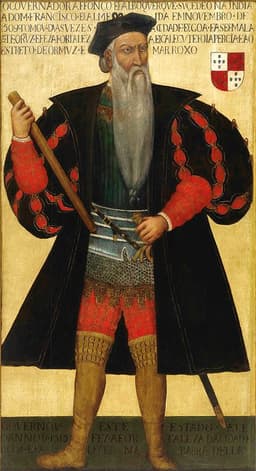
Afonso de Albuquerque
General · Medieval
79.6Total

Napoleon Bonaparte
General · Modern
70.9Total
Basic Information
Born
1453
1769
Died
1515
1821
Era
Medieval
Modern
Nationality
Portugal
France
Occupation
General
General
Civilization
Western
Western
Score Comparison
Military (10%)
77.5
94.0
Political (20%)
88.0
72.0
Influence (20%)
80.0
40.0
Legacy (20%)
75.0
80.0
Leadership (15%)
78.0
78.0
Strategy (15%)
82.0
90.0
TOTAL
79.6
70.9
Afonso de Albuquerque — Complete Timeline
1503 AD
First voyage to IndiaWar◆ Major
Afonso de Albuquerque led a fleet to India, establishing the first Portuguese fort at Cochin. This voyage laid the foundation for Portuguese control of the Indian Ocean trade.
ExplorationColonialismIndia
Impact: global
1510 AD
Conquest of GoaWar◆ Major
Albuquerque captured Goa from the Sultan of Bijapur. He made Goa the capital of Portuguese India, a position it held for over 400 years.
ConquestColonialismIndia
Impact: regional
1511 AD
Conquest of MalaccaWar◆ Major
Albuquerque led a Portuguese fleet to capture the strategic port of Malacca. This gave Portugal control of the spice trade route between the Indian Ocean and the Pacific.
ConquestSpice TradeSoutheast Asia
Impact: global
1513 AD
Siege of AdenWar
Albuquerque attempted to capture Aden in Yemen but failed. This failure prevented Portugal from controlling the entrance to the Red Sea and limited their influence in the region.
SiegeFailureRed Sea
Impact: regional
1515 AD
Death at seaOther◆ Major
Afonso de Albuquerque died at sea off the coast of Goa, possibly from illness or poison. His death left the Portuguese Empire in the Indian Ocean without its most capable leader.
DeathLeadershipEmpire
Impact: regionaltragic
Napoleon Bonaparte — Complete Timeline
1799 AD
Coup of 18 BrumaireOther◆ Major
Napoleon Bonaparte, with support from his brother Lucien and key political figures, overthrew the Directory in a bloodless coup. He established the Consulate with himself as First Consul, effectively becoming the ruler of France. This event ended the French Revolution's most unstable period.
French RevolutionCoupRise to Power
Impact: regional
1804 AD
Promulgation of the Napoleonic CodeOther◆ Major
Napoleon enacted the Civil Code of the French, known as the Napoleonic Code, a comprehensive set of laws that replaced the fragmented feudal legal systems. The code established legal equality, protected property rights, and secularized law. It became the basis for legal systems in many European and world countries.
Legal ReformNapoleonic CodeCivil Law
Impact: globalconstructive
1805 AD
Battle of AusterlitzWar◆ Major
Napoleon's Grande Arm
Napoleonic WarsBattleDecisive Victory
Impact: global
1812 AD
Invasion of RussiaWar◆ Major
Napoleon led the Grande Arm
Napoleonic WarsInvasionDisaster
Impact: globaldestructive
1815 AD
Battle of WaterlooWar◆ Major
Napoleon's French army was defeated by the combined forces of the Duke of Wellington's Anglo-Allied army and Gebhard Leberecht von Bl
Napoleonic WarsBattleFinal Defeat
Impact: globaldestructive
Expert Analysis
afonso-de-albuquerque-vs-napoleon-bonaparte
# The Conqueror and the Admiral
In the winter of 1510, a Portuguese fleet slipped into the waters off the western coast of India, its commander—a man with a graying beard and a reputation for ruthless efficiency—preparing to seize a city that would become the heart of an eastern empire. Three centuries later, on a June evening in 1815, a French emperor watched his grand army dissolve into mud and chaos near a Belgian village called Waterloo. Two men, separated by time and geography, connected by a shared ambition to reshape the world through force of arms. Afonso de Albuquerque built an empire that would last four centuries. Napoleon Bonaparte built one that crumbled in two decades. Why such different outcomes? The answer lies not merely in their genius, but in the worlds they inherited and the choices they made.
Origins
Napoleon Bonaparte was born in 1769 on the island of Corsica, a recent French acquisition. His family was minor nobility, poor but proud. At nine, he entered a French military academy, where his thick Corsican accent and small stature marked him as an outsider. He devoured history books, particularly Plutarch’s *Lives*, and dreamed of Alexander. The French Revolution, erupting when he was twenty, shattered the old order and created a ladder for ambitious men of talent. Napoleon climbed it with breathtaking speed.
Afonso de Albuquerque came from a different world entirely. Born in 1453 near Lisbon, he belonged to Portugal’s royal court, his father a trusted advisor to the king. The year of his birth was also the year Constantinople fell to the Ottomans—a reminder that Christendom faced threats from both east and south. Portugal, a small kingdom on Europe’s Atlantic edge, had spent decades exploring the African coast, seeking a sea route to the spices of India. Albuquerque grew up breathing salt air and hearing tales of distant lands. His world was one of maritime horizons, not continental conquest.
Rise to Power
Napoleon’s ascent was meteoric. At twenty-four, he drove the British from the French port of Toulon. At twenty-six, he crushed a royalist uprising in Paris with a “whiff of grapeshot.” In 1796, at twenty-seven, he took command of a starving, unpaid army in Italy and turned it into a conquering force, winning a dozen battles in a year. By 1799, he was First Consul of France. In 1804, he crowned himself Emperor. Each victory fed the next, building a legend that seemed unstoppable.
Albuquerque’s path was slower, harder, less glamorous. His first voyage to India came in 1503, when he was fifty years old. He had spent decades serving in North Africa, learning the arts of siege and diplomacy. In 1506, he was given command of a fleet bound for the Indian Ocean, but his mission was vague, his authority disputed. He arrived in a world where Portugal already had a presence—a few fortified trading posts—but no real empire. The Portuguese governor, Francisco de Almeida, saw Albuquerque as a rival, not an ally. For years, he struggled not just against Asian sultans but against his own countrymen.
Leadership & Governance
Napoleon was a military genius of the first order—his 94.0 military score and 93.0 strategy rating reflect a mind that could read a battlefield like a chessboard. He revolutionized warfare with speed, massed artillery, and the *corps* system, allowing his armies to move faster and strike harder than any enemy. His political score of 75.0, however, reveals a flaw: he was a brilliant conqueror but a mediocre administrator of conquest. The Napoleonic Code reformed French law and spread ideals of meritocracy, but his empire was held together by force and fear. He placed his brothers on thrones across Europe, but they proved incompetent. He demanded loyalty but inspired resentment.
Albuquerque governed differently. His military score of 82.2 and strategy of 75.5 were lower than Napoleon’s, but his political score of 80.0 and leadership of 84.3 tell a different story. He understood that empire required more than battles. After capturing Goa in 1510 from the Sultan of Bijapur, he did not simply plunder and leave. He made Goa the capital of Portuguese India, encouraging Portuguese men to marry local women, granting land to settlers, and establishing a system of administration that would last for centuries. He built forts, not just to dominate but to protect trade. He cultivated alliances with local rulers, offering protection in exchange for tribute. When he took Malacca in 1511, he seized the strategic choke point of the spice trade, but he also allowed local merchants to continue their business under Portuguese license. He was building a network, not just an empire.
Triumph & Tragedy
Napoleon’s greatest triumph was Austerlitz in 1805, where he crushed the combined armies of Russia and Austria, a victory so complete that it forced both emperors to sue for peace. His greatest tragedy was the invasion of Russia in 1812. He marched with half a million men; he returned with fewer than fifty thousand. The Russian winter, the scorched-earth tactics, and his own overconfidence destroyed the Grand Army. He never recovered. Exiled to Elba in 1814, he escaped in 1815, only to meet final defeat at Waterloo—a battle he might have won if his subordinates had arrived on time or if the Prussians had stayed away.
Albuquerque’s triumph was Malacca. The port was the Venice of the East, controlling the passage between the Indian Ocean and the South China Sea. By taking it, he gave Portugal control of the spice trade for a generation. His greatest tragedy was the Siege of Aden in 1513. He attempted to capture the fortress that guarded the entrance to the Red Sea, hoping to cut off the Ottoman route to India. He failed. The walls were too strong, his forces too few. That failure meant Portugal never fully controlled the Indian Ocean; the Ottomans remained a threat, and the spice trade could still flow through the Red Sea. He died at sea in 1515, possibly poisoned, possibly of illness, leaving an empire still fragile.
Character & Destiny
Napoleon was driven by an insatiable hunger for glory. “I am not a man,” he once said, “but a thing.” He saw himself as an instrument of destiny, a force of nature. This made him fearless in battle but blind to limits. He could not stop. After Austerlitz, he should have made peace. Instead, he invaded Spain, then Russia, then kept fighting until the whole of Europe united against him. His personality—brilliant, arrogant, restless—built his empire and destroyed it.
Albuquerque was different. He was no less ambitious, but his ambition was focused. He wanted to build something lasting, not just conquer. He wrote to the King of Portugal: “If you want to hold India, you must hold the sea.” He understood that empire was not about glory but about trade, alliances, and administration. He was ruthless—he executed prisoners and burned ships—but he was also patient. He accepted setbacks, learned from failures, and built slowly. His personality—pragmatic, stubborn, strategic—created an empire that outlived him.
Legacy
Napoleon’s legacy is immense but ambiguous. He spread the ideals of the French Revolution—legal equality, secular government, meritocracy—across Europe, but he also caused millions of deaths and left France smaller than he found it. His name is synonymous with genius and hubris. He is remembered in statues, in the Napoleonic Code, in the very shape of modern Europe. But his empire vanished within a generation.
Albuquerque’s legacy is quieter but more durable. The Portuguese Empire he built in the Indian Ocean lasted until the 20th century. Goa remained Portuguese until 1961. The forts he built still stand. The trade routes he secured shaped global commerce for centuries. He is remembered in Portugal as a national hero, but his name is less known elsewhere. He built an empire not of glory but of stone and salt water.
Conclusion
Standing at Waterloo, Napoleon might have thought of Alexander and Caesar. Sailing toward Goa, Albuquerque might have thought of Prince Henry the Navigator. One conquered continents, the other oceans. One burned bright and fast, the other burned steady and long. Their stories remind us that history rewards not just genius but patience, not just vision but the wisdom to build foundations that outlast the builder. Napoleon changed the world in a decade. Albuquerque changed it over a lifetime. Which kind of greatness lasts longer? The answer may depend on whether you are standing on a battlefield or a harbor.
Rankings
🥇
Afonso de AlbuquerqueLeader
Mil: 77.5Pol: 88.0Inf: 80.0
79.6
🥈
Napoleon Bonaparte
Mil: 94.0Pol: 72.0Inf: 40.0
70.9
+8.7 behind
How This Comparison Works
Algorithm
Each figure is scored on 6 dimensions (0—100 scale) based on structured historical data: Military (10%), Political (20%), Influence (20%), Legacy (20%), Leadership (15%), Strategy (15%). The weighted total produces the final ranking.
Data Sources
Scores are computed from structured sub-indicators in the database. Scale factors adjust for era (Ancient ×0.85, Modern ×1.0) and civilization size (Eastern ×1.05, Other ×0.80) to account for differences in population and military scale.
Maximum 3 Figures
Comparisons are limited to 2—3 figures to ensure readability and statistical meaningfulness.
Error Margins
±5 points per dimension — Sub-scores are derived from historical records with inherent uncertainty. Two figures within 5 points on a dimension should be considered roughly equivalent in that area.
Total Score Accuracy
±3 points overall — The weighted combination of 6 dimensions produces a total score with approximately ±3 points of uncertainty. Differences of less than 3 points are not statistically significant— the figures are effectively tied.
Known Limitations
- Historical records are incomplete and uneven across civilizations
- Figures from oral-tradition societies may be underrepresented
- Occupation labels can misclassify multi-role figures
- Scores measure capability and impact, not moral character
- Quantitative scoring is a comparison tool, not absolute truth
Capability Radar
Military (10%) — Battles & Warfare
Battles
85
95
Win Rate
80
90
Expansion
95
95
Political (20%) — Governance & Reform
Reform
80
95
Diplomacy
85
80
Economy
80
85
Influence (20%) — Cultural & Global Reach
Cultural
70
85
Global
85
90
Legacy (20%) — Historical Impact
Historical
85
95
Longevity
80
90
Leadership (15%) — Power & Stability
Tenure
70
85
Stability
65
70
Strategy (15%) — Tactics & Innovation
Strategy
95
95
Tactics
90
98
Reform
75
92
Similar Comparisons
Comments & Discussion
No comments yet. Be the first to share your thoughts!