Loading...
Afonso de Albuquerque vs Li Chengliang
Afonso de Albuquerque leads by 28.1 pts · 2 figures compared
…
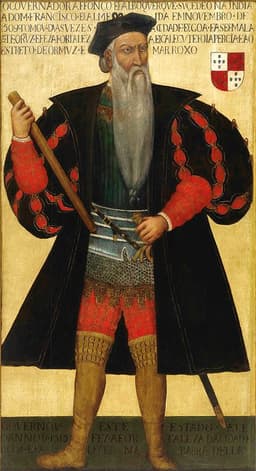
Afonso de Albuquerque
General · Medieval
79.6Total

Li Chengliang
General · Medieval
51.5Total
Basic Information
Born
1453
1526
Died
1515
1615
Era
Medieval
Medieval
Nationality
Portugal
China
Occupation
General
General
Civilization
Western
Eastern
Score Comparison
Military (10%)
77.5
67.5
Political (20%)
88.0
35.1
Influence (20%)
80.0
47.1
Legacy (20%)
75.0
40.8
Leadership (15%)
78.0
80.0
Strategy (15%)
82.0
55.0
TOTAL
79.6
51.5
Afonso de Albuquerque — Complete Timeline
1503 AD
First voyage to IndiaWar◆ Major
Afonso de Albuquerque led a fleet to India, establishing the first Portuguese fort at Cochin. This voyage laid the foundation for Portuguese control of the Indian Ocean trade.
ExplorationColonialismIndia
Impact: global
1510 AD
Conquest of GoaWar◆ Major
Albuquerque captured Goa from the Sultan of Bijapur. He made Goa the capital of Portuguese India, a position it held for over 400 years.
ConquestColonialismIndia
Impact: regional
1511 AD
Conquest of MalaccaWar◆ Major
Albuquerque led a Portuguese fleet to capture the strategic port of Malacca. This gave Portugal control of the spice trade route between the Indian Ocean and the Pacific.
ConquestSpice TradeSoutheast Asia
Impact: global
1513 AD
Siege of AdenWar
Albuquerque attempted to capture Aden in Yemen but failed. This failure prevented Portugal from controlling the entrance to the Red Sea and limited their influence in the region.
SiegeFailureRed Sea
Impact: regional
1515 AD
Death at seaOther◆ Major
Afonso de Albuquerque died at sea off the coast of Goa, possibly from illness or poison. His death left the Portuguese Empire in the Indian Ocean without its most capable leader.
DeathLeadershipEmpire
Impact: regionaltragic
Li Chengliang — Complete Timeline
1570 AD
Appointment as Commander of LiaodongPolitical Action◆ Major
Li Chengliang was appointed as the commander of the Liaodong military region, responsible for defending the Ming frontier against the Jurchen tribes. He held this post for decades, becoming the dominant military figure in the northeast.
Military CommandLiaodongMing Dynasty
Impact: regionalconstructive
1574 AD
Campaigns Against the Jianzhou JurchensWar◆ Major
Li Chengliang led a series of punitive expeditions against the Jianzhou Jurchens under Wang Gao, destroying their strongholds and killing thousands. These campaigns temporarily subdued the Jurchen threat but also fostered resentment.
Jurchen CampaignsFrontier WarfareMing Dynasty
Impact: regionaldestructive
1583 AD
Support for Nurhaci's RisePolitical Action
Li Chengliang supported the young Jurchen leader Nurhaci, providing him with military backing and resources. This patronage inadvertently helped Nurhaci unify the Jurchen tribes, creating the future threat of the Later Jin dynasty.
NurhaciJurchen UnificationMing Policy
Impact: globaldestructive
1590 AD
Corruption and Accumulation of WealthPolitical Action
Li Chengliang was accused of corruption, including embezzling military funds and accepting bribes from Jurchen leaders. His wealth and power grew unchecked, and he was criticized for prioritizing personal gain over frontier defense.
CorruptionMing MilitaryScandal
Impact: regionaldestructive
1615 AD
Retirement and DeathOther◆ Major
Li Chengliang retired from military service in his late 80s and died shortly after. His long tenure in Liaodong left a mixed legacy: he stabilized the frontier but also enabled the rise of Nurhaci, who would later overthrow the Ming.
RetirementDeathLegacy
Impact: regional
Expert Analysis
Origins
Afonso de Albuquerque was born in 1453 in Alhandra, Portugal, into a noble family with strong maritime connections. His father was a lord, and his mother came from a family of royal administrators. Albuquerque received a classical education and served in the court of King Afonso V. He later fought in the conquest of Arzila in Morocco in 1471, gaining military experience. His formative years were shaped by Portugal's Age of Discovery, with the goal of breaking Muslim dominance in the spice trade.
Li Chengliang was born in 1526 in Tieling, Liaodong, China, into a military family of Korean descent. His father, Li Ying, was a Ming military officer. Li Chengliang inherited the position of commander of the Liaodong garrison. He grew up among the frontier conflicts with the Jurchen tribes and rose through the ranks by demonstrating martial prowess. His background was deeply rooted in the Ming military system, with little exposure to the wider world beyond the northeastern border.
Rise to Power
Albuquerque's rise began with his appointment as chief captain of the Portuguese fleet to India in 1506. He distinguished himself in the conquest of Hormuz in 1507, but political rivalries led to his temporary imprisonment. In 1509, after the death of Francisco de Almeida, Albuquerque was appointed Governor of Portuguese India. His key turning point was the capture of Goa in 1510 from the Sultan of Bijapur, which became the capital of Portuguese India. He consolidated power by building fortresses and establishing alliances with local rulers.
Li Chengliang's rise was more gradual. He was appointed commander of Liaodong in 1570 after years of frontier service. He gained prominence through his campaigns against the Jianzhou Jurchens, particularly the destruction of Wang Gao's stronghold in 1575. His military successes earned him the title of Grand Guardian of the Heir Apparent. However, his power was based on patronage and personal relationships with Jurchen leaders, including the young Nurhaci, whom he supported and trained. This patronage would later prove disastrous for the Ming.
Leadership & Governance
Albuquerque governed with a centralized, militaristic approach. He established a network of fortified trading posts (feitorias) from Hormuz to Malacca, controlling key chokepoints. His governance included enforcing Portuguese law, promoting intermarriage with local women, and maintaining a policy of religious tolerance toward Hindus while persecuting Muslims. He also introduced the practice of using local soldiers in Portuguese armies. His leadership style was decisive and often ruthless, as seen in the massacre of Muslim traders in Malacca. He scored 78.0 in leadership and 82.0 in strategy.
Li Chengliang's governance was characterized by corruption and personal enrichment. He embezzled military funds, accepted bribes from Jurchen tribes, and amassed a vast personal fortune. His lax oversight allowed the Jurchen to grow stronger. He maintained stability through a system of tribute and patronage, but his failure to check the rise of Nurhaci was a strategic blunder. His political score was 35.1, reflecting his inability to navigate the complex Ming bureaucracy and the long-term consequences of his actions.
Triumph & Tragedy
Albuquerque's greatest triumph was the capture of Malacca in 1511, which gave Portugal control of the spice trade and established a base for further expansion into East Asia. He also successfully defended Goa against a massive Bijapuri counterattack in 1512. His greatest failure was the failed siege of Aden in 1513, which prevented Portugal from controlling the Red Sea and limited their ability to challenge the Ottoman Empire. He also faced constant political intrigue from rivals in Lisbon. His death at sea in 1515, possibly poisoned, left his empire incomplete.
Li Chengliang's triumphs include his campaigns against the Jianzhou Jurchens, which temporarily pacified the frontier. He also successfully defended Liaodong against multiple incursions. His greatest failure was his support for Nurhaci, who later unified the Jurchen tribes and founded the Qing dynasty, which eventually overthrew the Ming. His corruption weakened the Ming military, and his long tenure created a power vacuum after his death. He retired in 1615 and died in 1618 at age 92. His legacy is deeply mixed: he is remembered as a capable but corrupt general who inadvertently doomed the Ming.
Character & Destiny
Albuquerque was ambitious, strategic, and unyielding. His motto "Deus, Pátria, Rei" (God, Fatherland, King) reflected his devotion to Portuguese imperialism. He was known for his meticulous planning and ability to inspire loyalty, but also for his cruelty toward enemies. His character drove him to build an empire, but his arrogance and political naivety led to his downfall. Historians describe him as the "Caesar of the East" for his administrative and military achievements.
Li Chengliang was pragmatic, self-serving, and shortsighted. He focused on immediate gains rather than long-term stability. His willingness to cultivate Nurhaci showed a lack of foresight. He was a master of frontier politics but failed to see the larger threat. His character led to a temporary peace but ultimately enabled the rise of the Qing. He is often criticized for his corruption and nepotism.
Legacy
Albuquerque's legacy is immense: he laid the foundations for the Portuguese Empire in Asia, which lasted over 400 years. His conquests opened trade routes that enriched Portugal and reshaped global commerce. The fortifications and administrative systems he established influenced later colonial powers. He is celebrated as a national hero in Portugal, with monuments and a commemorative statue in Lisbon. His total score of 79.6 reflects his enduring impact.
Li Chengliang's legacy is more ambiguous. He is remembered as a capable frontier commander but also as a corrupt official who contributed to the Ming dynasty's decline. His support for Nurhaci directly led to the rise of the Qing, which ruled China for over 250 years. Some historians see him as a tragic figure who inadvertently shaped Chinese history. His total score of 51.5 reflects his limited influence beyond his region and the negative consequences of his actions.
Conclusion
Afonso de Albuquerque had a greater impact than Li Chengliang. His strategic vision and military conquests established a global empire that reshaped trade and politics in the Indian Ocean for centuries. His scores in military (77.5), political (88.0), and strategy (82.0) far exceed Li Chengliang's (67.5, 35.1, and 55.0 respectively). While Li Chengliang influenced the rise of the Qing, his impact was largely negative and confined to a single region. Albuquerque's legacy is more positive and far-reaching, earning him a total score of 79.6 compared to Li's 51.5. In the contest of empire builder versus frontier warden, the Portuguese general stands out as the more consequential figure.
Rankings
🥇
Afonso de AlbuquerqueLeader
Mil: 77.5Pol: 88.0Inf: 80.0
79.6
🥈
Li Chengliang
Mil: 67.5Pol: 35.1Inf: 47.1
51.5
+28.1 behind
How This Comparison Works
Algorithm
Each figure is scored on 6 dimensions (0—100 scale) based on structured historical data: Military (10%), Political (20%), Influence (20%), Legacy (20%), Leadership (15%), Strategy (15%). The weighted total produces the final ranking.
Data Sources
Scores are computed from structured sub-indicators in the database. Scale factors adjust for era (Ancient ×0.85, Modern ×1.0) and civilization size (Eastern ×1.05, Other ×0.80) to account for differences in population and military scale.
Maximum 3 Figures
Comparisons are limited to 2—3 figures to ensure readability and statistical meaningfulness.
Error Margins
±5 points per dimension — Sub-scores are derived from historical records with inherent uncertainty. Two figures within 5 points on a dimension should be considered roughly equivalent in that area.
Total Score Accuracy
±3 points overall — The weighted combination of 6 dimensions produces a total score with approximately ±3 points of uncertainty. Differences of less than 3 points are not statistically significant— the figures are effectively tied.
Known Limitations
- Historical records are incomplete and uneven across civilizations
- Figures from oral-tradition societies may be underrepresented
- Occupation labels can misclassify multi-role figures
- Scores measure capability and impact, not moral character
- Quantitative scoring is a comparison tool, not absolute truth
Capability Radar
Military (10%) — Battles & Warfare
Battles
85
65
Win Rate
80
60
Expansion
95
35
Political (20%) — Governance & Reform
Reform
80
30
Diplomacy
85
50
Economy
80
25
Influence (20%) — Cultural & Global Reach
Cultural
70
30
Global
85
20
Legacy (20%) — Historical Impact
Historical
85
40
Longevity
80
35
Leadership (15%) — Power & Stability
Tenure
70
70
Stability
65
45
Strategy (15%) — Tactics & Innovation
Strategy
95
60
Tactics
90
55
Reform
75
40
Similar Comparisons
Comments & Discussion
No comments yet. Be the first to share your thoughts!