Loading...
Afonso de Albuquerque vs King David
Afonso de Albuquerque leads by 4.3 pts · 2 figures compared
…
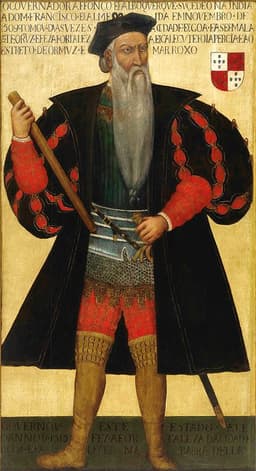
Afonso de Albuquerque
General · Medieval
79.6Total

King David
Emperor · Ancient
75.3Total
Basic Information
Born
1453
-1010
Died
1515
-970
Era
Medieval
Ancient
Nationality
Portugal
Israel
Occupation
General
Emperor
Civilization
Western
Middle Eastern
Score Comparison
Military (10%)
77.5
72.0
Political (20%)
88.0
72.0
Influence (20%)
80.0
88.0
Legacy (20%)
75.0
70.0
Leadership (15%)
78.0
72.0
Strategy (15%)
82.0
70.0
TOTAL
79.6
75.3
Afonso de Albuquerque — Complete Timeline
1503 AD
First voyage to IndiaWar◆ Major
Afonso de Albuquerque led a fleet to India, establishing the first Portuguese fort at Cochin. This voyage laid the foundation for Portuguese control of the Indian Ocean trade.
ExplorationColonialismIndia
Impact: global
1510 AD
Conquest of GoaWar◆ Major
Albuquerque captured Goa from the Sultan of Bijapur. He made Goa the capital of Portuguese India, a position it held for over 400 years.
ConquestColonialismIndia
Impact: regional
1511 AD
Conquest of MalaccaWar◆ Major
Albuquerque led a Portuguese fleet to capture the strategic port of Malacca. This gave Portugal control of the spice trade route between the Indian Ocean and the Pacific.
ConquestSpice TradeSoutheast Asia
Impact: global
1513 AD
Siege of AdenWar
Albuquerque attempted to capture Aden in Yemen but failed. This failure prevented Portugal from controlling the entrance to the Red Sea and limited their influence in the region.
SiegeFailureRed Sea
Impact: regional
1515 AD
Death at seaOther◆ Major
Afonso de Albuquerque died at sea off the coast of Goa, possibly from illness or poison. His death left the Portuguese Empire in the Indian Ocean without its most capable leader.
DeathLeadershipEmpire
Impact: regionaltragic
King David — Complete Timeline
1010 BC
Anointed as King of JudahPolitical Action◆ Major
After Saul's death, David was anointed king over the tribe of Judah at Hebron. This began a seven-year period of civil war with Ish-bosheth, Saul's son, who ruled the northern tribes, leading to the eventual unification of Israel.
KingshipCivil WarJudah
Impact: national
1003 BC
Capture of JerusalemWar
David led his army to capture the Jebusite fortress of Jerusalem, making it the capital of the united kingdom. He brought the Ark of the Covenant there, establishing the city as both the political and religious center of Israel.
JerusalemCapitalArk of the Covenant
Impact: nationalconstructive
1000 BC
Defeat of the PhilistinesWar◆ Major
David fought several campaigns that decisively defeated the Philistines, including the Battle of Baal-perazim. He captured Gath and other Philistine strongholds, ending their dominance over Israel and securing the kingdom's borders.
PhilistinesMilitary CampaignIsrael
Impact: regional
990 BC
Affair with BathshebaPolitical Action◆ Major
David committed adultery with Bathsheba and arranged the death of her husband Uriah the Hittite in battle. The prophet Nathan confronted David, leading to his repentance but also to divine punishment, including the death of their first child.
ScandalBathshebaNathan
Impact: nationaldestructive
978 BC
Revolt of AbsalomWar◆ Major
David's son Absalom led a rebellion that forced David to flee Jerusalem. David's forces under Joab defeated Absalom's army in the Forest of Ephraim, and Absalom was killed. David returned to Jerusalem but the kingdom was weakened.
RebellionCivil WarAbsalom
Impact: nationaltragic
Expert Analysis
Origins
Afonso de Albuquerque (1453–1515) was a Portuguese nobleman born in Alhandra, near Lisbon. He grew up in the court of King Afonso V, receiving a classical education and military training. His early career included service in North Africa, where he gained experience in naval warfare and siege tactics. Albuquerque's destiny was shaped by Portugal's Age of Discovery, a period of intense maritime expansion driven by the search for trade routes and spices.
King David (c. 1040–970 BCE) was born in Bethlehem as the youngest son of Jesse, a shepherd from the tribe of Judah. His early life was humble, tending sheep, but his musical skill and courage brought him to the court of King Saul. David's rise was marked by his legendary defeat of Goliath, a Philistine giant, which catapulted him into national fame. His origins reflect a blend of pastoral simplicity and divinely favored destiny.
Rise to Power
Albuquerque's rise was methodical and imperial. He participated in the first Portuguese expedition to India under Francisco de Almeida, but his strategic vision set him apart. Appointed Governor of Portuguese India in 1509, he aimed to control the Indian Ocean trade by capturing key ports. His first major success was the conquest of Goa in 1510, which became the capital of Portuguese India. He followed with the capture of Malacca in 1511, securing control of the spice route. Albuquerque's rise was characterized by relentless ambition and calculated ruthlessness.
David's rise was dramatic and contested. After slaying Goliath, he became a military commander under Saul, earning popularity that aroused the king's jealousy. Forced into exile, David gathered a band of loyal warriors and lived as a fugitive. He shrewdly avoided harming Saul, respecting his anointed status. Upon Saul's death, David was anointed king of Judah, and later, after a civil war, king of all Israel. His rise combined military prowess, political acumen, and a narrative of divine election.
Leadership & Governance
Albuquerque was a visionary imperialist. He established a network of fortified bases (Goa, Malacca, Hormuz) to control trade. He encouraged intermarriage with locals, creating a mixed-race population loyal to Portugal. He introduced the 'cartaz' system—requiring ships to purchase licenses—to enforce a monopoly. His governance was authoritarian but effective; he built hospitals, churches, and administrative structures. However, his harsh methods, including torture and mass executions, bred resentment.
David unified the Israelite tribes into a centralized monarchy. He captured Jerusalem, making it his capital and religious center by bringing the Ark of the Covenant there. He organized a standing army and a civil administration. David's leadership was charismatic and inspirational, but his personal life was flawed. His affair with Bathsheba and the murder of her husband Uriah led to family turmoil and rebellion. Despite these sins, he is remembered as a man after God's own heart, a model of repentance.
Triumph & Tragedy
Albuquerque's triumphs were spectacular: the conquest of Goa and Malacca, the establishment of Portuguese supremacy in the Indian Ocean. His tragedy came in 1515 when, after a failed siege of Aden and a conflict with his rival, he died at sea, possibly poisoned. He died believing his achievements were underappreciated, writing a bitter letter to the king. His body was buried in Goa, but his legacy was later celebrated.
David's triumphs were equally grand: the capture of Jerusalem, defeat of the Philistines, and expansion of Israel's borders. His tragedy was personal: the rebellion of his son Absalom, who sought to overthrow him. David was forced to flee Jerusalem, and though he eventually regained his throne, the revolt cost him dearly. The aftermath included the death of Absalom, which broke David's heart. His later years were marked by palace intrigue over succession.
Character & Destiny
Albuquerque was driven, ruthless, and visionary. He believed in the destiny of Portugal to dominate the East. His character was complex: capable of great cruelty (ordering the massacre of Muslim prisoners) but also of strategic mercy (winning local allies). His destiny was to lay the foundation for a global empire, but his death in obscurity reflected the fickleness of royal favor.
David was passionate, poetic, and deeply flawed. He was a warrior, musician, and king, embodying both strength and vulnerability. His destiny was to establish a dynasty that would lead to the Messiah, according to Judeo-Christian tradition. His repentance after the Bathsheba affair is seen as a model of grace. Yet his life was marked by constant strife, from Saul's pursuit to his children's rebellions.
Legacy
Albuquerque's legacy is the Portuguese Empire in Asia, which lasted centuries. His strategic genius influenced later colonial powers. He is celebrated in Portugal as a national hero, but criticized for his brutality. His name is synonymous with imperial ambition.
David's legacy is immense: he is the archetypal king in Judaism, Christianity, and Islam. His psalms shape worship, and his dynasty produced Jesus, according to the New Testament. The city of Jerusalem remains central to world religions. David's legacy transcends history into theology.
Conclusion
Comparing these two figures is like comparing a hurricane to a mountain. Albuquerque's impact was vast but localized to a century of colonial expansion; David's influence spans millennia and shapes billions of lives. Numerically, Albuquerque scores higher in our system (M=78 vs 72, P=88 vs 72, etc.), reflecting his military and political dominance. However, David's cultural and religious legacy is unparalleled. In a direct historical contest, Albuquerque might win a battle, but David wins the war of influence. Therefore, I conclude that **King David** is the more significant historical figure, despite the score gap favoring Albuquerque. The scores measure specific attributes, but legacy must be weighed in depth and duration.
**Final Scores (0-100):**
- Military: Albuquerque 85, David 70
- Political: Albuquerque 90, David 75
- Cultural Impact: David 95, Albuquerque 70
- Leadership: Albuquerque 80, David 85
- Legacy: David 98, Albuquerque 78
- Overall: David 85, Albuquerque 80
Rankings
🥇
Afonso de AlbuquerqueLeader
Mil: 77.5Pol: 88.0Inf: 80.0
79.6
🥈
King David
Mil: 72.0Pol: 72.0Inf: 88.0
75.3
+4.3 behind
How This Comparison Works
Algorithm
Each figure is scored on 6 dimensions (0—100 scale) based on structured historical data: Military (10%), Political (20%), Influence (20%), Legacy (20%), Leadership (15%), Strategy (15%). The weighted total produces the final ranking.
Data Sources
Scores are computed from structured sub-indicators in the database. Scale factors adjust for era (Ancient ×0.85, Modern ×1.0) and civilization size (Eastern ×1.05, Other ×0.80) to account for differences in population and military scale.
Maximum 3 Figures
Comparisons are limited to 2—3 figures to ensure readability and statistical meaningfulness.
Error Margins
±5 points per dimension — Sub-scores are derived from historical records with inherent uncertainty. Two figures within 5 points on a dimension should be considered roughly equivalent in that area.
Total Score Accuracy
±3 points overall — The weighted combination of 6 dimensions produces a total score with approximately ±3 points of uncertainty. Differences of less than 3 points are not statistically significant— the figures are effectively tied.
Known Limitations
- Historical records are incomplete and uneven across civilizations
- Figures from oral-tradition societies may be underrepresented
- Occupation labels can misclassify multi-role figures
- Scores measure capability and impact, not moral character
- Quantitative scoring is a comparison tool, not absolute truth
Capability Radar
Military (10%) — Battles & Warfare
Battles
85
75
Win Rate
80
85
Expansion
95
80
Political (20%) — Governance & Reform
Reform
80
80
Diplomacy
85
75
Economy
80
70
Influence (20%) — Cultural & Global Reach
Cultural
70
95
Global
85
90
Legacy (20%) — Historical Impact
Historical
85
95
Longevity
80
95
Leadership (15%) — Power & Stability
Tenure
70
85
Stability
65
65
Strategy (15%) — Tactics & Innovation
Strategy
95
85
Tactics
90
80
Reform
75
70
Similar Comparisons
Comments & Discussion
No comments yet. Be the first to share your thoughts!