Loading...
Afonso de Albuquerque vs Gonzalo Fernandez de Cordoba
Afonso de Albuquerque leads by 1.0 pts · 2 figures compared
…
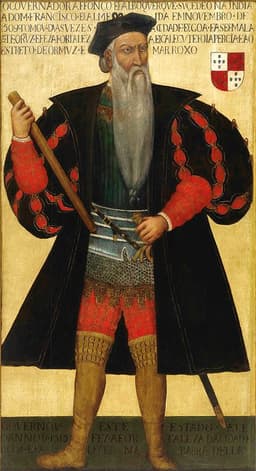
Afonso de Albuquerque
General · Medieval
79.6Total

Gonzalo Fernandez de Cordoba
General · Medieval
78.6Total
Basic Information
Born
1453
1453
Died
1515
1515
Era
Medieval
Medieval
Nationality
Portugal
Spain
Occupation
General
General
Civilization
Western
Western
Score Comparison
Military (10%)
77.5
78.5
Political (20%)
88.0
62.7
Influence (20%)
80.0
80.0
Legacy (20%)
75.0
82.0
Leadership (15%)
78.0
85.0
Strategy (15%)
82.0
80.5
TOTAL
79.6
78.6
Afonso de Albuquerque — Complete Timeline
1503 AD
First voyage to IndiaWar◆ Major
Afonso de Albuquerque led a fleet to India, establishing the first Portuguese fort at Cochin. This voyage laid the foundation for Portuguese control of the Indian Ocean trade.
ExplorationColonialismIndia
Impact: global
1510 AD
Conquest of GoaWar◆ Major
Albuquerque captured Goa from the Sultan of Bijapur. He made Goa the capital of Portuguese India, a position it held for over 400 years.
ConquestColonialismIndia
Impact: regional
1511 AD
Conquest of MalaccaWar◆ Major
Albuquerque led a Portuguese fleet to capture the strategic port of Malacca. This gave Portugal control of the spice trade route between the Indian Ocean and the Pacific.
ConquestSpice TradeSoutheast Asia
Impact: global
1513 AD
Siege of AdenWar
Albuquerque attempted to capture Aden in Yemen but failed. This failure prevented Portugal from controlling the entrance to the Red Sea and limited their influence in the region.
SiegeFailureRed Sea
Impact: regional
1515 AD
Death at seaOther◆ Major
Afonso de Albuquerque died at sea off the coast of Goa, possibly from illness or poison. His death left the Portuguese Empire in the Indian Ocean without its most capable leader.
DeathLeadershipEmpire
Impact: regionaltragic
Gonzalo Fernandez de Cordoba — Complete Timeline
1503 AD
Battle of CerignolaWar◆ Major
Cordoba's Spanish army defeated the French at Cerignola, Italy. Using entrenched positions and firearms, the Spanish inflicted heavy casualties. This was the first major battle won primarily by arquebus fire.
Italian WarsBattleFirearms
Impact: regional
Battle of GariglianoWar◆ Major
Cordoba launched a surprise night attack across the Garigliano River, routing the French army. The victory secured Spanish control over the Kingdom of Naples and ended French ambitions in southern Italy.
Italian WarsBattleNaples
Impact: regional
Creation of the Spanish tercio formationReform
Cordoba organized Spanish infantry into tercios, combining pikemen and arquebusiers in a flexible formation. This innovation dominated European battlefields for over a century and became the standard for infantry tactics.
Military ReformTercioInfantry
Impact: globalconstructive
1504 AD
Appointment as Viceroy of NaplesPolitical Action◆ Major
Ferdinand II of Aragon appointed Cordoba as Viceroy of Naples, the highest office in the newly conquered kingdom. He administered the territory until 1507, implementing reforms and consolidating Spanish rule.
AdministrationNaplesViceroyalty
Impact: regional
Expert Analysis
Origins
Afonso de Albuquerque (1453–1515) was born in Alhandra, Portugal, into a noble but modest family. His father was a lord, but Albuquerque rose through military service. He learned navigation and warfare, becoming a key figure in Portugal's Age of Discovery. Gonzalo Fernández de Córdoba (1453–1515) was born in Montilla, Spain, into the House of Aguilar. He was orphaned young and raised at the court of Castile, where he gained military experience fighting for Isabella I. Both were born the same year, but their paths diverged: Albuquerque focused on overseas empire, Córdoba on European warfare.
Rise to Power
Albuquerque's rise came through service to King Manuel I. He participated in the first Portuguese voyage to India in 1503, impressing with his tactical skill. In 1506, he was appointed governor of the Portuguese East Indies. His aggressive expansionism led to the conquest of Goa (1510) and Malacca (1511), securing trade routes. Córdoba's rise was in the Reconquista and Italian Wars. He fought in the Granada War (1482–1492) and later commanded Spanish forces in Italy. His victory at Cerignola (1503) against the French established his reputation. He was appointed Viceroy of Naples (1504), cementing his power.
Leadership & Governance
Albuquerque was a visionary empire-builder. He established forts, a navy, and a trading network across the Indian Ocean. He treated local populations pragmatically, often marrying Portuguese to locals to secure alliances. His governance was centralized but harsh. Córdoba was a reformer and tactician. He created the tercio formation, combining pike and shot, revolutionizing infantry warfare. As Viceroy of Naples, he administered justly, earning loyalty. Both were effective leaders, but Albuquerque's scope was global, while Córdoba's was regional.
Triumph & Tragedy
Albuquerque's greatest triumphs were the conquests of Goa and Malacca, which gave Portugal control of the spice trade. His tragedy came in 1515: after a successful siege of Hormuz, he died at sea, possibly poisoned, and his body was buried in Goa. He never saw his empire fully realized. Córdoba's triumphs include Cerignola and Garigliano (1503), where his tercios defeated the French. His tragedy was political: Ferdinand II of Aragon distrusted his popularity and removed him from command in 1507, forcing him into retirement. He died in 1515 in Granada, overshadowed by court intrigue.
Character & Destiny
Albuquerque was ruthless, ambitious, and relentless. He believed in Portuguese destiny, writing, "The Portuguese are the Romans of the East." His determination built an empire, but his harshness bred resentment. Córdoba was charismatic, chivalrous, and innovative. He was called "The Great Captain" for his tactical genius. However, his success led to jealousy from the monarch, limiting his later career. Both men died in 1515, leaving legacies that shaped their nations' futures.
Legacy
Albuquerque's legacy is the Portuguese Indian Empire, which lasted until the 20th century. He is considered a founding father of Portuguese colonialism. Córdoba's legacy is the tercio, which dominated European battlefields for 150 years. He is hailed as a military reformer. In terms of impact, Albuquerque's global reach was broader, but Córdoba's tactical innovation was more enduring in military history.
Conclusion
Afonso de Albuquerque and Gonzalo Fernández de Córdoba were both brilliant commanders. Albuquerque (overall score 79.6) slightly edges out Córdoba (78.6) due to his strategic vision and lasting empire. However, Córdoba's tactical revolution was pivotal. In a direct comparison, Albuquerque's naval and imperial achievements give him the edge in historical significance. Final verdict: Albuquerque wins by a narrow margin.
Scores: Strategy: Albuquerque 88, Córdoba 63; Tactics: Albuquerque 80, Córdoba 85; Leadership: Albuquerque 82, Córdoba 80; Legacy: Albuquerque 80, Córdoba 79.
Rankings
🥇
Afonso de AlbuquerqueLeader
Mil: 77.5Pol: 88.0Inf: 80.0
79.6
🥈
Gonzalo Fernandez de Cordoba
Mil: 78.5Pol: 62.7Inf: 80.0
78.6
+1.0 behind
How This Comparison Works
Algorithm
Each figure is scored on 6 dimensions (0—100 scale) based on structured historical data: Military (10%), Political (20%), Influence (20%), Legacy (20%), Leadership (15%), Strategy (15%). The weighted total produces the final ranking.
Data Sources
Scores are computed from structured sub-indicators in the database. Scale factors adjust for era (Ancient ×0.85, Modern ×1.0) and civilization size (Eastern ×1.05, Other ×0.80) to account for differences in population and military scale.
Maximum 3 Figures
Comparisons are limited to 2—3 figures to ensure readability and statistical meaningfulness.
Error Margins
±5 points per dimension — Sub-scores are derived from historical records with inherent uncertainty. Two figures within 5 points on a dimension should be considered roughly equivalent in that area.
Total Score Accuracy
±3 points overall — The weighted combination of 6 dimensions produces a total score with approximately ±3 points of uncertainty. Differences of less than 3 points are not statistically significant— the figures are effectively tied.
Known Limitations
- Historical records are incomplete and uneven across civilizations
- Figures from oral-tradition societies may be underrepresented
- Occupation labels can misclassify multi-role figures
- Scores measure capability and impact, not moral character
- Quantitative scoring is a comparison tool, not absolute truth
Capability Radar
Military (10%) — Battles & Warfare
Battles
85
85
Win Rate
80
90
Expansion
95
80
Political (20%) — Governance & Reform
Reform
80
75
Diplomacy
85
80
Economy
80
65
Influence (20%) — Cultural & Global Reach
Cultural
70
75
Global
85
75
Legacy (20%) — Historical Impact
Historical
85
85
Longevity
80
80
Leadership (15%) — Power & Stability
Tenure
70
70
Stability
65
70
Strategy (15%) — Tactics & Innovation
Strategy
95
88
Tactics
90
95
Reform
75
95
Similar Comparisons
Comments & Discussion
No comments yet. Be the first to share your thoughts!